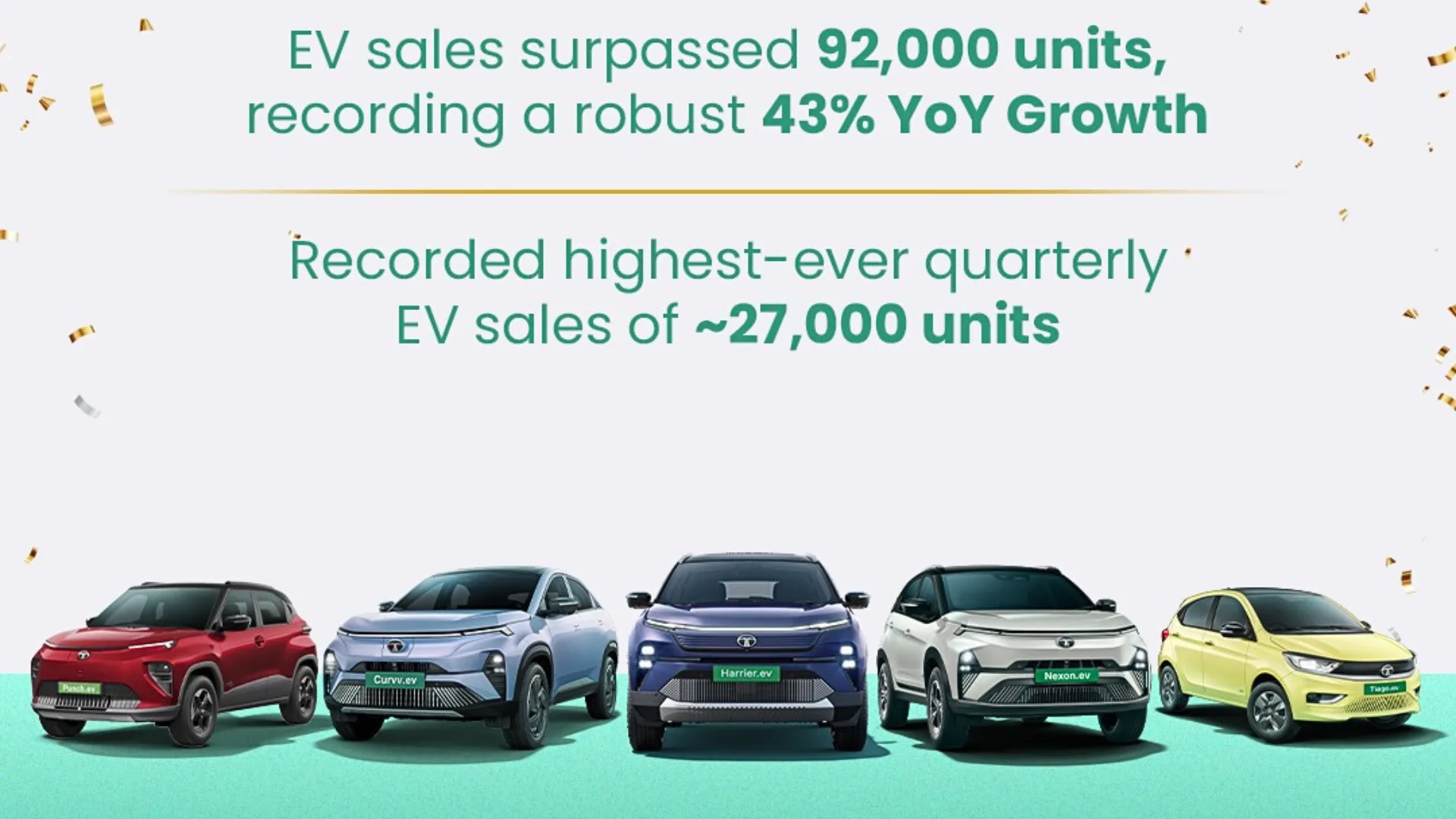
Tata Motors has just closed FY2025-26 with a performance that will be talked about for a long time in India’s automotive history. The company’s EV business surpassed 92,120 units for the full financial year, recording a robust 43.32% year-on-year growth over 64,276 units sold in FY2024-25.
And if that were not enough, Q4 FY26 alone saw approximately 27,000 EV units sold, a massive 69% jump compared to Q4 FY25.
These are not just impressive company numbers. They are a clear signal that something fundamental has shifted in the way Indian buyers think about electric cars.
The Full FY26 Story — Key Numbers
Before diving deeper, here is the complete data picture for FY2025-26:
| Metric | FY26 | FY25 | YoY Growth |
|---|---|---|---|
| Total PV Sales | 6,41,587 units | 5,56,263 units | +15.34% |
| EV Sales | 92,120 units | 64,276 units | +43.32% |
| Q4 FY26 EV Sales | 26,931 units | 15,936 units | +69% |
| March 2026 EV Sales | 9,494 units | 5,353 units | +77.36% |
| CNG Sales | 1,72,000+ units | — | +24% YoY |
| Export Sales | 10,200 units | 2,678 units | +280.88% |
Source: Tata Motors official press release, April 1, 2026 | RushLane | Autocar Professional
Tata’s overall passenger vehicle sales stood at 6,41,587 units, growing 15.34% compared to last year. EVs were the biggest highlight, but other segments also contributed well.
March 2026 closed the year on a strong note. The company sold over 66,000 passenger vehicles in the domestic market, with EV wholesales at around 9,500 units. More importantly, EV retail crossed 11,000 units for the first time.
That retail number is key — it shows real customer demand, not just dealer stocking.
March 2026 — The Perfect Finish to a Record Year
March is traditionally a strong month for auto sales due to financial year-end buying. But Tata Motors’ March 2026 performance went well beyond seasonal tailwinds.
In March 2026, Tata Motors sold 66,192 passenger vehicles in the domestic market, a 28.24% YoY increase from 51,616 units in March 2025. Including exports, total PV sales reached 66,971 units, up 29.11% YoY.
On the EV side, March 2026 was particularly historic:
- EV wholesales: ~9,494 units — up 77.36% from 5,353 units in March 2025
- EV retail: crossed 11,000+ units — an all-time monthly high for Tata Motors
- EV wholesales: hit a record of approximately 9,500 units in the month
That 11,000+ retail number is the most important data point here. Retail reflects actual customer purchases, not just dealer dispatches. The fact that retail hit an all-time high in March tells us this demand is real and consumer-driven, not just a pipeline push.
Read more here –
Q4 FY26 — A Quarter India’s EV Market Has Never Seen Before
Combined domestic and international EV volumes in Q4 FY26 reached 26,931 units — a 69% increase over the 15,936 units sold in Q4 FY25, according to Autocar Professional.
What makes this even more impressive is the consistency across the quarter:
| Month | EV Sales | YoY Growth |
|---|---|---|
| January 2026 | ~8,253 units | Strong YoY |
| February 2026 | 8,385 units | +57% YoY |
| March 2026 | 9,494 units | +77.36% YoY |
Source: Autocar Professional, Vahan Dashboard
As Autocar Professional noted, back-to-back monthly figures indicate that demand held firm through the entire final quarter rather than being concentrated in a single month. This is a critical distinction. It tells us this is not seasonal noise or end-of-year channel filling. It is genuine, structural, month-on-month demand growth.
Tata’s Best Selling EV Models in India
Tata’s EV lineup in FY26 is arguably the strongest and most diverse it has ever been. The brand currently sells electric vehicles across five distinct models:
Tiago EV — India’s most affordable electric car, starting under ₹9 lakh. This model opened up EV ownership to first-time buyers and price-sensitive segments that were previously priced out of the electric market entirely.
Punch EV — The compact electric SUV that has become a massive urban favourite. Affordable, practical, and carrying Tata’s trusted Punch nameplate — this model has been one of the biggest volume drivers of FY26.
Nexon EV — India’s most loved and best-selling electric SUV for multiple years running. Consistent, reliable, and now available in multiple variants to suit different budgets.
Harrier EV — The premium offering that is driving aspirational EV demand among buyers upgrading from ICE SUVs. Early deliveries have already begun supporting Tata’s premium EV volumes.
Curv EV — The newest addition to the lineup, bringing fresh product excitement and helping Tata maintain momentum going into FY27.
According to Tata Motors’ own quarterly commentary, Nexon and Punch emerged as the highest-selling SUV models in H2 FY26 — underscoring the particular strength of Tata’s SUV-led EV strategy.
The diversity of this lineup — from the Tiago EV at under ₹9 lakh to the Harrier EV in the premium segment — is a strategic advantage that no competitor in India’s EV car market can currently match.
A Major Overall Market Milestone
FY26 was not just a great year for Tata’s EV business. It was a transformational year for the company’s overall market position.
According to Business Standard and Tata Motors’ official press release, Tata Motors rose to the #2 spot in both wholesale and Vahan registrations in H2 FY26 — competing directly with Maruti Suzuki for the industry leadership position.
This is significant because it reflects the combined strength of three major growth pillars working together:
- EV leadership — 43% growth, 37% market share in the E4W segment
- CNG strength — 1,72,000+ units sold, growing at 24% YoY, outpacing industry
- SUV dominance — Nexon and Punch as top-selling models in their segments
The combination of all three has made Tata Motors a genuinely formidable force across multiple buyer segments simultaneously.
What the CEO Said
Shailesh Chandra, MD and CEO of Tata Motors Passenger Vehicles, in the company’s official press release dated April 1, 2026, said:
“FY26 has been a landmark year marked by multiple milestones. We achieved our highest-ever annual sales volumes of over 6.4 lakh units, delivering industry-beating growth of 15% YoY and ended it with strong positive momentum, emerging as the #2 ranked player in the industry based on Vahan registrations in H2.”
On the EV business specifically, he added:
In EVs, we further strengthened our leadership position with our sustained focus on strengthening the value proposition and holistically addressing adoption barriers. This led to robust 43% YoY growth and our highest-ever EV volumes of over 92,000 units during FY26.”
These are not just corporate soundbites. The emphasis on “addressing adoption barriers” is telling — it reflects a deliberate, long-term strategy of making EVs more accessible, more practical, and more affordable for real Indian buyers rather than chasing premium-only volumes.
What This Really Means for India’s EV Market
Tata Motors crossing 92,000 EV units in a single financial year is not just a company milestone — it is a market milestone. Here is what it tells us:
1. EV demand in India is now real and sustained. These are not government fleet numbers or one-off bulk orders. Real retail buyers across cities and towns are choosing Tata EVs for daily use — and the 11,000+ monthly retail record in March 2026 is the clearest proof of that.
2. The multi-price-point strategy is working. By offering EVs from under ₹9 lakh to the premium segment, Tata has dismantled the “EV is too expensive” barrier for a large and diverse buyer base. No single price point has driven this growth — the entire portfolio has contributed.
3. Charging anxiety is reducing. Tata’s growing Tata.ev charging network, combined with India’s expanding public charging infrastructure, is clearly giving more buyers the confidence to go electric. This is a structural shift in consumer sentiment, not a temporary spike.
4. FY27 could be even bigger. With the Curv EV gaining traction and a strong product pipeline ahead, Tata shows no signs of slowing down. Based on the current growth trajectory, crossing 1.2 lakh EVs in FY27 is a realistic target — though it is important to note this is an editorial estimate based on current momentum and not an official company projection.
Ihave been tracking India’s EV market since 2021, covering every major launch, every monthly sales report, and every policy shift that has shaped this industry. In all that time, FY26 for Tata Motors stands out as one of the most complete and well-rounded annual performances I have seen from any Indian automaker in the EV space.
From 64,276 EV units in FY25 to 92,120 units in FY26, that is nearly 28,000 additional electric vehicles finding homes across India in just one year. When you put that in the context of reduced fuel consumption, lower tailpipe emissions, and genuinely shifting buyer mindsets, the scale of what Tata has achieved in FY26 starts to feel truly historic.
The electric revolution on Indian roads has a very clear leader right now. And Tata Motors is showing absolutely no signs of giving up that position.