India’s electric four-wheeler (E4W) market had a truly outstanding March 2026, registering 22,315 units, up sharply from 14,712 units in February 2026.
That is a month-on-month jump of 51.7%, which is a very strong signal that the Indian EV car market is growing at a very healthy pace.
March is traditionally a strong month due to year-end demand and financial year closing push, but even accounting for that, these numbers are genuinely impressive and show that more and more Indian buyers are seriously considering electric cars.
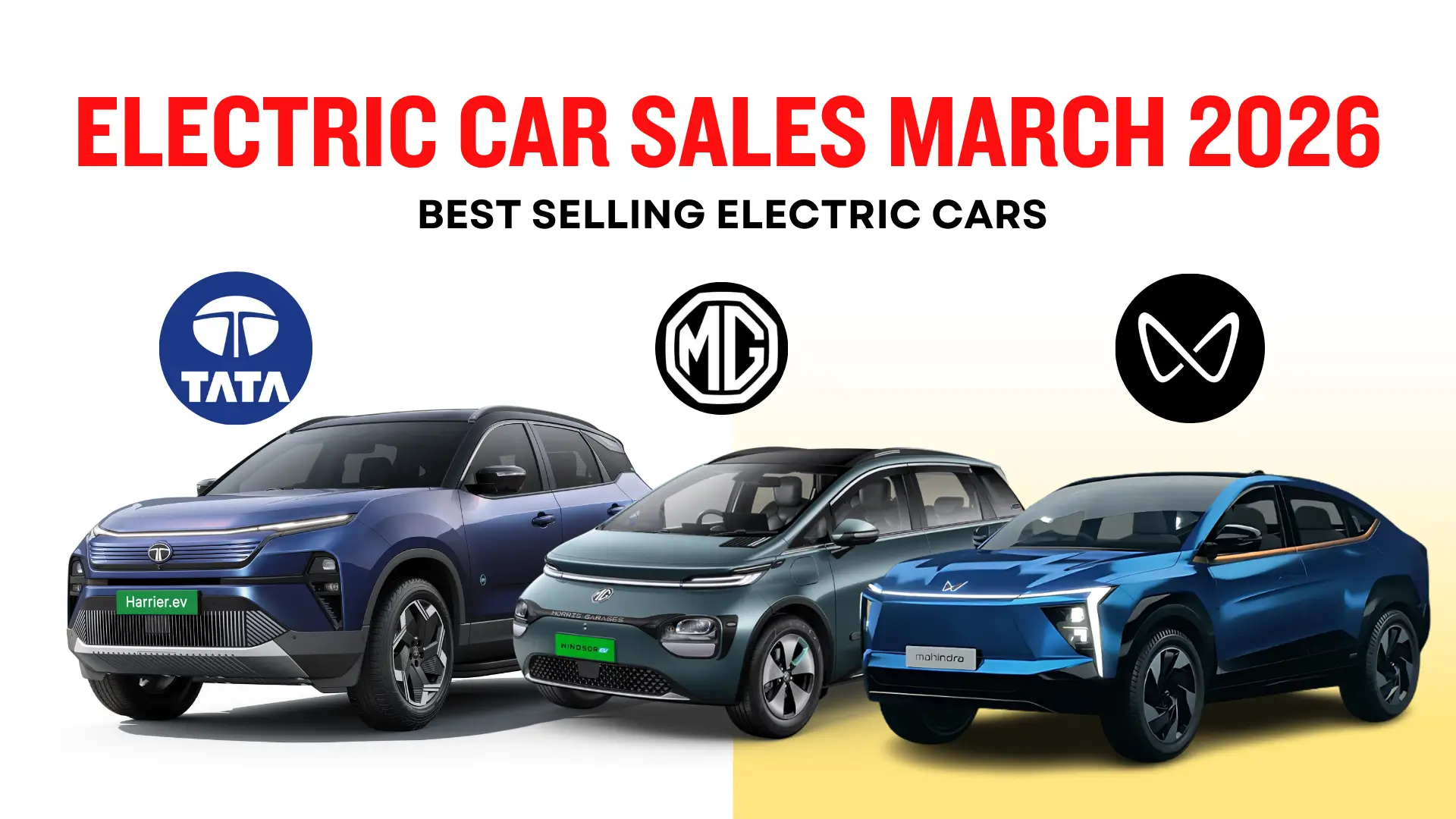
The market continues to be led by the top three players, Tata Motors, Mahindra & Mahindra, and JSW MG Motor India, who together account for nearly 83.5% of total sales.
But it is not just about the big three this month; some really interesting things are happening lower down the table too, and Maruti Suzuki, with its recent launch of e-Vitara, is the one everyone is talking about.
Brand-Wise Electric Car Sales Data – March 2026
| S No. | Brand | Mar 2026 | Feb 2026 | Difference | % Change | Market Share |
|---|---|---|---|---|---|---|
| 1 | Tata Motors | 8,253 | 5,947 | 2,306 | +38.8% | 37% |
| 2 | Mahindra & Mahindra | 5,244 | 3,174 | 2,070 | +65.2% | 23.5% |
| 3 | JSW MG Motor India | 5,141 | 3,556 | 1,585 | +44.6% | 23% |
| 4 | Maruti Suzuki India | 949 | 223 | 726 | +325.6% | 4.3% |
| 5 | VinFast Auto India | 691 | 415 | 276 | +66.5% | 3.1% |
| 6 | Hyundai Motor India | 476 | 329 | 147 | +44.7% | 2.1% |
| 7 | Kia India | 458 | 303 | 155 | +51.2% | 2.1% |
| 8 | BMW India | 437 | 260 | 177 | +68.1% | 2% |
| 9 | BYD India | 414 | 335 | 79 | +23.6% | 1.9% |
| 10 | Mercedes-Benz AG | 97 | 70 | 27 | +38.6% | 0.4% |
| 11 | Tesla India Motors | 49 | 29 | 20 | +69% | 0.2% |
| 12 | Stellantis Automobiles | 30 | 14 | 16 | +114% | 0.1% |
| 13 | Others | 76 | 57 | 19 | +33.3% | 0.3% |
| Total | 22,315 | 14,712 | 7,603 | +51.7% | 100% |
Source: Vahan Dashboard as of April 2, 2026. Telangana data not included.
#1 Tata Motors – 8,253 Units | 37% Market Share
Tata Motors continues to be the undisputed king of India’s electric car market. With 8,253 units in March 2026 and a commanding 37% market share, no other brand is even close to challenging Tata at the top right now.
The growth of 38.8% over February is solid and shows that demand for Tata’s EV lineup remains very strong and consistent.
Key volume drivers remain:
- Nexon EV — Still India’s highest-selling electric SUV
- Tiago EV — Strong performer in the affordable segment
- Harrier EV — Adding premium volumes steadily
Tata’s wide dealership network, competitive pricing, and trusted brand name continue to work strongly in its favour. The brand’s sales are nearly 1.6x that of its closest rival, which shows just how dominant Tata currently is.
#2 Mahindra & Mahindra – 5,244 Units | 23.5% Market Share
Mahindra has been one of the biggest stories of the Indian EV market in recent months, and March 2026 is no different. With 5,244 units and a massive 65.2% jump over February, Mahindra is clearly firing on all cylinders.
The brand has now firmly established itself as the strong #2 in India’s EV car market a position it has earned through some very exciting new products:
- XUV400 — Proven and popular electric SUV
- BE-series models — Driving fresh excitement and new buyers
- XEV 9e platform — Gaining strong traction among premium buyers
Mahindra’s aggressive EV push and improving supply chain are clearly paying off in a big way.
#3 JSW MG Motor India – 5,141 Units | 23% Market Share
JSW MG Motor India is right behind Mahindra with 5,141 units in March, a very strong 44.6% jump over February. The battle for the #2 and #3 spots between Mahindra and MG is getting very interesting and close.
MG’s strength continues to come from a well-rounded lineup:
- Windsor EV — Continues to drive strong volumes, especially in the fleet segment
- ZS EV — Reliable mid-size SUV option
- Comet EV — Compact and city-friendly option
MG holds a solid 23% market share and is clearly not going anywhere. The brand’s consistent performance quarter after quarter makes it one of the most stable players in the Indian EV car space.
#4 Maruti Suzuki India – 949 Units | 4.3% Market Share
Now this is the most exciting story of March 2026! Maruti Suzuki jumped a massive 325.6% compared to February, going from just 223 units to 949 units in a single month. That is an extraordinary leap.
India’s largest car brand is clearly getting serious about EVs, and buyers are responding positively. As Maruti expands its electric lineup and leverages its massive dealer network across every corner of India, it could very soon become a major force in the EV segment. Watch this space very closely!
#5 VinFast Auto India – 691 Units | 3.1% Market Share
VinFast is quietly building its presence in India, and March 2026 shows continued progress with 691 units — a 66.5% jump over February. The Vietnamese brand is steadily expanding its dealer network and creating awareness among Indian buyers.
With a focus on the premium EV segment, VinFast’s growth trajectory looks encouraging even though overall volumes are still relatively modest.
#6 Hyundai Motor India – 476 Units | 2.1% Market Share
Hyundai registered 476 units in March — a decent 44.7% improvement over February. The Creta EV and Ioniq 5 continue to be the main products driving Hyundai’s EV volumes.
Hyundai has a strong brand name and an exciting EV lineup on paper, but scaling volumes will require either more competitive pricing or more model options in India. Future launches will be key to whether Hyundai can meaningfully grow its EV market share.
#7 Kia India – 458 Units | 2.1% Market Share
Kia posted 458 units in March, up 51.2% from February. The EV6 and EV9 are the main products in Kia’s lineup, targeting the premium segment.
Kia shares the same 2.1% market share as Hyundai, and both brands together represent a meaningful chunk of the premium EV pie. Consistent supply and more accessible pricing could help Kia scale faster.
#8 BMW India – 437 Units | 2% Market Share
BMW had an excellent March with 437 units — a strong 68.1% jump over February. The German luxury brand continues to lead India’s luxury EV segment comfortably with its popular i4, iX, and i7 lineup.
Premium buyers in India are clearly warming up to luxury EVs, and BMW is benefiting nicely from this trend.
#9 BYD India – 414 Units | 1.9% Market Share
BYD India registered 414 units in March, a modest 23.6% increase over February. While the Chinese EV giant has a strong global reputation, its growth in India has been relatively slower compared to its potential.
BYD continues to operate in the premium space in India, and its volumes, though growing, remain limited compared to what the brand achieves in other markets.
Brands to Watch
| Brand | Mar 2026 | Feb 2026 | % Change |
|---|---|---|---|
| Mercedes-Benz AG | 97 | 70 | +38.6% |
| Tesla India Motors | 49 | 29 | +69% |
| Stellantis Automobiles | 30 | 14 | +114% |
Tesla India continues to generate huge buzz despite low volumes — 49 units in March with a 69% jump over February. As Tesla expands its India operations, volumes could pick up meaningfully in the coming months.
Stellantis showed the highest percentage jump of 114%, though on a very small base. Still a positive directional signal.
What do these EV sales figures for March tell us?
March 2026 has been a landmark month for India’s electric car market. A total of 22,315 units sold in a single month is a number that would have seemed ambitious just a couple of years ago.
Here is what stands out most from this month:
- Tata Motors remains the undisputed leader — consistent, dominant, and reliable
- Mahindra is on fire — the 65.2% MoM jump is genuinely impressive
- MG Motor is holding its ground very well in a competitive market
- Maruti’s 325.6% jump is the biggest surprise of the month — a sign of things to come
- Premium brands like BMW, Tesla, and Kia are all growing steadily
- Overall market growth of 51.7% over February tells us demand is very real and very strong
India’s electric car market is no longer just about early adopters or government fleet purchases. Real, everyday buyers across different income groups and cities are now choosing EVs, and that is the most exciting development of all.
FY 2026-27 is setting up to be a genuinely historic year for electric mobility in India.
FAQs