Q1. How Much Does Illumio Actually Cost in 2026? (Pricing Anchors, No Spin)
Illumio does not publish a price list. Based on buyer-reported data, Illumio Segmentation runs about $30 to $80 per workload per year at sub-1,000 scale, drops to roughly $22 at 10,000 workloads, and lands near $10 to $12 at 50,000 workloads. CloudSecure cloud workloads sit in the $20 to $50 per workload per year band. Minimum ACV for a new deployment starts at $25,000 to $50,000.
Every figure is directional. Illumio’s quote-only model means your real number depends on workload count, term length, product mix, and how hard you negotiate. For a deeper procurement framing, see our MDR buyers guide.
Why no rate card exists
Illumio uses a custom-quote subscription model tied to features, usage, and deployment complexity (illumio.com). There is no public PAYG SKU on AWS or Azure Marketplace, only private offers. Vendr’s catalog shows zero verified Illumio transactions, which is unusual and worth flagging for transparency.
A CISO at a 4,500-person logistics firm told me on a procurement call last quarter that the first quote came in 38% above the second one, same scope. That gap is the negotiation surface. It is not a fluke.
The volume curve buyers should anchor against
| Workloads | Est. $/WL/yr | Est. Annual Cost | Min ACV |
|---|---|---|---|
| 50 | $80 | $4,000 | ~$10,000 |
| 500 | $50 | $25,000 | ~$25,000 |
| 1,000 | $42 | $42,000 | ~$40,000 |
| 5,000 | $28 | $140,000 | ~$125,000 |
| 10,000 | $22 | $220,000 | ~$200,000 |
| 25,000 | $15 | $375,000 | ~$350,000 |
| 50,000 | $10 to $12 | $500,000 to $600,000 | Custom |
The biggest step-down sits between 100 and 1,000 workloads. Above 5,000, discounts are incremental and fought deal by deal.
Term length and channel levers
Three-year terms are the default enterprise structure (illumio.com subscription docs). Multi-year commits typically unlock another 10% to 20% off list compared with 1-year pricing. AWS and Azure Marketplace private offers let you draw down MACC or EDP cloud commit, which is useful if you have unspent cloud spend on the books. Cross-reference against our managed SIEM pricing guide to model the full data plane.
What the pricing anchor doesn’t tell you
⚠️ The per-workload rate is the starting line, not the finish line. Buyers who negotiate hard on the unit rate and never budget the professional services and policy-tuning labor end up with what I call a Fleet of Ferraris, expensive engines sitting idle because the in-house team is overwhelmed.
In our experience supporting MDR service clients through Zero Trust evaluations, the buyers who win on TCO are the ones who treat segmentation as an outcome to be operated, not a license to be bought. The license is roughly 30% to 40% of three-year TCO at every scale tested. The rest is people, process, and integration work.
“Licensing and cost can feel high compared to simpler controls.”
— AWS Marketplace verified buyer, Illumio AWS Marketplace Verified Review
“My experience was really good because I think it’s not very expensive if we compare it with Guardicore.”
— Verified buyer, Illumio PeerSpot Verified Review
Anchor your conversation with the rep on per-workload rate and three-year amortized TCO together. One without the other is theater.
Q2. How Does Illumio’s Workload-Based Licensing Work? (VEN, PCE, SKU Taxonomy)
Every Illumio product licenses by the workload, defined as one OS instance with a VEN (Virtual Enforcement Node) installed. A bare-metal server counts as one workload. Five user endpoints equal one workload. Cloud VMs (Virtual Machines) are metered as a daily average. Misreading these ratios before scoping is how buyers end up 15% to 30% short on day one. The 2024 to 2025 rebrand retired Illumio Core and Illumio ASP. Current SKUs are Segmentation, CloudSecure, Endpoint, and Insights.
The Illumio Workload, defined
The Illumio Workload (WL) is the licensing atom. Per the Illumio workload calculator (illumio.com/workload-calc), a workload is an OS endpoint where applications and services are running, with a VEN agent attached when managed. The same definition spans bare-metal servers, virtual machines, and container hosts.
Each workload includes a baked-in data ingestion allowance. Cloud and data center resources get 50 MB per day. Endpoints share that allowance across up to five devices.
Conversion ratios that catch buyers off guard
| Workload Type | Licensing Ratio | Notes |
|---|---|---|
| Data center server or VM | 1:1 | One OS = one workload |
| Cloud VM | Daily-average count | Metered hourly, averaged daily, true-ups apply |
| Container host (C-VEN) | Host = 1 WL | Pods do not count separately |
| User endpoint | 5:1 | Five Windows or macOS devices = 1 WL |
If your CMDB (Configuration Management Database) is stale or your cloud fleet auto-scales, the daily-average meter will surprise you at true-up.
The current SKU map
Illumio consolidated everything under the Breach Containment Platform umbrella in 2024 to 2025. Two anchor solutions sit underneath: Illumio Insights for visibility and detection, and Illumio Segmentation for enforcement (illumio.com/illumio-platform).
| Product | Category | Coverage | Licensing Unit |
|---|---|---|---|
| Illumio Segmentation (formerly Core) | CWPP, microsegmentation | DC, hybrid cloud, endpoints via VEN | Managed Workload |
| Illumio CloudSecure | CWPP, CSPM visibility | AWS, Azure, GCP agentless | Cloud Workload |
| Illumio Endpoint | Endpoint microsegmentation | Windows, macOS laptops, VDIs | 5 endpoints = 1 WL |
| Illumio Insights | NDR, CDR, XDR | AI-powered cloud detection | Insight Workload |
| PCE (SaaS or on-prem) | Control plane | Policy compute engine | Bundled |
| PCE Supercluster | Enterprise add-on | 25,000+ WL, multi-region | Custom |
| NEN (Network Enforcement Node) | Agentless enforcement | Legacy, OT, IoT via switch ACLs | Per instance |
| IVA (Illumio Virtual Advisor) | AI assistant | Embedded GenAI | Bundled |
Why the rebrand matters at the negotiation table
If you read 2022 or 2023 reviews, you will see Illumio ASP and Illumio Core. Those names are gone. ASP became the platform umbrella. Core became Segmentation. Illumio Edge and Illumio Xpress reached EOL (End of Life) in November 2024, which retired the SMB tier (computerweekly.com).
⚠️ Buyers renewing from legacy Core pricing should explicitly negotiate that they are not being moved to a higher-priced new SKU involuntarily. The rebrand is a re-anchoring opportunity for the rep, and a re-anchoring risk for you.
The 76-tools problem this creates
The average enterprise runs roughly 76 security tools. Complexity is itself a vulnerability. Illumio’s workload model sounds clean until mid-deployment, when you find your CMDB is stale, your container hosts were not counted, and your cloud fleet auto-scaled past the committed band. A practical starting point is our security stack guide.
In our experience helping enterprises right-size segmentation scope before signing, the single highest-leverage exercise is a CMDB reconciliation against the Illumio workload calculator output. Run it before, not after. Buyers who skip it usually pay for it twice, once at true-up, and again in remediation labor.
Show me the estate, then we’ll talk price
The honest order of operations is: inventory first, scope second, quote third. If your rep wants to skip to the quote, that is a tell. Ask them to walk the calculator with you, line by line, against your CMDB export.
Q3. What’s the Real Full Bill? (License + Support + Professional Services + Renewals)
The software license is the smallest line on the invoice. A mid-market 500-workload Year 1 deployment typically lands at around $23,750 software, $50,000 implementation PS (Professional Services), $15,000 annual policy tuning, and $7,000 training, for roughly $96,000 all-in. The license is about 25% of the bill. Add Sentinel ingestion, true-up buffers, and a 5% renewal uplift, and Year 2 rarely feels cheaper.
The full bill anatomy
A buyer who signed a $50K software deal and got a $170K Year 1 invoice is not an edge case. It is the norm at mid-market scale. Here is what makes up the rest.
| Line Item | 500 WL Year 1 | 5,000 WL Year 1 | Mandatory? |
|---|---|---|---|
| Software license | $23,750 | $131,000 | Yes |
| Implementation PS | $50,000 | $150,000 | Effectively yes |
| Annual policy tuning | $15,000 | $40,000 | Quasi-mandatory |
| Training (admins) | $7,000 | $20,000 | Recommended |
| Internal SecOps labor | $20,000 | $100,000 | Hidden but real |
| CMDB hygiene | $10,000 | $40,000 | Conditional |
| Sentinel ingestion (MS charge) | $0 | $54,750 | Conditional |
| True-up buffer (8% to 10%) | $1,680 | $11,200 | Standard |
The 500 WL Year 1 total runs roughly $115,000, dropping to about $49,000 in steady-state Years 2 and 3. Three-year amortized cost lands near $142 per workload per year.
Contract mechanics that trap buyers
The Illumio MSA (Master Subscription Agreement) auto-renews for one-year terms unless either party gives 60 days written notice before expiration. Miss the window and you are renewed at whatever the Order Form says, which often includes “then-current rates” language. That phrase resets your discount level at renewal.
⏰ Calendar the 60-day notice the day you sign. Treat it as a contractual obligation, not a reminder.
Renewal uplift is not published, but enterprise vendor norms put it at 5% to 10% on flat scope. Right-to-downsize is only available at renewal under standard MSA terms. Mid-term reductions are not permitted. For renewal-time leverage tactics, our analysis of why businesses switch providers tracks the most common breaking points.
What the Order Form won’t show you
💸 The five most common buyer-reported billing surprises:
- Implementation PS not included: Standard deployment runs $35,000 to $80,000 even for a 250 to 1,000 WL footprint.
- Annual policy tuning retainer: Policy-driven tools require forever-tuning. Budget $15,000 to $75,000 per year for active environments.
- Sentinel ingestion charged by Microsoft: Not Illumio’s bill, but it hits your TCO at $5,000 to $50,000 per year depending on telemetry volume.
- Cloud workload true-up: Daily-average metering produces 5% to 15% overage in auto-scaling environments.
- PCE upgrade engineering: Major version upgrades cost $10,000 to $40,000 per cycle in internal labor or PS.
Buyer voices on the real bill
“Illumio can take time to fully tune, since defining the right policies requires upfront effort.”
— Verified buyer, Illumio AWS Marketplace Verified Review
“Teams may also need training to get comfortable with the model and workflows.”
— Verified buyer, Illumio AWS Marketplace Verified Review
“The adoption journey of Illumio is not easy, after 1 year one customer was still learning to enable some features.”
— Enterprise buyer, Illumio G2 Verified Review
The maintenance treadmill
Policy-driven segmentation tools require continuous tuning. Frame the ongoing PS line as a subscription inside the subscription. In our work running 24/7 SOC service operations for global enterprises, the pattern is consistent: tools that demand daily policy curation either get an internal team built around them or quietly decay into shelfware.
The honest tradeoff to surface with your CFO: are you buying a product, or are you buying an outcome? Illumio is a product. The outcome (reduced lateral movement, contained breaches) requires the people and process layer on top, every year, forever.
One contract clause worth fighting for
Negotiate a contractual right-to-downsize at renewal in the initial agreement. Reps will resist. It is the single most useful clause if your workload count rationalizes mid-cycle, and it costs them nothing to grant when the deal is closing.
Q4. What Are Illumio’s Hidden Costs? (The Charges That Don’t Appear on the Quote)
The Illumio workload license is consistently less than 40% of three-year TCO. Hidden costs include PCE infrastructure ($5,000 to $30,000 per year), Supercluster uplift at 25,000+ workloads ($50,000 to $150,000 per year), cloud true-ups (5% to 15% overage), Microsoft Sentinel ingestion ($5,000 to $50,000 per year, charged by Microsoft), FIPS engineering ($10,000 to $50,000 one-time), CMDB hygiene ($5,000 to $25,000), and annual PCE upgrade engineering ($10,000 to $40,000 per cycle).
The full hidden-cost map
Software is consistently 30% to 39% of three-year TCO across the 500, 5,000, and 25,000 workload scenarios tested. The remaining 60% to 70% is what nobody puts on the quote.
| Category | Annual Cost Est. | Mandatory? | Triggered By |
|---|---|---|---|
| PCE infrastructure (on-prem) | $5,000 to $30,000 | Conditional | On-prem PCE choice |
| Supercluster uplift | $50,000 to $150,000 | Conditional | 25,000+ WL threshold |
| Cloud workload true-up | 5% to 15% overage | Conditional | Auto-scaling environments |
| Implementation PS | $25,000 to $200,000 (one-time) | Effectively yes | New deployment |
| Ongoing PS tuning | $15,000 to $75,000 | Quasi-mandatory | Policy churn |
| FIPS engineering | $10,000 to $50,000 (one-time) | Conditional | Regulated industry |
| CMDB hygiene | $5,000 to $25,000 | Conditional | Stale inventory |
| Sentinel ingestion | $5,000 to $50,000 | Conditional | Sentinel connector |
| Azure Firewall Premium | ~$20,000 to $60,000 | Conditional | Azure-heavy estates |
| PCE upgrade engineering | $10,000 to $40,000 per cycle | Quasi-mandatory | LTS upgrades |
The 10% true-up rule
Daily-average cloud workload metering means an auto-scaling environment can blow past the committed count without anyone noticing until the annual reconciliation invoice arrives. Budget a 10% buffer at signature. It is cheaper to negotiate the buffer in than to fight the true-up out.
In our experience advising mid-market and enterprise SOC teams on Zero Trust scoping, the cloud true-up is the single most predictable surprise. If you have horizontal scaling on Kubernetes or auto-scaling groups in AWS, model the worst week of the year, not the average. Our AWS security cost calculator can help frame the modeling.
Buyer-reported surprises, verbatim
“Licensing and cost can feel high compared to simpler controls.”
— Verified buyer, Illumio AWS Marketplace Verified Review
“Illumio can take time to fully tune, since defining the right policies requires upfront effort.”
— Verified buyer, Illumio AWS Marketplace Verified Review
“ITQlick notes that Illumio’s pricing starts from $3,900 per license, to calculate TCO one must also account for customization, data migration, training, hardware, maintenance, and upgrades.”
FIPS, CMDB, and Sentinel: the three line items nobody warns you about
To claim FIPS (Federal Information Processing Standards) compliance for SecureConnect, the VEN must be installed on specific RHEL versions and configured to operate in FIPS mode (docs.illumio.com). That is engineering labor, not a license cost.
CMDB hygiene is a prerequisite, not an afterthought. An Illumio dashboard showing 98% enforcement coverage means very little if 12% of your workloads are missing from the CMDB and the IT team cannot manage daily policy drift. That is paper security.
Sentinel ingestion is charged by Microsoft at roughly $2 to $5 per GB per day on standard tier (Microsoft Sentinel pricing docs). At 50 GB per day, you are at about $54,750 per year on top of your Illumio bill. Sentinel Commitment Tiers can lower this materially. Our managed SIEM practice routinely models this.
What I would budget for, before I signed
✅ A 10% true-up buffer in the contract.
✅ Two to six weeks of internal effort or PS to normalize the CMDB before deployment.
✅ A separate labeling workshop ($5,000 to $15,000) before the policy work begins.
✅ A right-to-downsize clause at renewal.
✅ Capped renewal uplift at 3% to 5% or CPI (Consumer Price Index), whichever is lower.
The Illumio sales team will not volunteer these. They are not hidden because anyone is hiding them. They are hidden because the Order Form is a software contract, and most of the real cost lives outside the software contract.
A more honest path to the same outcome
Working with security teams at the 1,000 to 10,000 employee range, what I have noticed is that the Zero Trust outcome (reduced blast radius, contained lateral movement) is rarely a single-product purchase. It is a stack decision: identity, segmentation, detection, response, and the humans who own the workflow at 2 a.m.
We built Under Defence MAXI, our WarRoom platform, to be vendor-agnostic on purpose, integrating with the SIEM (Security Information and Event Management), EDR (Endpoint Detection and Response), and segmentation tools you already own, so the outcome is owned end-to-end without forcing a rip-and-replace. That is a different conversation than “how much does Illumio cost?” but it is the conversation the CFO usually wants to have once the hidden-cost map is on the table. Pair it with a 2-minute Alert-to-Triage and 15-minute escalation for critical incidents, and the math shifts.
“UnderDefense covers the entire spectrum of cybersecurity needs we have. Their team responds rapidly and the MAXI platform gives us complete visibility.”
— Verified reviewer, IT Director, Under Defence G2 – Verified Review
Q5. What Does Illumio Really Cost Over 3 Years? (TCO at 500, 5,000 and 25,000 Workloads)
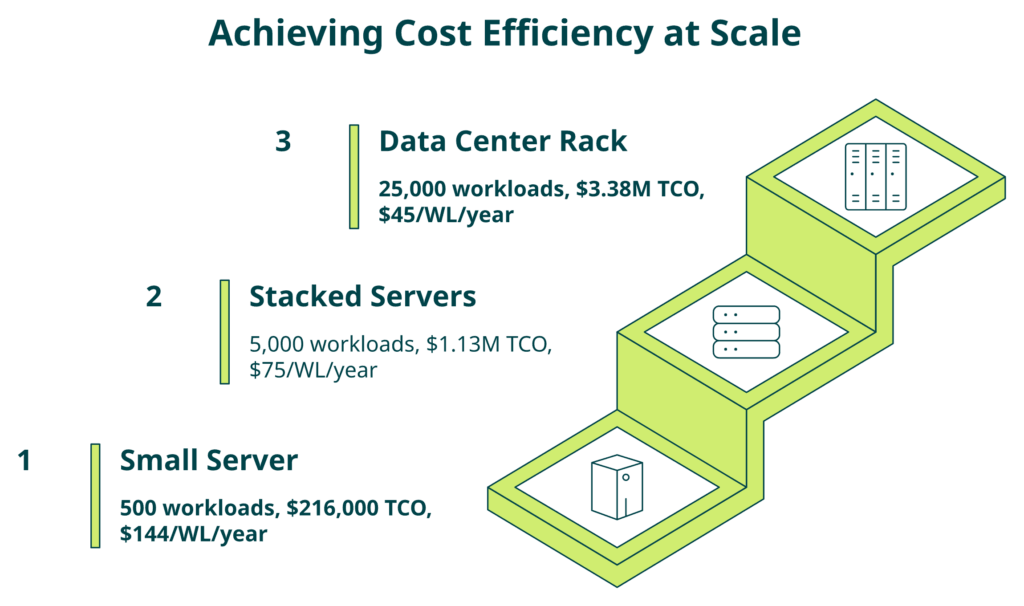
Three-year all-in TCO (Total Cost of Ownership) lands near $216,000 at 500 workloads (about $144 per workload per year amortized), $1.13M at 5,000 workloads ($75 per WL per year), and $3.38M at 25,000 workloads ($45 per WL per year). In every scenario, the software license is just 30% to 40% of the three-year total. Implementation costs run 1.3 to 4 times the Year 1 software license. Year 1 is the most expensive year by a factor of 2 to 2.5 because PS (Professional Services) and training front-load the spend.
The headline numbers, side by side
| Scenario | Year 1 | Year 2 | Year 3 | 3-Yr Total | Avg $/WL/yr | Software % of TCO |
|---|---|---|---|---|---|---|
| 500 WL | ~$115,000 | ~$49,000 | ~$52,000 | ~$216,000 | $144 | ~31% |
| 5,000 WL | ~$481,000 | ~$239,000 | ~$247,000 | ~$1.13M | $75 | ~39% |
| 25,000 WL | ~$1.45M | ~$960,000 | ~$972,000 | ~$3.38M | $45 | ~30% |
Buyers consistently underestimate Year 1 because the rep quotes the software line. The software is the smallest line on the page. For a parallel benchmark, see our MDR price guide.
Year 1 anatomy at 500 workloads
For a 500-workload mid-market deployment, Year 1 typically stacks up as: software license about $23,750, implementation PS roughly $50,000, annual policy tuning $15,000, training $7,000, internal SecOps labor $15,000, and a true-up buffer of about $2,400. That puts you near $115,000 cash out the door before steady state.
A 2024 Illumio customer interviewed by Forrester noted enforcement took six months to reach material coverage. NIBE Group, a 150-company conglomerate with 500 apps, hit roughly 98% enforcement in six months. That is the best-case reference, not the typical one.
Renewal uplift sensitivity
Software uplift is rarely the budget killer. Scope creep in PS and internal labor is.
| Renewal Uplift | 3-Yr TCO at 5,000 WL |
|---|---|
| 0% (capped) | ~$1.13M |
| 5% | ~$1.16M |
| 7% | ~$1.18M |
| 15% | ~$1.23M |
⚠️ The bigger risk is the policy tuning retainer expanding mid-cycle as new apps come online. Lock the PS retainer scope, not just the per-WL rate.
The CFO conversation, in plain terms
The NIST Cybersecurity Framework has five functions: Identify, Protect, Detect, Respond, and Recover (NIST CSF 2.0, February 2024). Illumio buys you Protect. If you are spending $1.13M over three years on segmentation and zero on Detect or Respond, that is the imbalance to flag at the next budget meeting. Our 2026 cybersecurity budget playbook walks through that rebalance.
In our experience helping CISOs map spend across the CSF (Cybersecurity Framework), the segmentation line frequently crowds out detection and incident response. The Forrester TEI (Total Economic Impact) composite cited a $10.2M three-year benefit (Forrester TEI 2023, Illumio-commissioned). That number assumes the Detect and Respond layer is funded. If it is not, the segmentation ROI flattens because lateral movement still goes unseen until the breach is on the front page. Pairing segmentation with our MDR service closes that gap.
What I would budget for at signature
✅ Software at the negotiated per-WL rate.
✅ PS at 1.3 to 4 times the Year 1 software license, scoped by workload count.
✅ A 5% to 10% true-up buffer.
✅ Internal labor at $100 to $150 per hour, fully loaded, for 600 to 1,200 hours at 5,000 WL.
✅ A capped renewal uplift clause at 3% to 5% or CPI (Consumer Price Index), whichever is lower.
The headline number to take into the boardroom is not the per-workload rate. It is the three-year amortized cost per workload per year, with a footnote on the assumed PS and labor scope. Our SOC cost calculator can help model the labor side.
Q6. What Is Illumio’s ROI? (Breach Cost Math, Compliance Savings, and Board-Level Justification)
Illumio’s core ROI claim is a 66% reduction in breach blast radius (Forrester TEI 2023, Illumio-commissioned). Against the IBM 2024 average breach cost of $4.88M, that maps to roughly $3.2M in avoided impact per contained event. For PCI DSS (Payment Card Industry Data Security Standard) environments, segmentation directly reduces audit scope, which buyers report as $50,000 to $200,000 per year in compliance offsets. At 500 workloads ($216K three-year TCO), payback breaks even on a single mid-size contained breach.
The ROI framework, by lever
| Benefit Category | Annual Value Est. | Source | Confidence |
|---|---|---|---|
| Breach blast radius reduction | 66%, ~$3.2M avoided per event | Forrester TEI 2023 | Medium (vendor-commissioned) |
| PCI DSS audit scope reduction | $50K to $200K | PCI DSS v4.0 segmentation guidance | High |
| Tool consolidation offset (5,000 WL) | $75K to $175K | Illumio pricing research | Medium |
| IR (Incident Response) time savings | 7 hrs avg downtime per incident avoided | Illumio 2025 CDR Research | Medium |
| Segmentation effort reduction | 90% vs traditional methods | Forrester TEI 2023 | Medium |
| Forrester TEI composite ROI | 111% over 3 years, payback in 6 months | Forrester TEI 2023 | Medium |
Compliance ROI, by vertical
PCI DSS v4.0 explicitly recognizes network segmentation as an audit-scope reduction lever. NIS2 (Network and Information Security Directive 2) Article 21 carries penalties up to 2% of global revenue or €10M for in-scope entities (EU NIS2 Directive, January 2023). HIPAA (Health Insurance Portability and Accountability Act) breach notification costs scale with affected record count, so reducing blast radius reduces notification scope. Our compliance services regularly map segmentation to audit boundaries.
The honest counterpoint
ROI math is probabilistic, not guaranteed. A 2021 Forrester study commissioned by Illumio found 43% of organizations could not name a qualified business outcome from microsegmentation. That is not a small number. It usually correlates with the Fleet of Ferraris pattern, where the tool is bought before the team is built.
“The biggest benefit, in my opinion, has been the amount of education and learning that everyone involved in this project has gained as a result of looking at the visibility data.”
— Cybersecurity Advisor, Logistics Company, Illumio Forrester TEI 2023 Verified Review
“If we experienced this same event without Illumio, at least two to three times more systems would have been impacted.”
— Director of Infrastructure, Legal Firm, Illumio Forrester TEI 2023 Verified Review
What the ROI math misses
💰 Forrester reports security teams spend an average of 14.1 hours per week chasing false positives because of tool sprawl and outdated detection (Illumio 2025 CDR Research). Segmentation alone does not solve this. It reduces blast radius. It does not reduce alert volume. Reducing alert volume is the territory of SOC automation.
In our experience running 24/7 SOC operations for global enterprises, the customers who get the most ROI from segmentation are the ones who pair it with a managed detection and response layer that owns the alert-to-action loop. One of our customers caught a payroll fraud scheme in their first three months on Under Defence MAXI, our WarRoom platform, which paid for the contract on a single incident no segmentation tool would have flagged. That is east-west visibility plus human triage, not segmentation in isolation. The SLA model behind it is a 2-minute Alert-to-Triage and 15-minute escalation for critical incidents.
Three ROI levers to take to the board
- Breach cost avoidance, modeled against your own incident history and the IBM $4.88M average.
- Compliance offset, quantified against your PCI, HIPAA, or NIS2 audit scope today.
- Tool consolidation, naming the legacy ACL tools and east-west traffic capture you can retire.
Apply your own incident cost assumptions. Do not take the $10.2M Forrester composite at face value for your deal size.
Q7. How Does Illumio Compare to Guardicore, Cisco, ColorTokens, and Zscaler on Price?
At 5,000 workloads over three years, Illumio (about $1.13M TCO) and Akamai Guardicore ($1.07M to $1.31M) are TCO peers, and the choice is architectural, not financial. Cisco Secure Workload runs 13% to 46% more expensive. ColorTokens delivers strong OT (Operational Technology) value at $550K to $800K with native OT support. Zero Networks is dramatically cheaper ($360K to $500K) but cloud-limited and AD-dependent. Zscaler solves user-to-app access, not workload-to-workload segmentation, so it is apples-to-oranges architecturally.
Raw TCO at 5,000 workloads, 3 years
| Vendor | 3-Yr SW License | 3-Yr Impl PS | 3-Yr Ops Labor | 3-Yr TCO | vs. Illumio |
|---|---|---|---|---|---|
| Illumio Segmentation | $441,000 | $310,000 | $384,000 | $1,135,000 | Baseline |
| Akamai Guardicore | $400K to $550K | $290K to $380K | $375K | $1.07M to $1.31M | -3% to +17% |
| Cisco Secure Workload | $450K to $650K | $350K to $500K | $400K | $1.20M to $1.55M | +13% to +46% |
| Zero Networks | $150K to $250K | $60K to $100K | $150K | $360K to $500K | -60% to -46% |
| ColorTokens Xshield | $250K to $400K | $150K to $250K | $150K | $550K to $800K | -41% to -19% |
Capability-adjusted reality
Raw TCO misses real capability gaps. Guardicore’s proprietary kernel firewall on every host adds OS upgrade overhead and creates NIST tension. NIST SP 800-207 explicitly discourages overly proprietary solutions in Zero Trust architecture (NIST SP 800-207, August 2020). Adjusted for that, Guardicore’s three-year TCO climbs to roughly $1.15M to $1.49M.
Zero Networks has the lowest raw TCO but no native OT support and limited cloud workload coverage. Add $100K to $200K in supplemental tooling for a typical enterprise estate. ColorTokens leads on OT/IoT (Internet of Things) protocol support natively, making it the strongest value for industrial estates. Our top threat detection tools roundup tracks how these stacks pair with detection layers.
Decision rubric
| Use Case | Recommended Vendor | Reason |
|---|---|---|
| VMware-heavy (80%+) | VMware vDefend | Near-zero incremental cost on existing NSX licensing |
| Mixed IT/OT/IoT | ColorTokens Xshield | Native OT protocol support, agentless |
| Cloud-first, AD-integrated | Zero Networks | Fastest deploy (1 to 3 weeks), lowest TCO |
| Hybrid DC + cloud, complex apps | Illumio | Most mature label-based ADM (Application Dependency Mapping) at scale |
| Threat hunting integrated | Akamai Guardicore | Built-in threat hunting console |
| Cisco-native + ACI | Cisco Secure Workload | ACI integration, despite price premium |
Forrester’s 2025 Microsegmentation Wave ranked Illumio first in current offering, ColorTokens second, and Cisco third.
The buyer voice
“My experience was really good because I think it’s not very expensive if we compare it with Guardicore.”
— Verified buyer, Illumio PeerSpot Verified Review
“Regarding price, Cisco Secure Workload can be expensive if you don’t have a budget. Every extra security measure or enforcement you’re putting on top of your existing environment will be an extra cost.”
— Verified buyer, Cisco Secure Workload PeerSpot Verified Review
“Compared to the pricing we were seeing from both Illumio and Edgewise, Guardicore was very competitive.”
— Verified buyer, Akamai Guardicore PeerSpot Verified Review
The architectural lens
The M&M (network) analogy is useful here: hard exterior, soft tasty center. Guardicore adds another layer to the hard exterior with its proprietary kernel firewall on every host. It does not actually harden the soft center any differently than Illumio does. The kernel module is a NIST alignment risk, not just a TCO premium.
Working with security teams across regulated industries, what I have noticed is that the best vendor on paper is often not the best vendor for your operational reality. If your team is two engineers and a dog, ColorTokens or Zero Networks beats Illumio on time-to-value, even if the Forrester ranking does not say so. For teams in this position, our outsourced vs in-house SOC analysis is the next read.
Q8. What Are Illumio’s Switching Costs and Lock-In Risks?
Illumio’s MSA (Master Subscription Agreement) has no convenience termination right. Early exit requires a material breach with a 30-day cure period, and likely payment of remaining term fees. Beyond the contract, switching costs include rebuilding the label taxonomy (the most expensive remediation buyers encounter), decommissioning VENs (Virtual Enforcement Nodes) across the estate, migrating policy to a new platform, and re-running ADM (Application Dependency Mapping). For a 5,000-workload environment, real switching costs run $150,000 to $350,000.
Contractual lock-in mechanics
| Mechanism | Severity | What to Negotiate Before Signing |
|---|---|---|
| No convenience termination | High | Add a termination-for-convenience clause with cure period |
| 60-day auto-renewal notice | Medium | Calendar at signature, treat as contractual |
| Then-current rates at renewal | High | Lock per-WL rate or cap uplift at CPI |
| No mid-term right-to-downsize | High | Negotiate right-to-downsize at each renewal |
| Co-term complexity across SKUs | Medium | Co-term Order Forms at first opportunity |
⏰ The 60-day auto-renewal notice window is the most commonly missed clause. Miss it, and you are renewed at then-current rates with no negotiation surface. Our analysis of why businesses switch providers covers the patterns that lead to renewal regret.
Architectural switching costs
| Component | Switching Cost Est. (5,000 WL) | Why Costly |
|---|---|---|
| Label taxonomy rebuild | $50,000 to $120,000 | New platform requires new schema; label work is foundational |
| VEN decommission labor | $25,000 to $60,000 | Agent removal across estate, validation per workload |
| ADM re-run | $20,000 to $50,000 | New platform’s discovery cycle |
| Policy migration | $30,000 to $80,000 | Translation from label-based to new model |
| CMDB re-tagging | $15,000 to $40,000 | Asset inventory normalization |
Adoption is slow even on the way in. One enterprise buyer noted on G2 that they were still learning to enable some features after a year. That same learning curve runs in reverse on the way out.
“The adoption journey of Illumio is not easy, after 1 year one customer was still learning to enable some features.”
— Enterprise buyer, Illumio G2 Verified Review
Negotiation protections to embed at signature
✅ Right-to-downsize at each renewal (not just expiration).
✅ Locked per-WL rate for the full term, not “then-current” language.
✅ Carry-forward discount on expansion workloads.
✅ Capped renewal uplift at 3% to 5% or CPI, whichever is lower.
✅ Data export rights for traffic flow telemetry and label schema.
✅ Termination for convenience with 90-day notice and prorated refund.
These are negotiable at signature. They are nearly impossible to add at renewal. A virtual CISO partner can run point on these clauses if the in-house team is overloaded.
Complexity is its own lock-in
An over-engineered segmentation deployment, with a label taxonomy only one consultant truly understands, increases switching cost by design. That is not a feature, but operational risk. In our experience advising CISOs through MDR (Managed Detection and Response) consolidations, the most painful switches are the ones where the original architects have left the company and the documentation is stale. Our cybersecurity technical debt analysis dives deeper into this pattern.
The Cisco reference Under Defence often cites is relevant here. Cisco itself uses third-party security partners because no single vendor owns the whole stack honestly. The same logic applies to segmentation. Buying Illumio does not buy you out of the lock-in problem. It buys you a different lock-in problem, and the only protection is the contract you sign on day one. Pair that contract with vendor-agnostic detection through Under Defence MAXI, our WarRoom platform, backed by a 2-minute Alert-to-Triage and 15-minute escalation for critical incidents.
One clause to insist on
The single most useful clause to fight for is a contractual right-to-downsize at each renewal, not just at term expiration. Reps will resist. It costs them nothing at signature and saves you six figures if your workload count rationalizes mid-cycle.
Q9. How Do You Negotiate the Best Illumio Deal in 2026? (Procurement Playbook)
Three levers consistently unlock the best Illumio pricing: a 3-year commitment adds 15% to 25% in discount, a named competitive alternative (Guardicore or Cisco) in the room adds another 10% to 20%, and fiscal year-end timing matters because Illumio’s FY closes January 31. Start negotiations 60 to 90 days before fiscal year-end (FYE), by early November at the latest. Miss the window and the next-best leverage period is Q3 close in late October. For broader procurement context, our MDR buyers guide walks through similar lever stacks.
The 10 discount levers, ranked by impact
| Lever | Discount Potential | Notes |
|---|---|---|
| Multi-year commit (3-yr) | 15% to 25% | Standard enterprise structure |
| Volume tier escalation | Step-down at 100, 1,000, 5,000 WL | Biggest gap is 100 to 1,000 |
| Competitive displacement | 10% to 20% | Name Guardicore, Cisco, ColorTokens |
| FYE timing (Nov to Jan) | 5% to 15% | Illumio FYE is January 31 |
| Multi-product bundle | 5% to 15% on add-on | Segmentation + Insights together |
| Marketplace MACC/EDP drawdown | 0% to 10% net | AWS or Azure private offer |
| Pilot-to-production conversion | Blended retroactive rate | Negotiate at PoC signature |
| PS credits as close concession | $25K to $100K value | Free implementation hours |
| Auto-renewal cap | Avoids 5% to 15% Year 4 uplift | Lock at 3% or CPI |
| Executive engagement | Variable | VP-level escalation late in deal |
The fiscal year calendar
| Period | Leverage | Notes |
|---|---|---|
| November to January 31 (FYE) | Highest | Reps closing the year, most flex on PS and rate |
| Late October (Q3 close) | High | Quarter pressure, second-best window |
| February to April | Low | Fresh fiscal year, no urgency |
| May to August | Medium | Normal pipeline pace |
⏰ Start internal approval workflows in early September. Most enterprise procurement cycles take 8 to 12 weeks. If you want signature in January, your RFP needs to be out by early November. Our 2026 cybersecurity budget playbook can help align the calendar to your fiscal cycle.
Contract clauses to negotiate at first signature
The Illumio MSA (Master Subscription Agreement) auto-renews on 60 days notice with then-current rates language. That language is the single largest renewal risk. Push back at signature, not renewal. A virtual CISO partner can run point on these clauses if your in-house team is stretched.
✅ Lock per-WL rate for the full term, not just Year 1.
✅ Cap renewal uplift at 3% to 5% or CPI (Consumer Price Index), whichever is lower.
✅ Carry forward the discount percentage to expansion workloads.
✅ 10% true-up grace buffer before incremental billing kicks in.
✅ Right-to-downsize at each renewal, not just term expiration.
✅ PS credits as a close concession, not an upsell.
✅ Right to co-term all SKUs to a single anniversary date.
Throw stones at the architecture before you sign
Before committing to a three-year deal, run a Threat-and-Risk-Model exercise to validate where segmentation is actually needed. In our experience advising security teams through procurement, buyers who skip this step over-buy workload licenses for assets that do not require agent-level enforcement. A static jump server, a backup target, or a one-way data diode rarely needs full VEN (Virtual Enforcement Node) coverage. Pairing this with penetration testing can validate the actual east-west exposure.
The negotiation table is also a scoping table. If you walk in with 5,000 workloads but 3,500 of those are non-business-critical and could be covered by NEN (Network Enforcement Node) or simple VLAN ACLs, your real ask is 1,500 WL of high-value coverage. That conversation gets you a better unit rate and a lower TCO simultaneously.
💰 The buyer who anchors on workload count loses. The buyer who anchors on outcomes wins. Tell the rep what you are protecting, not how many endpoints you have.
Q10. Is There a Cheaper Path to Zero Trust? (M365 Audit, SDP, and Managed Alternatives)
Before committing to Illumio’s workload-licensing model, run a Microsoft 365 E5 entitlement audit. Many enterprises already own Defender for Endpoint, Purview, Conditional Access, and Azure Firewall capabilities that cover 30% to 50% of the use case at zero incremental cost. For organizations under 5,000 workloads without dedicated microsegmentation staff, managed breach containment via an MDR (Managed Detection and Response) partner reduces all-in TCO by roughly 25% to 40% versus direct Illumio procurement.
The cheapest path may already be on your invoice
Most enterprises run on M365 E5 or G5 licensing without ever auditing what they already own. The Zero Trust feature overlap is significant. For Microsoft-heavy estates, our MDR for Microsoft 365 practice routinely maps this overlap.
| Illumio Capability | M365 E5 Equivalent | Coverage Gap |
|---|---|---|
| Endpoint segmentation | Defender for Endpoint + ASR rules | No native east-west DC visibility |
| Cloud workload visibility | Defender for Cloud + Azure Firewall Premium | AWS and GCP gaps |
| Application access control | Conditional Access + Entra ID | No host-to-host policy |
| Data flow inspection | Purview Information Protection | Not workload-aware |
| Identity governance | Entra ID Governance | Not workload-anchored |
The point is not that M365 replaces Illumio. It does not. The point is that 30% to 50% of what your rep is selling, you may already be paying Microsoft for. CISA’s Zero Trust Maturity Model 2.0 explicitly maps identity-anchored controls as a foundational layer (CISA, April 2023).
SDP versus microsegmentation, architecturally
Software-Defined Perimeter (SDP) and identity-aware proxies offer a less-intrusive path to east-west control. The traditional network is the M&M model, hard exterior with a soft tasty center. Illumio tries to harden the center workload by workload. SDP redefines the perimeter around the identity, which is where modern attacks actually originate.
For 1,000 to 5,000 employee enterprises with hybrid cloud and remote workforces, SDP often solves the same root problem (lateral movement reduction) without per-workload VEN rollout. It is not a universal substitute, but a serious architectural alternative most buyers do not evaluate. Our cloud security architecture analysis covers this in more depth.
The NIST CSF budget map
NIST Cybersecurity Framework 2.0 has five functions: Govern, Identify, Protect, Detect, Respond, and Recover (NIST CSF 2.0, February 2024). Spending $1.13M over three years on the Protect function (segmentation) while underfunding Detect and Respond is the imbalance Forrester flagged in 2021 (43% of microsegmentation buyers could not name a qualified business outcome).
✅ Run the M365 E5 audit before you sign Illumio.
✅ Map your CSF spend across all five functions, not just Protect.
✅ Quantify what your existing EDR (Endpoint Detection and Response) and SIEM (Security Information and Event Management) already cover.
Managed BCaaS economics
Illumio’s MSP partner program (Breach Containment as a Service) prices software at 60% to 75% of direct rates with a managed service wrap on top. At 1,000 workloads, all-in BCaaS runs $75,000 to $125,000 per year versus $115,000-plus direct in Year 1. The labor and policy tuning are someone else’s problem. Our outsourced vs in-house SOC breakdown applies the same logic to detection labor.
In our experience running 24/7 SOC operations for global enterprises, the buyers who get the most Zero Trust outcome per dollar are the ones who pair lightweight segmentation with a managed detection layer that owns the alert-to-action loop. We built Under Defence MAXI, our WarRoom platform, to be vendor-agnostic on purpose, integrating with Splunk, Sentinel, and CrowdStrike rather than replacing them. The SLA backing it is a 2-minute Alert-to-Triage and 15-minute escalation for critical incidents.
“UnderDefense Maxi has provided actual security oversight on our cloud environment with one of our finance applications. They are able to monitor and provide insight on activity in our environment immediately and provide effective response.”
— Verified reviewer, IT Director, Under Defence G2 – Verified Review
The shadow IT discovery angle
Zero Trust is not just about segmenting known assets. It is about discovering the unsanctioned apps your CMDB does not know exist. A free OAuth log audit through your IdP (Identity Provider) often uncovers 40 to 200 sanctioned and unsanctioned SaaS apps that segmentation would have walled off without ever knowing existed. That is a fundamentally different security posture than per-workload enforcement on a stale CMDB. Our attack surface management guide walks through the discovery side.
Q11. Who Should Buy Illumio in 2026, and Who Should Look Elsewhere?
Illumio is the right call for regulated enterprises with 2,500-plus workloads, clear east-west segmentation mandates (PCI DSS, HIPAA, NIS2), and a dedicated SecOps team to own ongoing policy management. For organizations under 1,000 workloads without internal microsegmentation expertise, it is budget-destructive, the Fleet of Ferraris trap. Managed alternatives deliver comparable risk reduction at 40% to 60% lower all-in TCO for teams whose hands are already full.
Buy or don’t-buy, by org profile
| Org Profile | Workload Count | Internal Team | Regulatory Driver | Recommended Path |
|---|---|---|---|---|
| Regulated enterprise | 2,500+ | Dedicated SecOps (5+) | PCI, HIPAA, NIS2 | Buy Illumio direct |
| Mid-market hybrid cloud | 500 to 2,500 | Lean (1 to 3) | Optional | Buy via MSP/BCaaS |
| Cloud-first, AD-integrated | 500 to 5,000 | Lean | Variable | Zero Networks or ColorTokens |
| OT/IoT-heavy | Mixed | Specialist required | NIS2, IEC 62443 | ColorTokens |
| Under 1,000 WL, no SecOps | Under 1,000 | None to minimal | Often none | Managed MDR with east-west visibility |
| VMware-heavy (80%+) | Any | Network team | Variable | VMware vDefend |
The one contract question to ask before signing
Ask the rep: “What is our per-workload rate locked for renewal, and what is the contractual cap on Year 2-plus uplift?” If the answer is “we use then-current rates,” that is a renewal landmine. If they will not put a cap on the Order Form, walk back to the table.
What you are actually worried about
You are not worried about the license cost. You are worried about committing $500,000 to a tool your team cannot fully operate. That is the honest fear, and it is a legitimate one. NIBE Group hit 98% enforcement across 150 companies and 500 apps in six months. That is the best-case reference. Most teams do not have NIBE’s bench depth. Our MDR service exists for exactly that operating reality.
Less theater, more throughput. Less black box, more blue team. Illumio is excellent engineering, but excellent engineering idle on understaffed teams is just expensive theater.
“If you have a focus on security and governance, then this is the tool to use. The dashboards and Illumination map for visibility are top-notch.”
— Cybersecurity Manager, Illumio G2 Verified Review
“The adoption journey of Illumio is not easy, after 1 year one customer was still learning to enable some features.”
— Enterprise buyer, Illumio G2 Verified Review
“UnderDefense provides a very fast turnaround when it comes to investigations of alerts, vulnerabilities, and remediations.”
— Verified reviewer, Security Lead, Under Defence G2 – Verified Review
🔍 Not Sure Illumio Is Right for Your Team Size?
Get the same Zero Trust outcomes, without the $500K implementation overhead.
Under Defence MAXI delivers managed breach containment, east-west visibility, and agentic AI-driven threat response, integrated with your existing Splunk, Sentinel, or CrowdStrike stack. No rip-and-replace. No policy tuning treadmill. No VEN rollout project. The SLA model behind it is a 2-minute Alert-to-Triage and 15-minute escalation for critical incidents.
Trusted by Cisco, AirSlate, and 300-plus enterprises. G2 High Performer.
What I’m Thinking About Next
The conversation I keep having with CISOs in 2026 is not “should we buy Illumio.” It is “where does segmentation actually move the needle in an agentic-AI threat model where the attacker is faster than our policy update cycle.” My current read is that policy-driven segmentation has an 18 to 24 month half-life before agentic attack chains start routing around static policy in ways human-tuned rules cannot keep pace with.
I might be wrong here, but the SOCs that survive the next two years will not be the ones with the prettiest enforcement dashboards. They will be the ones that paired lightweight segmentation with autonomous detection and a human ally who owns the outcome. If you are sitting with that same question, I would love to compare notes via our contact us page.
References
Official Docs / Indian Statutes
- NIST. “SP 800-207: Zero Trust Architecture.” Published: August 2020.
- NIST. “Cybersecurity Framework 2.0.” Published: February 2024.
- CISA. “Zero Trust Maturity Model 2.0.” Published: April 2023.
- PCI Security Standards Council. “PCI DSS v4.0 Segmentation Requirements.” Published: March 2022.
- European Union. “Directive (EU) 2022/2555 (NIS2), Article 21.” Published: December 2022.
- Illumio. “Illumio Workload Calculator and Licensing Definitions.”
- Illumio. “Illumio Breach Containment Platform Overview.” Published: 2024 to 2025 rebrand.
- Illumio. “CloudSecure Licensing Documentation.”
- Illumio. “VEN FIPS OpenSSL Module Documentation.”
- Illumio. “Master Subscription Agreement, Auto-Renewal Clause (60-day notice, then-current rates).”
- Illumio. “PCE Supercluster Enterprise Add-on Documentation.”
- Illumio. “MSP and Enlighten Partner Program Documentation.”
- Illumio. “NIBE Group Customer Case Study (98% enforcement, 150 companies, 500 apps, 6 months).”
- Microsoft. “Microsoft Sentinel Pricing ($2 to $5 per GB per day, standard tier).”
- Microsoft. “M365 E5 Licensing and Feature Set Documentation.”
Datasets
- IBM Security. “Cost of a Data Breach Report 2024.” Published: July 2024.
- Illumio. “2025 Cloud Detection and Response Research Report.” Published: 2025.
Blogs
- Forrester Consulting. “The Total Economic Impact of Illumio Zero Trust Segmentation.” Commissioned by Illumio, 2023. [Secondary source]
- Forrester. “The Forrester Wave: Microsegmentation Solutions, Q1 2025.” Published: 2025. [Secondary source]
- AWS Marketplace. “Illumio Breach Containment Platform Listing and Verified Buyer Reviews.” [Secondary source]
- PeerSpot. “Illumio Pricing Discussion Threads.” [Secondary source]
- PeerSpot. “Akamai Guardicore Segmentation Verified Buyer Reviews.” [Secondary source]
- PeerSpot. “Cisco Secure Workload Verified Buyer Reviews.” [Secondary source]
- ITQlick. “Illumio ASP Pricing and TCO Analysis.” [Secondary source]
- G2. “Illumio Verified Buyer Reviews.” [Secondary source]
- G2. “UnderDefense MAXI Verified Buyer Reviews.” [Secondary source]
- Gartner Peer Insights. “Illumio Reviews (98% recommend, 59 reviews as of November 2025).” [Secondary source]
- Vendr. “Illumio Catalog Entry (0 verified transactions, noted for transparency).” [Secondary source]
- ComputerWeekly Microscope. “Illumio MSP Program and Xpress/Edge EOL Notice.” Published: November 2024. [Secondary source]
1. How much does Illumio actually cost per workload in 2026?
We see Illumio Segmentation priced at roughly $30 to $80 per workload per year at sub-1,000 scale, dropping to about $22 at 10,000 workloads, and landing near $10 to $12 at 50,000 workloads. CloudSecure cloud workloads sit in the $20 to $50 per workload per year band, and the minimum ACV for a new deployment generally starts at $25,000 to $50,000. Pricing is quote-only, so the rep’s first number is rarely the best number. On a recent procurement call, the first quote came in 38% above the second one for the exact same scope. Three-year terms unlock another 10% to 20% off list. AWS or Azure Marketplace private offers let you draw down MACC or EDP commit. We always recommend benchmarking against our MDR price guide so the per-workload anchor doesn’t dominate the conversation in isolation.
2. What hidden costs does the Illumio quote leave out?
We consistently see the software license land at less than 40% of three-year TCO. The hidden line items are where buyers get hurt.
-
PCE infrastructure: $5,000 to $30,000 per year for on-prem deployments.
-
Implementation Professional Services: $25,000 to $200,000 one-time.
-
Annual policy tuning: $15,000 to $75,000 per year.
-
Cloud workload true-up: 5% to 15% overage in auto-scaling environments.
-
Microsoft Sentinel ingestion: $5,000 to $50,000 per year, charged separately by Microsoft.
-
FIPS engineering: $10,000 to $50,000 one-time for regulated industries.
-
PCE upgrade engineering: $10,000 to $40,000 per cycle.
We tell every CISO: budget a 10% true-up buffer at signature, not after the reconciliation invoice arrives. Our SOC cost calculator helps model the labor side that the Order Form will not show
3. What is Illumio's real 3-year TCO at 5,000 workloads?
We model three-year all-in TCO at roughly $1.13M for a 5,000-workload deployment, or about $75 per workload per year amortized. Software is approximately 39% of that total. The remainder is implementation PS, annual policy tuning, training, internal SecOps labor, and a true-up buffer. Year 1 typically lands near $481,000 because PS and training front-load the spend. Years 2 and 3 stabilize around $239,000 to $247,000 each. A 5% renewal uplift adds about $30,000 over the term; a 15% uplift adds closer to $100,000. The pattern is consistent across scenarios. At 500 workloads we model $216K three-year TCO, and at 25,000 workloads it climbs to $3.38M. The per-workload rate is the headline number, but the three-year amortized cost per workload per year is the one to take to the board. Our 2026 cybersecurity budget playbook walks through how this fits a balanced CSF allocation.
4. How does Illumio compare to Guardicore, Cisco, and ColorTokens on price?
At 5,000 workloads over three years, we see Illumio (~$1.13M) and Akamai Guardicore ($1.07M to $1.31M) as TCO peers. The choice is architectural, not financial.
-
Cisco Secure Workload: 13% to 46% more expensive ($1.20M to $1.55M).
-
ColorTokens Xshield: 19% to 41% cheaper ($550K to $800K), strongest for OT/IoT estates.
-
Zero Networks: 46% to 60% cheaper ($360K to $500K), best for cloud-first AD-integrated estates.
Forrester’s 2025 Microsegmentation Wave ranked Illumio first in current offering, ColorTokens second, and Cisco third. Guardicore’s proprietary kernel firewall on every host creates NIST tension with SP 800-207’s guidance on overly proprietary Zero Trust solutions. If your team is two engineers and a dog, ColorTokens or Zero Networks beats Illumio on time-to-value, even if the analyst ranking does not say so. Our top threat detection tools roundup explores how these stacks pair with detection layers.
5. What is Illumio's ROI, and is it actually defensible at the board level?
We see Illumio’s core ROI claim at a 66% reduction in breach blast radius (Forrester TEI 2023, Illumio-commissioned). Mapped against the IBM 2024 average breach cost of $4.88M, that translates to roughly $3.2M avoided per contained event. PCI DSS environments report $50,000 to $200,000 per year in compliance offsets through audit-scope reduction. Tool consolidation typically offsets another $75,000 to $175,000 per year at the 5,000-workload tier. The honest counterpoint: a 2021 Forrester study found 43% of organizations could not name a qualified business outcome from microsegmentation. That correlates with the Fleet of Ferraris pattern, expensive engines sitting idle because the in-house team is overwhelmed. Segmentation reduces blast radius, but does not reduce alert volume; that requires a managed detection layer like our MDR service running alongside.
6. How do we negotiate the best Illumio deal?
We coach buyers through three primary levers that consistently unlock pricing:
-
3-year commitment: 15% to 25% additional discount versus 1-year.
-
Named competitive alternative (Guardicore, Cisco, ColorTokens) in the room: 10% to 20% additional concession.
-
Fiscal year-end timing: Illumio’s FY closes January 31, so start negotiations 60 to 90 days before, by early November.
The contract clauses we fight hardest for are: locked per-workload rate for the full term (not “then-current rates” language), capped renewal uplift at 3% to 5% or CPI, right-to-downsize at each renewal, PS credits as a close concession, and a 10% true-up grace buffer. Walk in with an outcomes anchor, not a workload count. If 3,500 of your 5,000 workloads could be covered by NEN or VLAN ACLs, your real ask is 1,500 WL of high-value coverage. Our virtual CISO practice runs point on these clauses for stretched in-house teams.
7. Is there a cheaper path to Zero Trust than buying Illumio direct?
Yes, three of them, depending on your estate. First, run a Microsoft 365 E5 entitlement audit. Defender for Endpoint, Purview, Conditional Access, and Defender for Cloud already cover 30% to 50% of the Illumio use case at zero incremental cost. CISA’s Zero Trust Maturity Model 2.0 maps identity-anchored controls as foundational. Second, evaluate Software-Defined Perimeter (SDP) and identity-aware proxies. For 1,000 to 5,000 employee enterprises, SDP often solves lateral-movement reduction without per-workload VEN rollout. Third, consider managed Breach-Containment-as-a-Service. Illumio’s MSP partner program prices software at 60% to 75% of direct rates, and the labor and policy tuning become someone else’s problem. We built Under Defence MAXI, our WarRoom platform, to integrate with your existing Splunk, Sentinel, or CrowdStrike rather than replacing them, backed by a 2-minute Alert-to-Triage and 15-minute escalation for critical incidents.
8. Who should buy Illumio, and who should look elsewhere?
We recommend Illumio direct for regulated enterprises with 2,500-plus workloads, dedicated SecOps teams of five or more, and clear east-west segmentation mandates from PCI DSS, HIPAA, or NIS2. Where it goes wrong:
-
Under 1,000 workloads with no dedicated microsegmentation staff: Fleet of Ferraris trap, 40% to 60% lower TCO available through managed alternatives.
-
Cloud-first, AD-integrated estates: Zero Networks delivers comparable outcomes faster.
-
OT/IoT-heavy environments: ColorTokens leads on native protocol support.
-
VMware-heavy estates (80%-plus): vDefend on existing NSX licensing has near-zero incremental cost.
The honest fear is committing $500,000 to a tool your team cannot fully operate. NIBE Group hit 98% enforcement across 150 companies in six months, but that is the best-case reference, not the typical one. Less theater, more throughput. Our outsourced vs in-house SOC breakdown applies the same operating-reality lens to detection.
The post Illumio Pricing Guide: Real Costs, Hidden Fees & ROI for 2026 appeared first on UnderDefense.