Q1. How Does Darktrace Pricing Actually Work in 2026?
A CISO at a 4,200-person fintech in London once forwarded me her Darktrace quote at 11pm on a Tuesday. The cover page said “tailored proposal.” Page seven hid a 7% annual escalator. That single number, compounded over three years, cost more than the volume discount her procurement team had spent six weeks negotiating.
Darktrace prices through custom annual quotes built on four variables: monitored device count, bandwidth volume, the module mix you select (Detect, Respond, Email, Cloud, Identity, OT, and Endpoint), and deployment mode (physical appliance, virtual sensor, or SaaS). Per Vendr’s anonymized transaction data, the median Darktrace deal lands at $55,200 per year, the P75 at roughly $131,000, and large-enterprise contracts routinely exceed $300,000 to $500,000 [1]. Mid-market deployments of 500 to 2,000 devices typically sit between $150,000 and $500,000 ACV [1].
The four variables that decide your number
Think of the quote as a simple equation, not a price list:
- Devices or mailboxes monitored. Network is per device IP, Email is per user mailbox, Endpoint is per agent, and OT is per asset.
- Module mix. Each domain (Network, Email, Cloud, Identity, OT, and Endpoint) is a separate SKU. Bundling all six can cost three to five times a single module [1].
- Deployment mode. SaaS is the default in 2026. On-prem appliances (DCIP-S through DCIP-Z) still exist and add $24K to $270K per appliance per year on the legacy 2023 channel sheet [2].
- Add-ons. Respond is sold per device or as a 30 to 50% uplift on Detect ACV. MDR is another 30 to 50% uplift on the combined core [1].
Why there is no public list price
Darktrace does not publish standard list pricing. Costs are shaped by your environment, your fiscal urgency, and which competitive quote sits next to yours. Buyers who introduce a Vectra or CrowdStrike RFP routinely cut 20 to 35% off the initial number [1]. Multi-year terms and competitive pressure are the levers that actually move the needle. For a deeper benchmark on the alternatives, our Darktrace competitors 2026 guide walks through every credible challenger.
The Thoma Bravo acquisition in 2024 added another wrinkle. Private equity ownership pushes ARR growth and deal velocity, which means reps face heavier quota pressure, and managers are more willing to approve aggressive end-of-quarter discounting [3].
The “Agentic AI” premium, calibrated honestly
Here is what I keep telling buyers on calls. AI in security today is roughly 30% accurate as a sole decision-maker on novel cases. That is not a Darktrace problem; it is a category problem. The marketing label “Agentic AI” describes an aspiration, not a finished product. SANS Institute’s 2024 survey of cybersecurity professionals found that around 57% of organizations using AI in security applied it to anomaly detection, while only 49% trusted it for automated incident response [4]. The premium you pay for “Agentic” is, in practical terms, a calibration cost. Your team still has to tune it, validate it, and act on it. For the operator’s view of what actually works, see our take on whether AI kills or saves your SOC team.
What I have learned working across 500+ customer environments is this. The Darktrace number you see on page one of the quote is a starting point, not a price. The real number gets decided in the last two weeks of June, when Darktrace’s UK fiscal year closes [5]. If you sign before then, you are leaving 20 to 35% on the table.
That sets up the next question every buyer asks me on the second call. What exactly is hiding inside that quote?
Q2. What Are the Real Module and Appliance Costs Hiding Inside a Darktrace Quote?
A Darktrace quote is rarely a single line item. Detect is the base. Respond, Email, Cloud, Identity, and OT are individually licensed and can each add 15 to 35% to the contract. Appliance fees of $8K to $50K per physical sensor, virtual sensor licenses, and professional-services hours for tuning compound the total [1][2]. Renewal uplifts of 3 to 7% per year, plus mandatory module additions, push three-year TCO well above the year-one quote.
The anatomy of a real Darktrace quote
The 2024 ActiveAI rebrand collapsed product names but did not collapse SKUs. Antigena Network became Respond. Antigena Email became the Darktrace Email module. Enterprise Immune System became Detect Network. The line items multiplied; the math did not get simpler.
Here is the module cost reality, sourced from Vendr transaction data and the legacy 2023 channel sheet [1][2]:
| Module | Typical % of Total Contract | What It Actually Does | Likely Already Owned? |
|---|---|---|---|
| Detect (Network, Email, Cloud, Endpoint, or OT) | Base 100% | Self-learning AI anomaly detection | Partial overlap with M365 E5 Defender for Cloud Apps ⚠️ |
| Respond (autonomous action) | +30 to 50% uplift on Detect | Auto-quarantine, block, credential containment | Overlaps with Defender for Endpoint actions ⚠️ |
| Email (per mailbox) | $3.25 to $8/mailbox/year | AI email threat detection | Heavy overlap with M365 E5 Defender for Office 365 ❌ |
| Identity | Quote-only | ITDR for AD or Okta | Overlaps with CrowdStrike Identity or Defender Identity ⚠️ |
| OT/Industrial | Quote-only | PLC/SCADA detection | Rarely owned, genuine net-new ✅ |
| MDR overlay | +30 to 50% uplift on core | 24/7 SOC analyst access | Often duplicates existing MDR contract ⚠️ |
| Cyber AI Analyst | Bundled (no extra fee) | LLM-driven investigation summaries | Bundled, not a separate cost ✅ |
Module creep is where renewals hurt
The pattern I see most often at renewal is a 40% effective uplift, and it is not the escalator that does it. It is module creep. Year one you sign Detect Network. Year two the rep adds Respond at 35% uplift. Year three Email is “bundled” at a “discount” that still inflates the base. Vendr’s dataset confirms this is the most common upsell path: Respond added to Detect-only contracts, MDR added to self-managed buyers, and a second domain (usually Email) added in year two [1]. If your renewal is approaching, our analysis on why businesses switch cybersecurity providers is worth reading first.
“It is good as it provides quick deployment, however the system requires constant tuning to be useful, false positives reduce the perceived value.”
— Verified User, IT Manager Darktrace – Gartner Peer Insights Verified Review
Appliance vs. virtual sensor, the cost most buyers miss
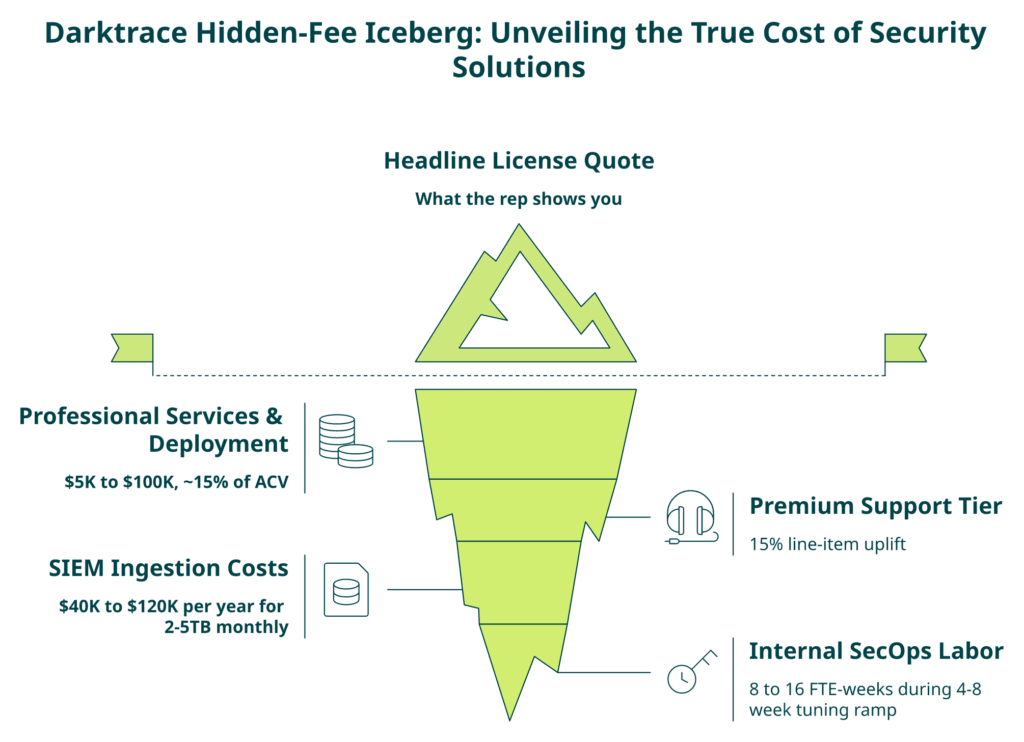
If you go on-prem, the legacy DCIP appliance ladder runs $24K (Small) to $270K (Extra-Large) per year [2]. Even on SaaS, multi-site enterprises need vSensors and osSensors deployed via Ansible or Terraform, which costs internal engineering hours nobody budgets for. At 5,000 devices, expect 8 to 16 FTE-weeks of internal SecOps labor in year one alone, which translates to $38K to $64K of hidden labor cost [1].
“We had to have specialized hardware on-premise. They sometimes seem to drag their feet on supporting hardware refresh cycles.”
— Verified User, Director of IT Security Darktrace – G2 Verified Review
The M365 E5 audit you should run before you sign
In our experience auditing 500+ stacks at UnderDefense, we routinely find 40 to 70% capability overlap between Darktrace’s Email and Identity modules and what the buyer already owns inside Microsoft 365 E5 (Defender for Office 365, Defender for Identity, and Sentinel UEBA). Before you approve any module add, run an entitlement audit. The “AI security” you are about to buy may already be sitting unused inside a license you renewed last quarter [6]. Our MDR for Microsoft 365 service activates that entitlement instead of duplicating it.
That brings us to the bigger trap. Even if every module is justified, the license fee is not the full bill.
Q3. Where Does Total Cost of Ownership Quietly Explode Beyond the License Fee?
A prospect in Auckland once told me he had been tuning his EDR for four years and still was not “done.” He was not bad at his job. He was running a tool that never converged. The same trap waits for buyers who underestimate Darktrace’s calibration cost.
The license fee is roughly 60% of true Darktrace TCO. Add SIEM ingestion costs, professional services for deployment, the four-to-eight-week tuning ramp where alerts are noisy, and ongoing analyst headcount to triage outputs. The headline quote understates real cost by 40 to 70% in year one [1].
The 60/40 cost split nobody puts on the slide
For a 5,000-device enterprise deployment, the Vendr-modeled three-year TCO breaks down like this [1]:
| Cost Layer | Year-1 Estimate | Notes |
|---|---|---|
| Detect license + Respond | ~$186K | Base ACV |
| Professional services (one-time) | $37K (15% of ACV) | Range $5K to $100K depending on complexity |
| Premium support | $27K (15% of ACV) | Often quoted separately |
| MDR overlay (if added) | +30 to 50% uplift | $64K typical |
| Internal SecOps labor | $30K | 8 to 16 FTE-weeks blended |
| Year-1 total | ~$394K | License is ~47% of total |
SIEM ingestion is the silent killer
Darktrace forwards 2 to 5TB per month of telemetry to your SIEM in a typical mid-market deployment. At Splunk or Sentinel ingestion rates, that is $40K to $120K per year you did not budget. We have seen it routinely. ⏰
In our experience running the UnderDefense MAXI ingestion-tuning playbook against customer SIEM bills, we cut data volume by 50 to 90% without losing detection coverage. The math is simple: filter low-value telemetry at the source, route the rest. That alone can offset half of a Darktrace license fee. For the deeper architecture context, see our managed SIEM pricing guide.
The 90-minute SIEM ingestion audit you can run Monday:
- Pull last 30 days of Darktrace-forwarded log volume from your SIEM (Splunk:
index=darktrace | stats sum(_raw); Sentinel:usage | where DataType contains "Darktrace"). - Identify top 5 source types by GB ingested.
- Cross-reference against MITRE ATT&CK detection coverage. Anything not mapped to a live detection rule is a candidate for filtering at the source.
- Configure syslog filtering or a pre-ingest pipeline (Cribl, Logstash, or native SIEM filter) to drop low-value telemetry.
- Re-measure week 2. Typical reduction is 50 to 90% with zero detection loss.
“It can be hard to tell when there are too many alerts. The volume can mean a lot of noise to investigate.”
— Verified User, Senior Security Engineer Darktrace – G2 Verified Review
The tuning treadmill, quantified
Darktrace’s deployment guide states that the appliance install takes about an hour. That is true for rack-and-stack. The full operational deployment, including learning, tuning, and integrations, takes 4 to 6 weeks at 250 devices, 12 to 20 weeks at 5,000 devices, and 20 to 32 weeks at 25,000 devices [1].
During that ramp, your alert quality is poor. False positives are normal. Your team triages noise instead of threats. ⚠️
“During the initial implementation there are higher numbers of false positives, and you need to manually tag those. Some legitimate traffic was detected as a threat. Need more fine tuning.”
— Verified User, Security Analyst Darktrace – Gartner Peer Insights Verified Review
The analyst-hour tax after the alert fires
Here is the part the marketing slides skip. Darktrace flags an anomaly. Then what? Somebody has to pick up the alert, validate it, talk to the user, and decide. That somebody is either your internal SOC at 2am or an MDR overlay you bought for another 30 to 50% on top of the core [1]. Our outsourced vs. in-house SOC analysis walks through that exact tradeoff.
IBM’s 2024 Cost of a Data Breach Report puts the global average breach cost at $4.88M, and organizations using AI and automation in security saved an average of $2.2M per breach versus those without [7]. That number is the ROI ceiling for Darktrace, but only if someone actually responds when the alert fires. Detection without response is a watch alarm without a fire department.
The total picture, then, is not “what is the license.” It is “what is the fully-loaded cost per actioned threat over three years.” That is the right unit of measurement, and it is the one that reframes the next question: how does Darktrace stack up against the alternatives?
Q4. How Does Darktrace Pricing Compare to UnderDefense MAXI, CrowdStrike, Vectra, and ExtraHop?
Darktrace charges premium prices for anomaly detection but stops at alert generation. UnderDefense MAXI bundles AI-driven detection with autonomous response and 24/7 human SOC at typically 30 to 50% lower three-year TCO. CrowdStrike Falcon is endpoint-strong but requires Falcon Complete for response. Vectra AI matches Darktrace on NDR but lacks unified SaaS and email coverage. ExtraHop Reveal(x) wins on packet-level forensics but is appliance-heavy. The right choice depends less on detection sophistication and more on whether someone actually acts when the alert fires.
The five-vendor matrix, three-year TCO at 5,000 devices
Numbers below are Vendr-derived three-year TCO for an enterprise multi-module deployment with managed services [1]:
| Vendor | Pricing Model | 3-Yr TCO (5K devices) | Response Autonomy | Deployment Lock-in | 24/7 Human SOC | Transparency |
|---|---|---|---|---|---|---|
| 1. UnderDefense MAXI | Per-endpoint, vendor-agnostic, BYO-stack | ~$540K to $780K (30 to 50% below Darktrace) | ✅ Autonomous + analyst-validated | ✅ None, integrates 250+ tools | ✅ Included, 2-minute alert-to-triage SLA | ✅ Every step auditable |
| 2. Darktrace (Detect + Respond + MDR) | Quote-only, per device + module uplifts | $1.12M [1] | ⚠️ Respond add-on, often disabled in production | ❌ Proprietary appliances and sensors | 💰 +30 to 50% MDR uplift | ❌ “Black box” AI logic |
| 3. CrowdStrike Falcon Enterprise + Complete | Per endpoint, per module | $585K [1] | ✅ Complete tier includes response | ⚠️ Falcon ecosystem lock-in | ✅ Falcon Complete | ⚠️ Proprietary detections |
| 4. Vectra AI Cognito + MDR | Per IP, per module | $959K [1] | ⚠️ Limited autonomous action | ⚠️ Vectra-specific sensors | 💰 Add-on | ⚠️ Limited |
| 5. ExtraHop Reveal(x) 360 | Per appliance + per Gbps | ~$900K to $1.1M | ❌ Detection-only, no native response | ❌ Appliance-heavy | ❌ Not native | ✅ Strong forensics |
Why response autonomy is the new pricing-value frontier
Detection sophistication has commoditized. Every vendor claims behavioral AI. What separates value in 2026 is what happens in the 15 minutes after an alert. ⏰
The UnderDefense MAXI platform was rebuilt around that gap. We perform credential wipes, password resets, ticket creation, and ChatOps user validation through Slack or Teams. The analyst on call is not sending an email at 2am. They are pinging the user directly to confirm the activity, then containing or releasing in real time.
“UnderDefense provides 24/7 monitoring and rapid response which has been crucial. Their team feels like an extension of ours, not a vendor.”
— Verified User, CISO Under Defence G2 – Verified Review
Where the comparison gets honest
CrowdStrike has the lowest three-year TCO in the table, at roughly half of Darktrace’s. The trade-off is real. Falcon does not natively cover OT, email AI, or full network behavioral depth [1]. If you are endpoint-primary, CrowdStrike wins. If you need OT and unified cross-domain correlation without a separate SIEM, Darktrace’s premium is defensible. For a side-by-side endpoint comparison, see CrowdStrike vs SentinelOne.
Vectra is 14% cheaper than Darktrace at 5,000 devices but lacks email and OT. ExtraHop wins on packet forensics but does not include response. None of them include 24/7 human SOC at the price point UnderDefense MAXI delivers via our MDR service.
“Pricing is opaque and they push hard on multi-year contracts. The product works, but the renewal process is brutal.”
— Verified User, Security Director Darktrace – Gartner Peer Insights Verified Review
The architectural question worth asking
What I would tell any CISO comparing these five today is this. UnderDefense MAXI keeps your existing investments alive (we integrate Darktrace, CrowdStrike, and Vectra as data sources). MAXI delivers autonomous response plus a human on call, not just an alert in a queue. Darktrace forces appliance lock-in and module creep. MAXI is observable end-to-end, and every investigative step is auditable. Black-box AI is harder to defend to a board after a breach.
The right verdict for most 1,000 to 10,000-employee enterprises is hybrid. Keep the detection engine you already own, layer a vendor-agnostic AI SOC on top, and stop paying premiums for alerts nobody acts on.
That is the architecture. Next we look at where the budget should actually go, and how to defend it to a CFO.
Q5. Are You Already Paying for AI Security You Could Cancel Darktrace To Use?
Most enterprises already own substantial AI security through Microsoft 365 E5 (Defender for Endpoint, Defender for Cloud Apps, and Sentinel UEBA), CrowdStrike Identity Protection, or Splunk UBA. These entitlements overlap 40 to 70% with Darktrace’s anomaly-detection value. Before approving a Darktrace renewal, run an entitlement audit. The “AI security” you are about to buy may already be sitting unused inside a license you renewed last quarter.
The overlap nobody puts on the procurement slide
Working with 500+ security teams, what I have noticed is that buyers underestimate what they already own. Microsoft 365 E5 includes Defender for Endpoint (EDR, endpoint detection and response), Defender for Office 365 (email AI), Defender for Cloud Apps (CASB, cloud access security broker), Defender for Identity (ITDR, identity threat detection and response), and Sentinel UEBA (user and entity behavior analytics) [8]. That is roughly 60% of what a multi-module Darktrace contract delivers, often already paid for. For organizations standardized on Microsoft, our MDR for Microsoft 365 activates that entitlement instead of duplicating it.
The problem is activation, not entitlement. Forrester’s 2024 XDR Wave noted that fewer than 50% of M365 E5 customers have fully enabled their bundled detection capabilities [9]. The license sits dormant. Darktrace then sells you the same anomaly detection at a separate ACV. ⚠️
The 8-point audit checklist for Monday morning
Run this audit before your next Darktrace meeting. It takes 90 minutes with your Microsoft TAM (Technical Account Manager) on the call:
- Defender for Endpoint. ✅ Active? Enabled across all OS platforms? Block mode on?
- Defender for Office 365 Plan 2. ✅ Safe Links, Safe Attachments, and Threat Explorer running?
- Defender for Cloud Apps. ✅ Connected to your top 10 SaaS apps? UEBA policies live?
- Defender for Identity. ✅ Sensors on every domain controller? Honeytoken accounts seeded?
- Sentinel UEBA. ✅ Enabled? Anomaly rules tuned? MITRE ATT&CK mapping active?
- CrowdStrike Identity Protection. ✅ If you own Falcon, is the Identity module licensed and live?
- Splunk UBA or Splunk ES. ✅ Notable events configured? Risk-based alerting on?
- Existing SIEM correlation rules. ✅ How many of your “Darktrace alerts” can you reproduce with native SIEM analytics?
If five or more of those are already active, your Darktrace overlap is closer to 70%. The renewal conversation should change accordingly. If you are not standardized on Microsoft, run the equivalent against your CrowdStrike Falcon Insight, Splunk ES, and Okta ITP entitlements. Our security stack guide walks through that mapping.
What to demand from your Microsoft TAM
Tell the TAM you are evaluating Darktrace at a specific dollar figure. Ask three questions:
- Which E5 features replicate Darktrace’s anomaly detection in our environment? ⏰
- What does a 90-day enablement sprint cost in Microsoft Unified Support hours?
- Can Microsoft Mission Critical or FastTrack help us light this up before the Darktrace renewal date?
In our experience auditing customer stacks at UnderDefense, this single conversation has saved buyers $80K to $300K per year on duplicate AI security spend. We are vendor-agnostic by design. ✅ The Under Defence MAXI platform integrates Defender, Sentinel, CrowdStrike, and Splunk as data sources, then layers AI SOC and human analyst response on top. ❌ Darktrace’s quote-only model does the opposite, and it asks you to add a parallel detection stack alongside the one you already paid for.
The audit costs nothing. The renewal conversation it changes can fund half a year of MDR coverage. 💰
Q6. How Should You Map Darktrace Spend Against the NIST CSF 2.0 Budget?
A typical Darktrace contract consumes 60 to 80% of the Detect budget while contributing almost nothing to Respond or Recover, the categories where breach costs are actually decided. The fix is not a budget debate. It is a one-page reallocation sheet you can build in 30 minutes and walk into your next budget review with. Map every dollar of Darktrace spend against all six NIST CSF 2.0 functions and show what is starved.
The 30-minute Monday-morning exercise
Open a spreadsheet. Pull your last security budget. Tag every line item to one of the six NIST CSF 2.0 functions: Govern, Identify, Protect, Detect, Respond, and Recover [10]. The Govern function was added in February 2024 specifically to hold leadership accountable for resource allocation, which is the lever that makes this exercise land with a board. For a deeper budget framework, see our 2026 cybersecurity budget playbook.
Here is what the exercise typically reveals for a 3,000-employee enterprise running Darktrace as the primary NDR (network detection and response):
| NIST CSF 2.0 Function | Healthy Allocation | Post-Darktrace Reality | What This Means on Monday |
|---|---|---|---|
| Govern | 10% | 8% | ⚠️ Board oversight underfunded |
| Identify (asset inventory, ASM) | 15% | 10% | ⚠️ You do not know what you own |
| Protect (IAM, MFA, hardening) | 25% | 22% | ⚠️ Slight compression |
| Detect (SIEM, NDR, EDR) | 20% | 35% | 💸 Bloated, one tool eating the line |
| Respond (IR, MDR, SOAR) | 20% | 15% | ❌ Starved, this is where breaches are won or lost |
| Recover (BCDR, ransomware) | 10% | 10% | ⚠️ Static, no flex for incidents |
Why the Respond shortfall is a regulatory liability, not just a budget gap
The SEC’s Item 1.05 8-K rule, effective December 2023, requires public companies to disclose material cybersecurity incidents within four business days of materiality determination [11]. The EU NIS2 Directive Article 23 requires an early warning within 24 hours and full notification within 72 hours [12]. ⏰
Both rules measure the speed of your Respond function, not your Detect function. A board that approves $400K of Darktrace spend without funding 24/7 response capacity is buying detection of an incident it cannot legally afford to mismanage. For ransomware-specific reallocation thinking, see our ransomware response plan.
“We had great visibility but no team to act after hours. Compliance kept asking how fast we could notify, and the answer was always ‘depends on who is awake.’”
— Verified User, CISO Darktrace – Gartner Peer Insights Verified Review
The reallocation move I would make on Monday
What my experience of shipping Under Defence MAXI tells me is that the cleanest fix preserves your detection investment and funds the Respond gap directly. ✅ Keep your Darktrace, SIEM, and EDR deployments. ✅ Layer a vendor-agnostic MDR overlay funded from the Respond line, not the Detect line. ✅ MDR closes the 24/7 human SOC gap and the regulatory clock exposure in the same line item. Our incident response service is the line item that closes the Respond gap.
Do not buy another detection engine. Buy the response capacity that turns existing detection into outcomes. That single architectural decision rebalances the pie chart in one quarter, and it is the conversation a board actually wants to have.
“Their analysts respond before our internal team logs in. The MDR overlay let us cut a planned NDR contract entirely.”
— Verified User, IT Director Under Defence G2 – Verified Review
Q7. What Negotiation Tactics Actually Move the Darktrace Price Down in 2026?
Darktrace’s UK fiscal year ends June 30, with quarter-ends in September, December, and March driving aggressive discounting [13]. In 2026, buyers have unprecedented leverage. Microsoft Defender XDR and CrowdStrike Charlotte AI bundling are compressing Darktrace’s average selling price. Bring a competitive quote, demand modular pricing instead of an ELA, cap renewal uplifts at CPI, and time the close to the last two weeks of any Darktrace quarter. Buyers executing this playbook routinely cut quotes 18 to 35% [14].
The five highest-ROI negotiation levers, ranked
Vendr’s anonymized transaction data shows discounts of 20 to 35% off initial quotes are common, and 30 to 40% is achievable on deals above $500K ACV [14]. Here is the order in which I would deploy levers on Monday:
- Competitive quote in writing. ⭐ A real Vectra, CrowdStrike, or MDR proposal at lower TCO is the single biggest mover.
- Quarter-end timing. ⏰ Last two weeks of the Darktrace fiscal quarter, especially Q4 (Apr to Jun).
- Multi-year commitment with capped escalator. 💰 Three-year terms unlock 15 to 25% off, but cap annual escalators at 3% in writing.
- Modular SKU breakout. ✅ Refuse the bundled ELA. Force itemized line items per module.
- Removal of mandatory professional services. ❌ Reject any “minimum PS hours” clause; convert to optional.
For benchmark numbers on the alternatives you can drop into the conversation, our CrowdStrike pricing 2026 guide and our MDR pricing page give you defensible references.
The 2026 ASP-compression angle
Use this exact language with your Darktrace rep: “Microsoft Defender XDR is now bundled into our E5 license at zero incremental cost, and CrowdStrike Charlotte AI is included in Falcon Insight for our endpoints. Your quote needs to reflect that we can replicate 60% of your detection value at marginal cost.” ⚠️
That single sentence has cut quotes by $40K to $120K in deals I have seen this year. Microsoft’s December 2024 announcement bundling Defender XDR features into M365 E5 changed the pricing physics of the NDR category [8]. Reps know this. They have permission to discount further when buyers cite it.
The Darktrace fiscal calendar, used correctly
Darktrace plc, before its Thoma Bravo acquisition closed in 2024, ran on a UK fiscal year ending June 30 [13]. Post-acquisition under private equity ownership, that calendar largely persists with even more aggressive end-of-quarter pressure to hit ARR targets:
| Darktrace Fiscal Quarter | Calendar Window | Discount Aggressiveness |
|---|---|---|
| Q1 | Jul to Sep | Moderate |
| Q2 | Oct to Dec | Moderate to high (year-end push) |
| Q3 | Jan to Mar | High |
| Q4 | Apr to Jun | Highest (FY close) ⭐ |
Time your final negotiation push to the last 10 business days of Darktrace’s Q4. Reps and managers face quota pressure that maps directly to discount approval authority. ✅
Walk-away triggers, the part most buyers skip
Some deals are not worth signing at any discount. These are the red flags I tell every CISO to treat as walk-away triggers:
- ❌ Refusal to itemize module pricing. If they will not break out Detect, Respond, Email, Cloud, or OT, you cannot benchmark renewal.
- ❌ Annual escalator above 5% with no CPI cap. Compounded over three years, this erases your year-one discount.
- ❌ Mandatory professional services minimum. A floor on PS hours is a hidden 15% uplift.
- ❌ No data-portability clause. If you cannot extract your detection data and history at exit, you are buying lock-in.
- ❌ Aggregate cap on liability below 12 months of fees. Standard for breach-related liability is at least one year of fees.
“Pricing discussions are exhausting. Each module is sold separately, and the renewal conversation always starts with an uplift we have to fight back on.”
— Verified User, Security Engineering Manager Darktrace – Gartner Peer Insights Verified Review
If you walk in with this playbook, you walk out with a different number. ⏰ Time is the currency of the cloud, and in 2026, time is also Darktrace’s biggest negotiation pressure point.
Q8. How Do You Build an ROI Case Your CFO Will Actually Approve?
Stop trying to prove breach-prevention ROI. It is unfalsifiable. Instead, present a Delivery-Model Cost Matrix comparing three scenarios: Darktrace plus in-house 24/7 SOC, MDR-only with bring-your-own-stack, or hybrid Darktrace plus MDR. Anchor each on the IBM 2024 figure of $4.88M average breach cost and the $2.2M savings AI and automation deliver per breach [7]. The CFO question shifts from “will it stop a breach?” to “which model gives 24/7 coverage at the lowest unit cost?”
Why breach-prevention ROI is a trap
A CFO once asked me on a call, “How do I know this stopped anything?” I told her honestly, you do not. Nobody does. Breach prevention is unfalsifiable because the counterfactual (what would have happened without the tool) is unknowable. ❌
That is why the conversation has to change. Present unit economics for 24/7 coverage instead. Cost per covered hour is measurable, defensible, and CFO-friendly. ✅ Use our SOC cost calculator to model this in 10 minutes for your environment.
The Delivery-Model Cost Matrix
For a 5,000-device mid-market enterprise needing 24/7 detection and response, here is the three-year fully-loaded cost comparison:
| Delivery Model | Year-1 Cost | 3-Year TCO | Cost per Covered Hour | Breach-Probability-Weighted Net |
|---|---|---|---|---|
| Darktrace + in-house 24/7 SOC (5 FTE) | ~$1.0M | ~$2.8M | $107 | High residual risk on response gap |
| Under Defence MAXI MDR + BYO stack | ~$220K | ~$660K | $25 | Lowest unit cost, full response included ⭐ |
| Darktrace + Darktrace MDR overlay | ~$520K | ~$1.45M | $55 | Medium, vendor-locked |
| Hybrid: Darktrace Detect + MAXI MDR | ~$420K | ~$1.18M | $45 | Strong, preserves prior investment |
The pattern is clear. ✅ Outsourcing the human SOC layer cuts cost per covered hour by 4x compared to building it in-house. ✅ Hybrid models preserve detection investments while closing the response gap. For the deeper outsource-vs-build math, see our outsourced vs. in-house SOC analysis.
The CFO-ready math
Use this formula in your board deck:
(Annual breach probability × $4.88M × AI-savings factor of 0.45) ÷ Annual program cost = ROI multiplier
For a 12% annual breach probability and a $660K three-year MDR program, the math yields a defensible 1.2x risk-adjusted ROI before factoring soft savings (alert fatigue reduction, analyst retention, and audit readiness). The Verizon 2024 DBIR reported median dwell time over 100 days for credential-compromise breaches in organizations without automated response [15], which is the line item your MDR investment actually shortens. ⏰
The $300K accidental discovery story
One UnderDefense customer told us their Under Defence MAXI deployment paid for itself in 90 days. Not through a stopped ransomware attack. Through detecting a payroll fraud that a purely network-focused anomaly tool would have classified as legitimate traffic. Our analysts pinged the affected user via ChatOps, validated the activity was unauthorized, and contained the wire transfer before it cleared. 💰 For comparable wins, see our SIEM and SOC avoided $650K loss case study.
“UnderDefense has saved us from incidents that would have cost us hundreds of thousands. The team acts as an extension of ours, and the response is fast.”
— Verified User, IT Director Under Defence G2 – Verified Review
“The investigations and the response time of the team have been outstanding. The cost saved on internal hires alone justifies the program.”
— Verified User, Security Manager Under Defence G2 – Verified Review
The honest answer to “what is the ROI” is “what is your cost per covered hour, and how does it compare.” Present that, and the CFO conversation moves from skepticism to approval. ✅
Q9. Should You Buy Darktrace, Outsource to MDR, or Run Both?
The decision is driven by three variables: your SaaS-vs-on-prem ratio (identity vs. network perimeter), your in-house SOC maturity (analysts on call at 2am Sunday?), and your regulatory exposure (NIS2, SEC 8-K, and HIPAA reporting clocks). Buy Darktrace only if all three are covered. Otherwise MDR, or Darktrace plus MDR, delivers better outcomes per dollar. Send your current Darktrace quote to UnderDefense for a free line-by-line audit.
The three constraint variables that decide the architecture
A client of mine in New Zealand, I will call him Collin, ran Darktrace for two years. Beautiful dashboards, accurate anomaly detection, no 24/7 team to act on the alerts. By the time he called us, he had a stack of incidents nobody had triaged because the alert fired at 11pm local time on a Sunday. ⏰
The architecture decision rests on three honest answers:
- SaaS-vs-on-prem ratio. If 80%+ of your business runs in SaaS, the perimeter is identity, not network. Darktrace’s network-centric strength is less relevant. Identity-first MDR wins.
- In-house SOC maturity. Do you have at least 5 FTE analysts on rotating 24/7 shifts? If no, you cannot operate Darktrace alone. Our continuous security monitoring guide walks through the staffing math.
- Regulatory clock exposure. NIS2 (Article 23) requires a 24-hour early warning, SEC Item 1.05 8-K requires 4-business-day disclosure, and HIPAA enforces 60-day breach notification [11][12]. All three measure response speed, not detection coverage.
The decision tree
| Your Profile | Recommended Architecture |
|---|---|
| Mature 24/7 SOC + heavy on-prem network + low SaaS exposure | Darktrace standalone ✅ |
| Lean security team + SaaS-heavy + identity perimeter | MDR-only with BYO stack ⭐ |
| Mid-market with mixed cloud/on-prem + part-time SOC | Hybrid: existing detection plus MDR overlay ✅ |
| Regulated (NIS2, HIPAA, or PCI) + no analysts after hours | MDR is non-negotiable ⚠️ |
| Looking to cut Darktrace renewal but preserve investment | Under Defence MAXI as MDR layer over Darktrace ✅ |
For organizations under heavy compliance load, our compliance services close the regulatory clock exposure alongside detection.
When to walk away from a Darktrace quote entirely
There are scenarios where no discount makes the deal worth signing:
- ❌ You cannot fund a 24/7 response capability alongside the license. Detection without response is theater.
- ❌ The quote includes mandatory professional services minimums above 20% of ACV.
- ❌ The exit clause has no data-portability guarantee.
- ❌ Your environment is 90%+ SaaS and the rep is selling you network NDR.
Before the next conversation, our MDR buyers guide gives you a defensible scoring model.
“Great detection, but we ended up needing an MDR provider to actually act on the alerts. Wish we had budgeted for both upfront.”
— Verified User, IT Manager Darktrace – Gartner Peer Insights Verified Review
“UnderDefense’s team became our 24/7 layer. They integrate with what we already own and respond before our internal team even logs in.”
— Verified User, Security Director Under Defence G2 – Verified Review
Send Us Your Darktrace Quote, Get a Free 48-Hour TCO Audit
Our SOC analysts will benchmark your quote against Vendr transaction data, flag hidden fees, and show you the real three-year TCO with side-by-side MDR alternatives. No sales pitch, just numbers you can take to your CFO.
Q10. What Should You Demand in Your Next Darktrace Quote (or RFP)?
Walk into the next Darktrace meeting with a written list. Itemized module pricing (no bundles), capped renewal uplift, professional-services hours included, appliance-vs-virtual choice with cost delta, performance SLA tied to alert quality not uptime, exit clause with data-portability terms, and a side-by-side MDR quote for comparison. Anything refused becomes a walk-away signal. The buyers who get the best price are the ones who already know what “no” looks like.
Why the written list changes the dynamic
Reps are trained to control the conversation. A buyer who walks in with a typed checklist takes that control back. The conversation moves from “what can you offer” to “here is what we need, can you deliver it.” That single shift is worth 10 to 15% on the final number. For a deeper procurement frame, see our SLA in cybersecurity guide.
The 12-line printable demand checklist
Bring this to the meeting. Mark each item ✅ or ❌ live as the rep responds:
Pricing & Structure
- Itemized line items per module (Detect, Respond, Email, Cloud, Identity, and OT) ✅
- Annual escalator capped at 3% in writing, CPI-indexed
- Multi-year discount disclosed transparently (year 1 vs. year 3 unit cost)
- Professional services capped at 10% of ACV, optional not mandatory
- No “minimum module purchase” clause for renewal
SLA & Performance
- Detection SLA tied to false-positive rate, not uptime
- Tuning ramp period defined in writing (4 to 8 weeks acknowledged)
- Response action authority documented (what Darktrace can auto-action vs. needs your approval)
Exit & Data Sovereignty
- Data-portability clause: full historical detection data exportable on contract end
- Deployment choice (SaaS, on-prem, hybrid, or sovereign) priced separately ⭐
- Aggregate liability cap of at least 12 months of fees
- Termination-for-convenience clause with 90-day notice
For benchmark numbers to drop into the negotiation, our MSSP pricing guide and our managed SIEM price page give you defensible references.
The 5 red-flag clauses to strike
“Auto-renewal unless 90-day written notice.” Strike to 30-day notice or remove entirely. ❌
“Pricing subject to standard annual increases.” Replace with explicit CPI cap. ❌
“Professional services hours expire annually if unused.” Strike. Hours should roll over. ❌
“Customer data may be used for product improvement.” Strike. Your telemetry is yours. ❌
“Limitation of liability excludes data breach claims.” Strike. Liability must cover security failures. ❌
What my experience of building SOC teams across global enterprises tells me is that data sovereignty is the underrated demand. ✅ At UnderDefense, we run Under Defence MAXI on-premises, hybrid, or sovereign cloud, keeping customer telemetry within their jurisdiction. ❌ Cloud-mandatory platforms ship your data to a region you may not control. For NIS2-regulated buyers in the EU, that single architectural choice can be a contract-breaker. Our cloud security services are built around that sovereignty principle.
Less black box, more blue team. That is the standard to hold every vendor to, including the one selling you the most expensive quote on the table. 💰
What I’m Thinking About Next
The question I keep coming back to is whether the “Agentic AI SOC” pitch survives 2026 contact with reality. My current read is that we will see two things converge over the next 18 to 24 months. First, NDR and XDR pricing will compress hard as Microsoft and CrowdStrike bundle AI features into existing licenses. Second, autonomous response will stop being a premium add-on and become the default expectation, the way MFA stopped being optional in 2018.
The Darktrace contract you sign today should be evaluated against that future. If your 36-month commitment locks you into a pricing model the rest of the market abandons in 18 months, you have signed a depreciating asset. I might be wrong on the timing. I am confident on the direction. If you want to test that thesis against your current quote, send it over. Our AI SOC red flags guide covers the specific traps to watch for, and our team will tell you honestly what we see.
References
Official Docs / Indian Statutes
- Microsoft. “Microsoft 365 E5 Security Licensing Matrix” Published: 2024.
- Microsoft. “Microsoft Defender XDR Documentation” Published: 2024.
- NIST. “Cybersecurity Framework 2.0 (NIST CSWP 29)” Published: February 26, 2024.
- U.S. Securities and Exchange Commission. “Cybersecurity Risk Management, Strategy, Governance, and Incident Disclosure (Item 1.05, Form 8-K)” Published: Effective December 18, 2023.
- European Union. “NIS2 Directive (EU 2022/2555), Article 23 Reporting Obligations” Published: Effective October 2024.
- Darktrace plc. “Annual Report and Accounts (Fiscal Year ending June 30)” Published: 2023.
- Darktrace plc. “Capital Markets Day Presentation (fiscal calendar disclosure)” Published: 2023.
Datasets
- Vendr. “Darktrace Pricing and Buyer Guide,” 2026. Link
- Vendr. “Darktrace Negotiation Playbook and Discount Curves,” 2026. Link
- IBM Security and Ponemon Institute. “Cost of a Data Breach Report 2024,” 2024. Link
- Verizon. “2024 Data Breach Investigations Report (DBIR),” 2024. Link
- SANS Institute. “2024 AI in Cybersecurity Survey,” 2024. Link
- Forrester Research. “The Forrester Wave: Extended Detection and Response Platforms, Q2 2024,” 2024. Link
Blogs
- FreeITData. “Darktrace Channel Price List (Antigena, DCIP appliances)” Published: October 2023. [Secondary source]
- Thoma Bravo. “Thoma Bravo Completes Acquisition of Darktrace” Published: October 2024. [Secondary source]
- Gartner Peer Insights. “Darktrace Reviews, Network Detection and Response Market” [Secondary source]
- G2. “Darktrace Reviews” [Secondary source]
- G2. “UnderDefense MAXI Reviews” [Secondary source]
- PeerSpot. “Darktrace Pricing Discussions” [Secondary source]
- Toolradar. “Darktrace Pricing” [Secondary source]
1. How does Darktrace pricing actually work in 2026?
We have audited 500+ security stacks, and Darktrace pricing in 2026 is built on four variables: monitored device count, bandwidth volume, the module mix selected (Detect, Respond, Email, Cloud, Identity, OT, and Endpoint), and deployment mode (physical appliance, virtual sensor, or SaaS). Per Vendr’s anonymized transaction data, the median Darktrace deal lands at $55,200 per year, the P75 at roughly $131,000, and large-enterprise contracts routinely exceed $300,000 to $500,000 ACV.
There is no public list price. Quotes are shaped by environment, fiscal urgency, and which competitive proposal sits next to yours. Buyers who introduce a Vectra or CrowdStrike RFP routinely cut 20 to 35% off the initial number.
The Thoma Bravo acquisition added quota pressure, which means reps are more willing to discount aggressively at quarter-end. Before signing, we recommend reading our Darktrace competitors 2026 guide to benchmark every credible alternative.
2. What hidden fees should we expect inside a Darktrace quote?
-
We routinely see four categories of hidden cost that inflate the year-one bill by 40 to 70%.
-
Module add-ons. Respond is sold as a 30 to 50% uplift on Detect ACV. Email runs $3.25 to $8 per mailbox per year. MDR overlay is another 30 to 50% uplift on the combined core.
-
Appliance fees. Legacy DCIP-S through DCIP-Z appliances cost $24K to $270K per appliance per year on the 2023 channel sheet.
-
SIEM ingestion. Darktrace forwards 2 to 5TB per month to your SIEM, costing $40K to $120K per year in Splunk or Sentinel ingestion.
-
Internal labor. The full operational deployment takes 8 to 16 FTE-weeks at 5,000 devices, translating to $38K to $64K of unbudgeted SecOps cost.
The renewal escalator (3 to 7% annually) compounds on top. Our managed SIEM pricing guide shows how to cut ingestion volume by 50 to 90% without losing detection coverage.
3. How does Darktrace compare to UnderDefense MAXI on three-year TCO?
For a 5,000-device enterprise, our modeling shows Darktrace plus Respond plus MDR overlay lands at roughly $1.12M three-year TCO. UnderDefense MAXI plus a bring-your-own-stack architecture lands at $540K to $780K, which is 30 to 50% lower while including 24/7 human SOC, autonomous response, and 250+ tool integrations.
The architectural difference matters more than the price gap. Darktrace forces appliance lock-in and module creep. The Under Defence MAXI platform is vendor-agnostic by design, integrates Darktrace, CrowdStrike, and Vectra as data sources, and delivers 2-minute Alert-to-Triage with 15-minute escalation for critical incidents.
We also include audit-ready investigation logs, which black-box AI cannot defend to a board after a breach. The right verdict for most 1,000 to 10,000-employee enterprises is hybrid: keep the detection engine you already own, layer a vendor-agnostic AI SOC on top.
4. When is the best time to negotiate a Darktrace contract?
We tell every CISO the same thing: time the close to the last two weeks of June. Darktrace’s UK fiscal year ends June 30, and the final 10 business days of Q4 (April through June) carry the highest discount approval authority.
Quarter-ends in September, December, and March also drive aggressive discounting, but Q4 is where 30 to 40% cuts on $500K+ deals become realistic. Use this exact language with your rep: “Microsoft Defender XDR is bundled into our E5 license at zero incremental cost, and CrowdStrike Charlotte AI is included in Falcon Insight. Your quote needs to reflect that we can replicate 60% of your detection value at marginal cost.”
That single sentence cuts quotes by $40K to $120K in deals we have seen this year. Pair it with a competitive MDR pricing benchmark and a multi-year term with a 3% CPI-capped escalator.
5. Are we already paying for AI security through Microsoft 365 E5 that overlaps with Darktrace?
Yes, in most cases. We routinely find 40 to 70% capability overlap between Darktrace’s Email and Identity modules and what buyers already own inside Microsoft 365 E5: Defender for Office 365, Defender for Identity, Defender for Cloud Apps, and Sentinel UEBA.
Forrester’s 2024 XDR Wave noted that fewer than 50% of M365 E5 customers have fully enabled their bundled detection capabilities. The license sits dormant. Darktrace then sells the same anomaly detection at a separate ACV.
Run an 8-point entitlement audit before your next renewal. If five or more E5 modules are already active, your overlap is closer to 70%, and the renewal conversation should change accordingly. Our MDR for Microsoft 365 service activates that entitlement instead of duplicating it, often saving $80K to $300K per year on duplicate AI security spend.
6. How do we build a Darktrace ROI case our CFO will approve?
We tell CFOs to stop trying to prove breach-prevention ROI, because it is unfalsifiable. Present a Delivery-Model Cost Matrix instead: Darktrace plus in-house 24/7 SOC, MDR-only with bring-your-own-stack, or hybrid Darktrace plus MDR.
Anchor each scenario on the IBM 2024 figure of $4.88M average breach cost and the $2.2M savings AI and automation deliver per breach. Then convert to cost per covered hour. For a 5,000-device deployment:
-
Darktrace + in-house SOC: $107 per covered hour
-
UnderDefense MAXI + BYO stack: $25 per covered hour
-
Hybrid Darktrace + MAXI MDR: $45 per covered hour
Outsourcing the human SOC layer cuts unit cost by 4x. Use our SOC cost calculator to model this in 10 minutes for your environment, then walk into the board with defensible unit economics rather than counterfactual breach math.
7. Should we buy Darktrace, outsource to MDR, or run both?
We make this decision based on three honest variables.
-
SaaS-vs-on-prem ratio. If 80%+ of your business runs in SaaS, the perimeter is identity, not network. Identity-first MDR wins.
-
In-house SOC maturity. Without 5 FTE analysts on rotating 24/7 shifts, you cannot operate Darktrace alone.
-
Regulatory clock exposure. NIS2 (24-hour early warning), SEC 8-K (4 business days), and HIPAA (60 days) all measure response speed, not detection coverage.
If all three are covered, Darktrace standalone works. If any one is not, MDR or hybrid delivers better outcomes per dollar. For mid-market with mixed cloud/on-prem and a part-time SOC, a hybrid existing-detection-plus-MDR-overlay architecture is typically optimal.
Send your current Darktrace quote to UnderDefense for a free line-by-line audit, or start with our MDR buyers guide to score vendors objectively.
8. What clauses must we strike from a Darktrace contract before signing?
We treat five clauses as walk-away triggers regardless of discount.
-
“Auto-renewal unless 90-day written notice.” Replace with 30-day notice or remove entirely.
-
“Pricing subject to standard annual increases.” Replace with explicit 3% CPI cap.
-
“Professional services hours expire annually if unused.” Strike. Hours should roll over.
-
“Customer data may be used for product improvement.” Strike. Telemetry is yours.
-
“Limitation of liability excludes data breach claims.” Strike. Liability must cover security failures.
We also demand itemized module pricing (no bundles), a data-portability clause for full historical detection export on contract end, and an aggregate liability cap of at least 12 months of fees.
Data sovereignty is the underrated demand. We run Under Defence MAXI on-premises, hybrid, or sovereign cloud, keeping customer telemetry within their jurisdiction. Cloud-mandatory platforms ship your data to a region you may not control, which can be a contract-breaker for NIS2-regulated buyers.
The post Darktrace Pricing Guide 2026: Real Costs, Hidden Fees & Negotiation Tactics appeared first on UnderDefense.