Here’s a scenario all security and compliance teams know well: a new enterprise prospect sends over a 200-question security questionnaire. Your team has answered 180 of those questions before. For the last prospect, and the one before that. You spend two weeks collecting evidence, formatting responses, and chasing internal stakeholders for sign-off. You submit the questionnaire. The deal closes. Three months later, another prospect sends an almost identical questionnaire in a different format, mapped to a different framework.
You do it all again.
Source: Troy Fine
This is a compliance theater. It generates effort without generating trust. In 2026, with supply chain risk at the top of every regulatory agenda and third-party ecosystems growing faster than teams can manage them, it is no longer a sustainable way to operate.
There is a better model. It is called a Trust Center. When it is powered by a modern GRC platform, it improves security assurance by replacing a reactive, labor-intensive process with a permanent, scalable competitive advantage.
In this article, you will learn:
- why questionnaire-based assurance breaks at scale,
- how a Trust Center paired with a modern GRC platform replaces repetitive, manual questionnaire cycles with continuously verified evidence, the concrete time and cost benefits for vendors, procurement teams, and GRC teams,
- a practical, step-by-step starter plan to publish a living Trust Center and measure its ROI.
The Broken Economics of Questionnaire-Based Trust
Security questionnaires became the default mechanism for third-party assurance for a simple reason: they were easy to distribute and easy to customize. Every procurement team, every enterprise buyer, every regulatory auditor could build their own list and send it to every vendor they touched. The result was a system that felt like due diligence because it generated volume. It does not scale.
The numbers tell the story that most teams already feel in their bones:
| Hidden Cost | Per Questionnaire | At Scale (50 vendors/year) |
| Security team hours | 8–12 hours | 400–600 hours |
| Legal / compliance review | 2–4 hours | 100–200 hours |
| Follow-up clarifications | 3–6 hours | 150–300 hours |
| Evidence re-collection | 4–8 hours | 200–400 hours |
| TOTAL | 17–30 hours | 850–1,500+ hours |
That’s an administrative burden that grows linearly with your vendor relationships and gives buyers a point-in-time snapshot that’s already outdated the moment you submit it.
And the buyers aren’t winning either. They’re reviewing inconsistent responses, interpreting subjective answers, and making risk assessments based on information they can’t verify independently.
A questionnaire tells you what an organization claims about its security at a single point in time. A Trust Center powered by a GRC platform tells you what their controls actually look like right now. Verified. Continuously maintained.
What a Trust Center Actually Is and Why the Definition Matters
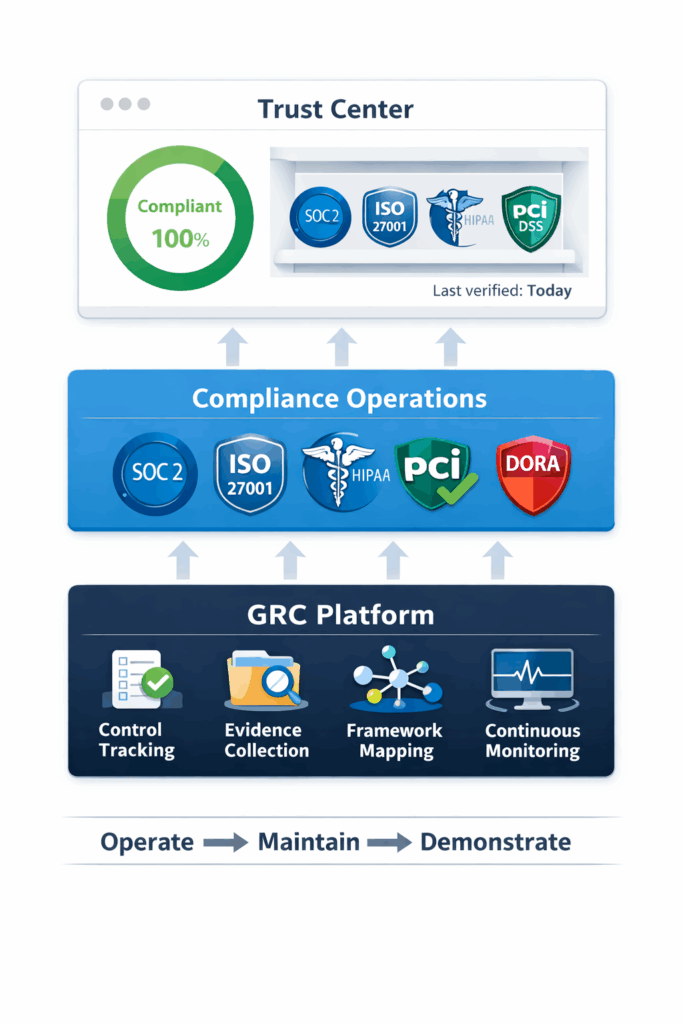
A Trust Center is a centralized, always-available hub where organizations proactively share verified security and compliance information with any stakeholder who needs it. Instead of responding to individual questionnaires, you publish once and let buyers, partners, regulators, and prospects access exactly what they need. On their timeline, not yours.
A mature Trust Center typically surfaces:
- Active certifications and third-party attestations (SOC 2 Type II, ISO 27001, PCI DSS, HIPAA, etc.)
- Security and compliance policies in accessible, non-confidential form
- Control descriptions and governance practices, organized by domain
- Audit results and most recent compliance status
- Subprocessor lists and supply chain transparency data
- Incident disclosure and response history where applicable
But here’s the distinction that separates a Trust Center from a static document library: a real Trust Center is a live, continuously updated view of your security posture. And that requires something to power it.
💡 The Critical Distinction: A Trust Center that is not connected to a live GRC platform is just a website with old PDFs. The moment your controls change, your certifications lapse, or a new framework requirement appears, a static Trust Center becomes misleading. That is more damaging than no Trust Center at all. Currency is the whole point.
Why Trust Centers and GRC Platforms Are Inseparable
A Trust Center on its own goes stale. Without a system continuously maintaining the information behind it, transparency loses credibility. Fast. A certification that expired six months ago, a policy last updated in 2023, or a control status that no longer reflects reality does not build trust. It destroys it.
This is where GRC platforms become the engine behind the Trust Center.
Modern GRC platforms maintain a living view of your entire Information Security Management System. They track controls and evidence continuously. They map controls across multiple frameworks automatically. They surface regulatory changes as they occur. And they ensure that what your Trust Center shows stakeholders matches what is actually happening inside your organization. When a Trust Center is powered by a GRC platform, it becomes an extension of operational reality.
The Framework Mismatch Problem and How to Solve It Once
One of the most persistent challenges in third-party risk management is framework misalignment. Your organization runs under ISO 27001. Your largest enterprise customer assesses risk using NIST CSF. Your EU customers cite NIS2. A financial services partner wants DORA alignment. A healthcare buyer needs HIPAA mapping.
Traditionally, each of these mismatches triggers a separate questionnaire and a separate manual effort to translate your controls into the language the requestor expects. Your team is not doing new security work. They are doing translation work, over and over, for the same underlying controls.
Trust Centers backed by modern GRC platforms solve this problem at the root.
Maintain Once. Present in Any Framework
A well-structured GRC platform maps your controls across frameworks automatically. Your SOC 2 CC6.1 control connects to ISO 27001 A.9.4, to NIST CSF PR.AC-4, and to NIS2 Article 21 measures. The platform maintains that mapping continuously. Nobody builds it manually.
What this means in practice:
- Your controls don’t change when a new framework request arrives
- Your Trust Center can present the same underlying security posture through the lens each stakeholder expects
- Your team stops answering the same question reframed seventeen different ways
The shift from saying “we support X framework” to “we continuously maintain controls that satisfy all of these frameworks simultaneously” is exactly the kind of proof that sophisticated buyers and regulators are looking for in 2026.
Questionnaires vs. Trust Centers: A Direct Comparison
If you’re making the case internally for a Trust Center investment, this is the table that tends to land with leadership:
| Dimension | ❌ Security Questionnaires | ✅ Trust Center + GRC Platform |
| Availability | On request, per cycle | Always-on, self-service |
| Freshness | Point-in-time snapshot | Continuously updated |
| Framework coverage | One framework per response | Mapped across all frameworks |
| Vendor effort | High: manual, repetitive | Low: publish once, reuse always |
| Buyer confidence | Subjective, hard to verify | Audit-backed, verifiable |
| Scalability | Breaks under vendor growth | Scales with ecosystem |
| Team cost | GRC team on questionnaire duty | GRC team focused on risk |
How UnderDefense MAXI Compliance Powers a Living Trust Center
The trust center model only works if the compliance engine behind it is reliable, current, and genuinely automated. That’s exactly what UnderDefense MAXI Compliance was built to be.
UnderDefense MAXI Compliance gives organizations the infrastructure to move from reactive, questionnaire-driven assurance to a continuous, proactive security posture. Stakeholders can verify it themselves. They never have to ask.
Real-Time Compliance Posture as the Foundation
The UnderDefense MAXI Compliance dashboard provides a live, always-current view of control status across every active framework in your program. Every control category, every mapped requirement, every evidence artifact is organized exactly the way auditors and enterprise buyers expect to see it.
When a prospect asks “what frameworks do you support?” the answer isn’t a PDF attachment. It’s a Trust Center link that shows real compliance posture, maintained automatically, timestamped and verifiable.
Auto Evidence Collection: The Engine That Keeps It Current
The reason most Trust Centers go stale is that someone has to manually update them. Evidence expires, certifications renew, controls change. Unless a person actively tracks and updates every artifact, the Trust Center drifts away from reality.
UnderDefense MAXI Compliance fixes this by integrating directly with the tools your organization already runs. AWS, Google Workspace, Microsoft 365, Azure, and more. It continuously pulls auditor-approved evidence through Auto-Checks, without anyone having to gather it manually. Every integration runs continuously. Every check is timestamped. Every result is structured exactly the way auditors and enterprise buyers expect.
When an auto-check fails, meaning a control has drifted from its expected state, the platform surfaces it immediately. Your team can create a remediation task, assign it to the right owner, and track it to closure. The Trust Center stays accurate because the underlying controls are actively monitored, not passively assumed.
Framework-Agnostic Coverage Without the Manual Mapping
UnderDefense MAXI Compliance maintains control mappings across SOC 2, ISO 27001, HIPAA, PCI DSS, GDPR, NIST CSF, DORA, NIS2, and more. When a new enterprise customer assesses you against a framework you’re not currently audited against, you don’t start from scratch. It maps your existing controls to the new framework automatically, showing you gap coverage instantly and generating a roadmap to close what’s missing.
Your Trust Center inherits this framework coverage automatically. A single, well-maintained ISMS properly governed inside MAXI Compliance becomes evidence of posture across every framework any stakeholder might need.
|
See MAXI Compliance in Action
|
|
Take the self-guided product tour and explore how real-time compliance monitoring, automated evidence collection, and multi-framework control mapping come together in a single platform.
|
The Supply Chain Impact: Who Benefits and How
A Trust Center changes the economics of trust across the entire supply chain ecosystem for every party involved.
For Vendors and Service Providers
The most immediate impact is time. Organizations that deploy a Trust Center backed by continuous GRC monitoring consistently report dramatic reductions in the volume of incoming questionnaires. Buyers can self-serve the information they need. When questionnaires do arrive, they are shorter and faster to respond to. The Trust Center has already answered most of them.
More importantly, the GRC team shifts its focus. Instead of dedicating senior security and compliance resources to administrative evidence-gathering cycles, they focus on actual risk management: improving controls, closing gaps, preparing for the next certification cycle. That’s the work that compounds. Questionnaire responses do not.
For Enterprise Buyers and Procurement Teams
The Trust Center model also changes what buyers can ask for and what they can expect. Instead of requesting a questionnaire and waiting weeks for a response, procurement and vendor risk teams can access a vendor’s Trust Center immediately. They can see compliance posture in real time and compare vendors against consistent standards.
The shift from subjective, self-reported questionnaire responses to verifiable, continuously-maintained compliance data is significant. It’s the difference between trusting what someone claims and seeing what their controls actually show.
For GRC and Security Teams
Perhaps the most underappreciated benefit is what happens to GRC teams’ capacity when questionnaire cycles stop dominating the calendar. In organizations running 50 or more vendor relationships, questionnaire management can consume the equivalent of multiple full-time roles. Automating that output through a Trust Center powered by MAXI Compliance reallocates that capacity toward risk management work that actually strengthens the security program.
Continuous assurance instead of reactive reporting. More time on risk. Less time proving it.
From Proving Security to Operating Securely: The Mindset Shift
The Trust Center model represents something more fundamental than a process improvement. It reflects a different philosophy about what compliance is for.
In the old model, compliance is something you prove. Usually in response to an external request, on a deadline, with evidence you had to scramble to collect. Security and compliance teams exist, in part, to produce these proofs on demand. The work is reactive, the output is temporary, and the value evaporates the moment the questionnaire is archived.
In the Trust Center model, compliance is something you demonstrate continuously. It is an outcome of how your controls actually operate day to day. The assurance is always current because the underlying systems are always monitored. Stakeholders do not need to ask because the answer is always available. And the compliance team’s work compounds rather than resets with every new request cycle.
In the questionnaire model, security and compliance teams exist to produce evidence on demand. In the Trust Center model, they exist to maintain and improve the security program. The evidence is a natural byproduct of doing that well.
This distinction matters strategically and operationally. Organizations that have made this shift consistently report that trust becomes a differentiator in their market. Customers notice it. It accelerates deal cycles rather than slowing them down.
What Rising Regulatory Expectations Mean for Your Trust Model
The regulatory tailwinds behind Trust Centers are strengthening, not stabilizing. DORA is now in enforcement. NIS2 has expanded third-party obligations across the EU. The SEC’s cybersecurity disclosure rules are creating new transparency expectations for public companies. AI governance frameworks including ISO 42001 and the EU AI Act are adding new layers of supply chain accountability that do not fit neatly into traditional questionnaire formats.
The pattern is consistent: regulators are asking for continuous evidence of control effectiveness, not periodic attestations. Enterprise buyers are following the same logic. The question is no longer “were your controls in place at your last audit?” The question is: “can you show me your controls are working right now?”
That is precisely the question a Trust Center powered by MAXI Compliance can answer.
Regulatory Pressure Driving Trust Center Adoption: DORA (Digital Operational Resilience Act) explicitly requires financial entities to monitor and manage ICT third-party risk on a continuous basis. NIS2 extends similar obligations across critical infrastructure sectors across the EU. Both frameworks favor organizations that demonstrate ongoing control effectiveness. A GRC-powered Trust Center is built precisely for that requirement.
How to Start: Building Toward a Trust Center in 2026
The good news is that you don’t need to build a complete Trust Center program overnight. The journey toward continuous, scalable assurance has natural starting points that deliver value immediately while building toward a more mature model.
- Start with your most-requested framework. If SOC 2 Type II accounts for 70% of your incoming questionnaire volume, start there. Get your controls into MAXI Compliance, connect your integrations, and automate evidence collection for that framework first.
- Map to adjacent frameworks. Once your SOC 2 controls are well-governed, MAXI automatically shows you coverage against ISO 27001, NIST CSF, and others. Close the gaps and expand your framework footprint without rebuilding from scratch.
- Publish your Trust Center. Even a partial Trust Center covering your certifications, key policies, and control categories for your primary framework immediately reduces incoming questionnaire volume. It gives buyers a place to start.
- Connect your integrations and let automation take over. AWS, Google Workspace, M365, Azure: connect your tools and let MAXI’s Auto-Checks maintain the evidence that keeps your Trust Center current.
- Measure the impact. Track questionnaire volume before and after. Track time-to-complete for any questionnaires that still arrive. Track audit preparation time for your next certification cycle. Build the ROI story that justifies continued investment and expansion.
Trust Should Be Reusable – and It Can Be
The security questionnaire had its moment. It served a real purpose when supply chains were simpler, vendor relationships were fewer, and the cost of manual assurance was manageable. That moment has passed.
In 2026, with regulatory expectations rising, buyer scrutiny intensifying, and third-party ecosystems growing faster than teams can manage them, the questionnaire model has become a structural liability. It generates effort without generating trust. It produces snapshots when stakeholders need live data. It scales linearly when the problem is growing exponentially.
A Trust Center powered by a modern GRC platform does more than solve the questionnaire problem. It reframes what assurance means. It turns compliance from a reactive obligation into a continuously demonstrated capability. It makes trust portable, reusable, and verifiable across every framework any stakeholder might prefer.
In a world where the cost of a third-party breach is regulatory, reputational, and financial, that shift is competitively essential.
UnderDefense MAXI Compliance is built to deliver early wins and scale with your business.
1. What is a Trust Center?
A Trust Center is a centralized, always-available hub where organizations proactively share verified security and compliance information: certifications, policies, control descriptions, and audit status. Any stakeholder who needs it can access it. Unlike a security questionnaire response, a Trust Center is continuously maintained and self-service accessible.
2. How is a Trust Center different from a SOC 2 report?
A SOC 2 report is an audited, point-in-time attestation produced once per audit cycle. A Trust Center is a living interface. It surfaces SOC 2 status alongside other frameworks, continuously updated control status, and real-time compliance posture every day.
3. Why do security questionnaires still dominate if Trust Centers are better?
Inertia, customization, and inconsistent adoption. Many procurement processes were built around questionnaires and have not been updated. As Trust Centers become more common, particularly among security-forward vendors, the expectation is shifting. Buyers who receive Trust Center links consistently report faster vendor assessment cycles and higher confidence in the data.
4. What makes a Trust Center go stale and how do you prevent it?
A Trust Center goes stale when it is disconnected from the systems that actually govern controls. If evidence is collected manually, certifications are updated by hand, and policy documents live outside the GRC platform, any drift in operations creates a gap between what the Trust Center shows and what is actually true. Connecting your Trust Center to a live GRC platform like MAXI Compliance with automated evidence collection and continuous control monitoring prevents this by design.
5. Which frameworks does UnderDefense MAXI Compliance support for Trust Center coverage?
UnderDefense MAXI Compliance supports SOC 2, ISO 27001, HIPAA, PCI DSS, GDPR, NIST CSF, DORA, NIS2, and others. Control mappings are maintained automatically, so expanding from your primary framework to adjacent ones doesn’t require rebuilding your compliance program from scratch.
6. How long does it take to set up a Trust Center with UnderDefense MAXI Compliance?
The Quick Start module is designed to get organizations from zero to a working compliance roadmap in a single session. Connecting your first integration, AWS, Google Workspace, M365, or Azure, starts auto-evidence collection immediately. Publishing a Trust Center based on your first framework can typically happen within days of completing your initial control assessment.
7. Will a Trust Center actually reduce our questionnaire volume?
Yes, meaningfully. The reduction depends on buyer behavior and how proactively you share the Trust Center link. Organizations that actively share their Trust Center with prospects early in the sales cycle consistently report fewer follow-up questionnaires and faster security review stages. The Trust Center does not eliminate all questionnaires, but it dramatically reduces the effort required for those that remain.
8. How does a Trust Center support AI governance requirements in 2026?
AI governance frameworks including ISO 42001, the EU AI Act, and NIST AI RMF are increasingly part of enterprise procurement requirements. A Trust Center backed by a GRC platform that maps AI governance controls alongside traditional security frameworks lets organizations demonstrate AI compliance posture in the same always-available, continuously-updated format as their security assurance.
The post Stop Answering the Same Security Questionnaire Twice: Why Your Supply Chain Needs a Trust Center appeared first on UnderDefense.