
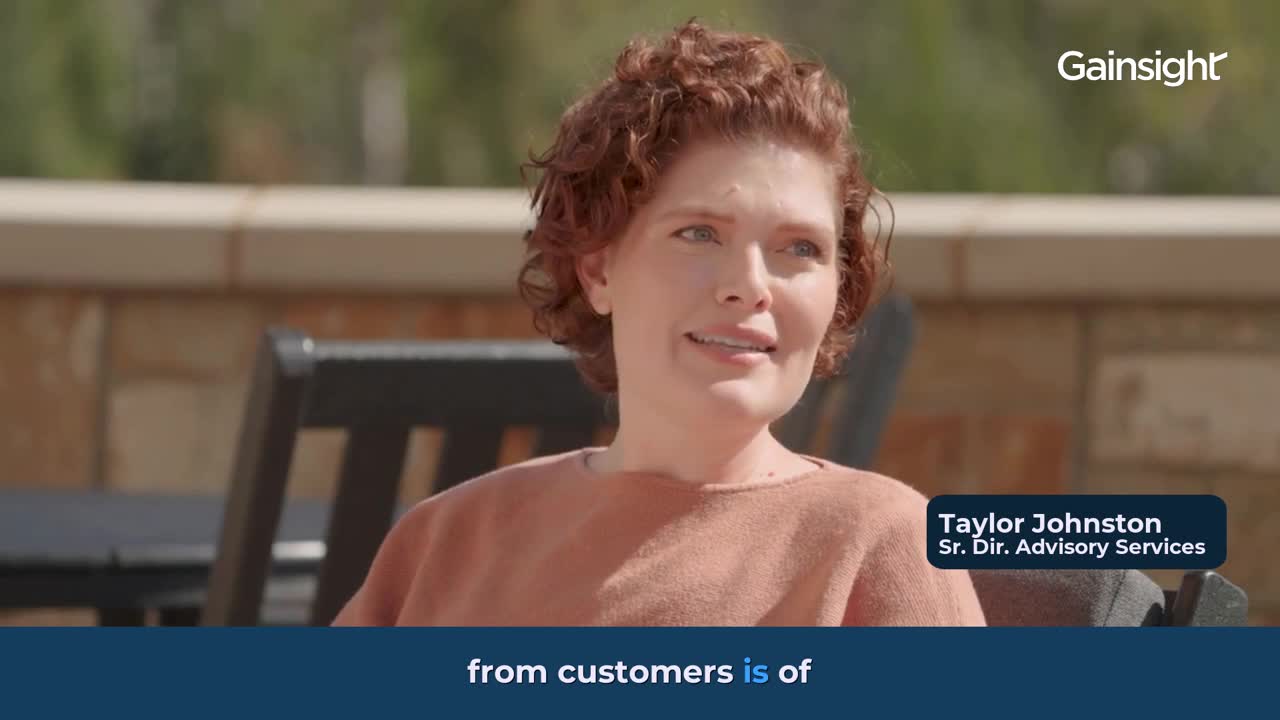
Let’s talk about the elephant in every Customer Success (CS) Zoom room: 100% of leaders in the function are now tied to revenue. Not “sort of responsible.” Not “indirectly accountable.” Directly on the hook for growth numbers that used to live two departments over.
That stat comes straight from Taylor Johnston, Gainsight’s Senior Director of Advisory Services, who’s been in the trenches long enough to know when a shift isn’t just a shift—it’s a complete rewiring of how CS works. And here’s the kicker: nearly half of CS leaders now carry direct revenue targets. Not pipeline influence. Not “supporting sales.” Actual dollar signs with their names on them.
AI Isn’t Coming—It’s Already Eating Your Lunch
Remember two years ago when raising your hand about using AI in CS made you look like that person who brought a calculator to a knife fight? Ori Entis, EVP and GM of Gainsight CS and Staircase, lived through that skepticism. Now? “If you’re not at least experimenting with AI right now, then you’re falling behind.”
The transformation isn’t subtle. CS teams are drowning in busy work—logging data, writing notes, summarizing calls—while their customers are getting less patient about waiting for value. It’s the perfect storm of higher stakes and less time, which is exactly why AI went from “nice to have” to “how are you still doing this manually?”
The Work That Actually Matters (And the Robots That Do the Rest)
Here’s what we’re seeing in the wild: CS teams need to be strategic value drivers, not data entry specialists. That’s where tools like Gainsight’s Staircase come in. Our customer intelligence platform sifts through mountains of emails, tickets, and surfaces what actually matters:
- Early warning signals for churn
- Sentiment analysis that catches problems before they explode
- Expansion opportunities hiding in plain sight
When every CS leader is suddenly accountable for revenue, finding where that growth will actually come from is easier said than done. Expansion signals are scattered across emails, tickets, and call notes—data no one has time to manually connect.
That’s the gap Staircase’s new Expansion Analyst fills. It studies 9–12 months of historical data to reveal which expansion motions have truly worked in the past, then scans your current accounts to find similar conditions. Instead of chasing hunches, CS leaders get a clear, prioritized map of where to invest next—complete with recommended next steps. It’s revenue strategy, powered by evidence.
“Next year we’re going to be sitting here talking about how it goes end to end,” Ori predicts. And based on what’s already happening, that timeline might be conservative.
One Flow to Rule Them All
When Customer Success becomes a revenue engine, focus is everything. You can’t automate your way to impact without a clear strategy for where that impact should start. Taylor has a deceptively simple prescription for teams drowning in transformation anxiety: “Think about orchestrating one flow with your customer.”
Start with a key customer segment
Focus on where a single, well-designed motion can scale impact—whether that’s your most engaged advocates, a high-value tier, or a segment that’s currently underserved. The goal isn’t to build a bespoke process; it’s to create one repeatable flow that can extend across your base.
Choose one high-impact motion
Begin with a journey that naturally scales—advocacy, onboarding, or renewal readiness are strong starting points. Taylor’s pick? Advocacy. “Our customers are hungry to talk to each other and to advocate on behalf of your brand. Let’s go engage them more effectively.”
Determine what can be digitized
Map the steps and determine where human touch drives real value—coaching, strategy sessions, storytelling—and where digital can amplify scale through automation or AI. Community discussions, learning content, and Journey Orchestrator programs can handle the heavy lifting between those human moments.
Deliver it across channels
Bring every motion—human, digital, and agentic—into one unified experience. Establish CSM-led touchpoints where they matter most, supported by in-app nudges, digital programs, and community engagement that keep customers learning and connected.
Ori reflected on a different angle: risk analysis using AI. “If you’re not using that to get signals from what’s happening, either through product usage or communication with your customer… you’re missing the spot.”
Gainsight’s CustomerOS: Where Everything Comes Together (Finally)
Here’s the thing about silos—they’re not just annoying, they’re actively destroying value. Digital touch, human-led, and agentic-led shouldn’t be separate motions anymore. They’re all part of what we call Gainsight’s CustomerOS, and Taylor’s spending her days helping companies figure out how to make these pieces actually talk to each other.
But strategy only matters if it can be executed, and that’s where Journey Orchestrator comes in. It’s the operational heartbeat of the CustomerOS, turning signals into action and ensuring that every insight from AI, every product milestone, and every human touchpoint actually moves the customer forward.
What started as a way to automate playbooks has become Gainsight’s real-time operating console for the post-sale experience. Think of it as mission control for customer success—one that listens to every data signal, adjusts in flight, and keeps your teams focused exactly where they create the most impact.
Agentic AI: The Thing You’ll Hear More About
Josh Schacter, SVP of Strategy and Market Development, admits he’s shocked that only 5-10% of people are familiar with agentic AI. “It’s kind of where LLMs and ChatGPT were about a year and a half or two years ago,” he observes.
But here’s what makes agentic AI different: agents don’t just send an email and peace out. They take context from Gainsight’s unified data layer, understand the customer’s specific situation, and can actually have a conversation—improvising within guardrails, reacting to needs, and behaving almost like a human would.
So what does that actually look like in practice? We’ve applied agentic AI to one of the most critical and complex areas of customer success: renewals.
Gainsight’s Renewal Agent identifies renewal potential, assesses risk, decides whether to call or email (or both), and can either hand off to a human or take it all the way to completion. For those unmanaged or semi-managed accounts that were basically left to fend for themselves? Game changer.
The Bottom Line That’s Actually a Starting Line
CS is fundamentally changing (finally!) from cost center to revenue driver, from manual to automated, from reactive to predictive. The companies that figure out how to orchestrate AI, human touch, and digital engagement into one coherent experience? They’re the ones who’ll still be around to talk about it next year.
As Taylor puts it: “We should all be asking ourselves, for every customer, no matter the size, shape or scope, how can we automate value to this customer in some way?”
The companies winning in CS right now aren’t the ones with the most CSMs. They’re the ones who figured out how to treat every customer like their best customer.
The evolution is here. The question is: Are you ready to EVOLVE?
The post How AI Agents and Unified Platforms Are Transforming Revenue Growth appeared first on Gainsight Software.


