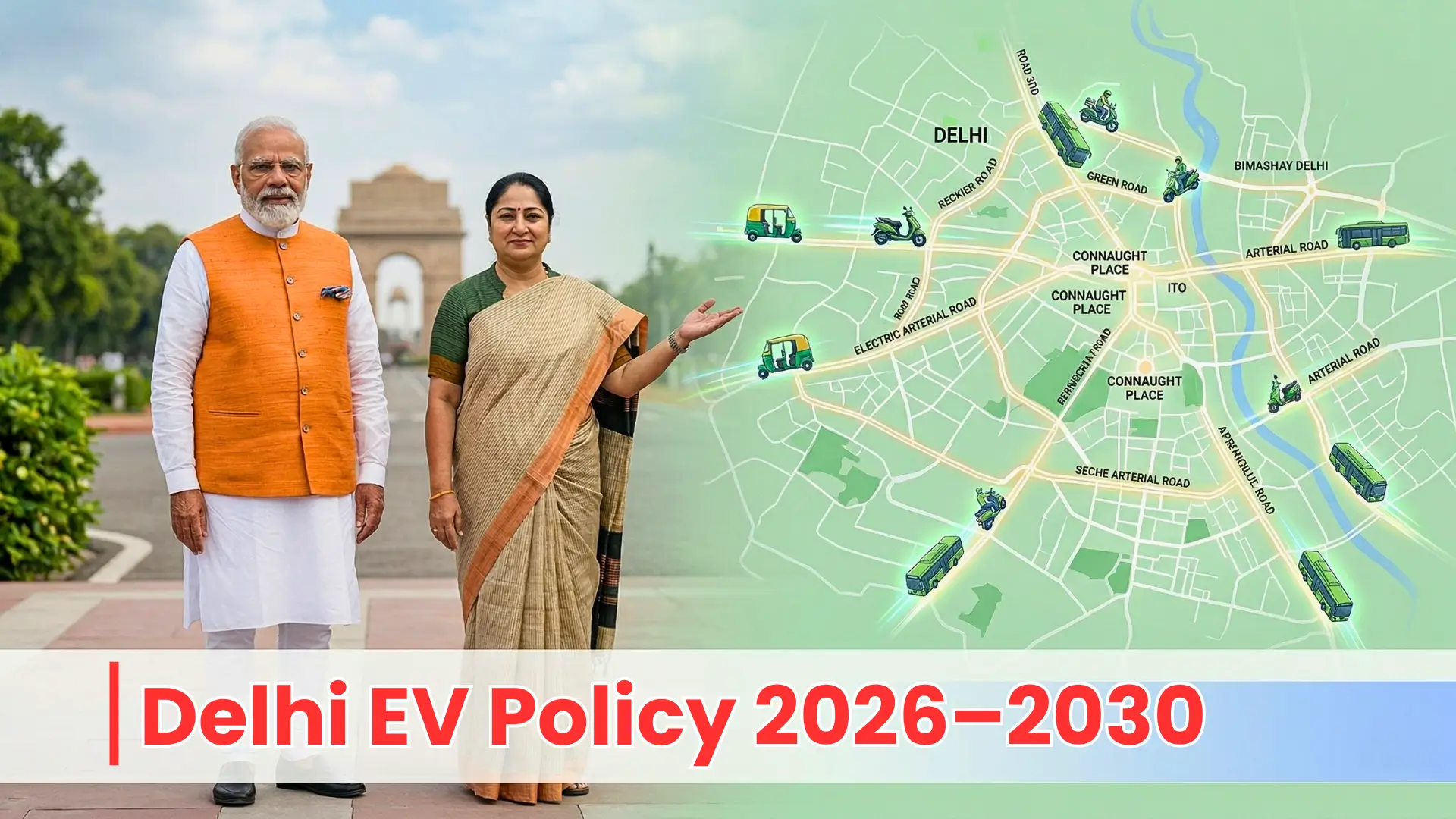
The Government of the National Capital Territory of Delhi (GNCTD) has released the Draft Delhi Electric Vehicle Policy 2026–2030, laying out an ambitious roadmap to accelerate electric vehicle adoption across the capital over the next four years.
The draft policy, applicable from the date of official notification, introduces tiered purchase incentives, scrapping bonuses, 100% road tax exemptions, and hard registration deadlines for conventional ICE vehicles, marking one of the most comprehensive EV policy frameworks released by any Indian state government to date.
According to the draft, vehicular emissions account for 23% of Delhi’s air pollution during winter, as reported by the Commission for Air Quality Management (CAQM) in its latest submission to the Hon’ble Supreme Court.
With two-wheelers making up nearly 67% of Delhi’s total vehicle stock, the policy prioritises their rapid electrification as the single most impactful lever for improving the city’s air quality.
The policy also responds directly to a Supreme Court directive in the M.C. Mehta vs. Union of India case, which called upon state governments to review and strengthen their EV policies.
It draws its constitutional backing from Article 21, the fundamental right to life, interpreted to include the right to a clean and pollution-free environment.
Key highlights from the draft include purchase incentives of up to ₹1 lakh for goods vehicles, a ₹50,000 incentive for e-autos in Year 1, a complete ban on new ICE three-wheeler registrations from January 2027, and a similar ban on ICE two-wheelers from April 2028.
The policy will remain in effect until 31 March 2030, unless extended or revised by GNCTD.
Here is a complete breakdown of every major provision.
2. Purchase Incentives for Electric Two-Wheelers
This is the section most Delhi residents will care about first, and rightly so.
Eligibility Condition: The ex-factory price of the electric two-wheeler must not exceed ₹2.25 lakh.
This price cap ensures the incentive reaches genuine middle-income buyers, not premium segment customers who don’t need state support.
Incentive Structure (Year-wise):
| Year of Registration | Incentive per kWh | Maximum Incentive |
|---|---|---|
| Year 1 from the date of notification | ₹10,000/kWh | ₹30,000 |
| Year 2 from the date of notification | ₹6,600/kWh | ₹20,000 |
| Year 3 from the date of notification | ₹3,300/kWh | ₹10,000 |
The incentive is structured to front-load benefits — the longer you wait, the less you get. This is a deliberate policy design choice to drive early adoption and create market momentum quickly. I think it’s smart.
If you’re on the fence about switching your petrol scooter to an EV, Year 1 is when you should move.
A typical 3 kWh electric two-wheeler in Year 1 would fetch you ₹30,000 in incentive, that’s a meaningful reduction on a ₹1–1.5 lakh vehicle. Combined with the scrapping bonus (discussed below), early movers can save significantly.
3. Purchase Incentives for Electric Three-Wheelers (E-Auto L5M)
For Delhi’s auto-rickshaw community, a demographic that is both economically vulnerable and environmentally impactful — the policy provides flat incentives per registration:
| Year of Registration | Incentive |
|---|---|
| Year 1 from the date of notification | ₹50,000 |
| Year 2 from the date of notification | ₹40,000 |
| Year 3 from the date of notification | ₹30,000 |
An important detail: this incentive is specifically applicable to public replacing old CNG auto-rickshaws or new auto-rickshaws registered with an NCT of Delhi permit.
It is not for private car buyers looking to claim three-wheeler benefits; it’s targeted directly at working auto drivers.
I’ve spoken to several auto drivers in my neighbourhood who are already considering the switch.
The ₹50,000 incentive in Year 1, combined with lower fuel costs, makes the economics genuinely attractive. CNG prices have been volatile; electricity costs are far more stable and predictable.
4. Purchase Incentives for Electric Goods Vehicles — N1 Trucks
The policy extends strong support to electric four-wheeler goods vehicles (N1 category) — a segment that’s critical for last-mile delivery and urban logistics:
| Year of Registration | Incentive |
|---|---|
| Year 1 from the date of notification | ₹1,00,000 |
| Year 2 from the date of notification | ₹75,000 |
| Year 3 from the date of notification | ₹50,000 |
This is significant. Delhi’s logistics and delivery ecosystem, particularly the e-commerce and FMCG supply chains, relies heavily on N1 trucks. A ₹1 lakh incentive in Year 1 makes a compelling business case for fleet operators to accelerate their electrification roadmap.
Importantly, the policy also mandates under Section 8.4 that no new conventional ICE vehicles (diesel/petrol) running as 4-Wheeler LCVs, 4-Wheeler LGVs (N1, up to 3.5 ton), and 2-Wheelers shall be inducted into fleet aggregators’ existing fleets from 01.01.2026.
BS-VI emission standard 2-wheelers get a brief reprieve until 31.12.2026, but after that, the door closes.
5. Scrapping Incentives: Trade Your Old Vehicle for a New EV
One of the most powerful features of this policy is the scrapping incentive, which rewards owners who retire their old, polluting BS-IV and below vehicles when they purchase a new EV.
Here’s the complete breakdown:
| Vehicle Type | Scrapping Incentive |
|---|---|
| Electric Two-Wheeler | ₹10,000 |
| Electric Three-Wheeler (L5M) | ₹25,000 |
| Electric Car (Non-Transport, ex-factory ≤ ₹30 lakh) | ₹1,00,000 |
| Electric Four-Wheeler Goods Vehicle (N1 Truck) | ₹50,000 |
Key conditions to note:
- The new EV purchase must be made within six (6) months of issuance of the Certificate of Deposit (CoD) from an authorised scrapping facility.
- The scrapping incentive applies only to Delhi-registered BS-IV and below vehicles in the respective category.
- For electric cars, the ₹1 lakh scrapping incentive is limited to the first 1,00,000 eligible applicants under this policy.
- All scrapping incentives will be disbursed through Direct Benefit Transfer (DBT) directly to individuals.
- The scrapping incentive on CoD applies only to the owner of the scrapped vehicle — you can’t claim it by scrapping someone else’s car.
The ₹1 lakh scrapping incentive for cars is genuinely eye-catching. If you’re driving an old petrol car registered in Delhi under ₹30 lakh ex-factory, this is a substantial push toward upgrading to an EV.
Read more –Electric Car Sales March 2026 – Brand-wise, Market Share & Trends
6. Road Tax & Registration Fee Exemptions
The Delhi EV Policy 2026–2030 provides 100% exemption on road tax and registration fees for eligible electric vehicles registered during the policy period. The specifics matter:
- All EVs (general): 100% exemption on road tax and registration fees at the time of vehicle registration.
- Electric cars with ex-showroom price ≤ ₹30 lakh: 100% exemption (with 50% exemption extended to Strong Hybrid EVs) till 31 March 2030.
- Electric cars with ex-showroom price > ₹30 lakh: No exemption from road tax and registration fees.
The differentiation at the ₹30 lakh price point is a deliberate equity decision; premium EV buyers don’t need government subsidy, and the policy correctly excludes them.
The 50% exemption for Strong Hybrid EVs (for cars under ₹30 lakh) also signals the government’s recognition that the transition won’t happen overnight, and partial credit to cleaner technologies is warranted.
7. Electrification Mandates: What Gets Banned and When
This section is arguably the most consequential part of the policy. It sets hard registration deadlines that will fundamentally reshape Delhi’s vehicle market.
Electric Three-Wheelers (L5)
From 01 January 2027: Only electric three-wheelers (L5 category) shall be permitted for new registration in the NCT of Delhi.
Electric Two-Wheelers
From 01 April 2028: Only electric two-wheelers shall be permitted for new registration in the NCT of Delhi.
School Buses
All schools in the NCT of Delhi must adhere to the following electrification targets:
| Effective Date | Minimum Electric Share of Fleet |
|---|---|
| Till the completion of Year 2 from the notification | 10% |
| Till the completion of Year 3 from the notification | 20% |
| Till 31st March 2030 | 30% |
The Education Department of GNCTD will issue necessary directions and integrate compliance requirements into school recognition and affiliation processes. Schools can’t ignore this — it’s tied to their official recognition status.
Government Fleet
- All hired/leased vehicles in GNCTD from the date of notification shall be only electric (except emergency/exempted vehicles).
- All new intra-state buses inducted by DTC and the Transport Department shall be electric.
- All new N1 trucks purchased/leased/hired by GNCTD departments, autonomous bodies, MCD, NDMC, and Delhi Cantonment Board shall be only electric.
Fleet Aggregators & Delivery Service Providers
No new conventional ICE vehicles (diesel/petrol) — 4-Wheeler LCVs, LGVs (N1, up to 3.5 ton), and 2-wheelers, shall be inducted into existing fleet aggregator fleets from 01.01.2026. BS-VI 2-wheelers get an extension till 31.12.2026.
8. Charging Infrastructure & Battery Swapping Plans
The policy recognises that EV adoption without charging infrastructure is a dead end, and it addresses this comprehensively.
Delhi Transco Limited (DTL), under the Power Department, is designated as the nodal agency for planning, coordination, and implementation of all public EV charging and battery swapping infrastructure in the NCT of Delhi. DTL’s responsibilities include:
- Planning and deploying all public charging and battery swapping stations across Delhi.
- Ensuring stations remain operational and developing Service Level Benchmarks (SLBs) for performance and uptime.
- Assessing present and future electricity load requirements from EV charging demand.
- Developing Standard Operating Procedures (SOPs) for deployment and operation.
- Creating a dedicated digital portal for end-to-end management of charging infrastructure.
- Establishing a Single Window Clearance facility for charge point and battery swapping operators.
OEM Responsibility: All OEMs operating in NCT of Delhi must ensure deployment of at least one public EV charging station per dealer, comprising a minimum of 3 charging points for two/three-wheelers and 2 charging points for four-wheelers.
The location must align with the PM E-DRIVE Scheme’s Category A, B, and C siting categories.
GNCTD will also propose to the Ministry of Heavy Industries under the PM E-Drive Scheme for central support toward charging and swapping infrastructure.
9. Institutional Framework: Who Is Responsible?
A policy is only as good as its implementation architecture. Here’s how accountability is distributed:
- Transport Department (Nodal Department): Overall implementation, clarifications, amendments, and the EV Cell under the Special/Additional/Joint Commissioner (EV).
- DTL (Power Department): Charging and swapping infrastructure planning and deployment.
- Environment Department: Quantifying emission reductions, ensuring OEM compliance with Battery Waste Management Rules 2022, and EPR requirements.
- Delhi Pollution Control Board (DPCC): Battery collection centres via the PPP model, Standard Operating Procedures for OEMs, EPR reporting.
- Urban Local Bodies (MCD, DDA, NDMC, Delhi Cantonment Board): Identifying land parcels for charging infrastructure, ensuring new civil projects are EV-charging-ready.
- Education Department: School bus fleet electrification compliance and awareness campaigns.
- District Magistrates (Revenue Department): Land aggregation for priority public EV infrastructure.
- Delhi EV Apex Committee: Chaired by Hon’ble Minister (Transport), will oversee implementation and management of the EV Fund.
10. EV Fund & Policy Validity
A dedicated EV Fund will be maintained under the Transport Department. Funding sources may include:
- State Budgetary Allocations
- Central and State Government Schemes and Grants
- Air Ambience Fund
- Environment Compensation Charge (ECC)
- PM E-DRIVE Scheme
- Cess, taxes, and other approved sources
All operational and implementation expenses related to the EV Policy 2026 will be met from this fund.
Financial spending will follow the latest applicable delegation of financial powers rules.
Policy Validity: The policy shall remain in force from the date of notification till 31 March 2030, unless extended or modified by the Government of NCT of Delhi.
Final Thoughts
Having analysed this policy in detail, I want to share a few honest observations.
The policy doesn’t just offer carrots; it has very real sticks. Hard registration bans on ICE two-wheelers and three-wheelers by 2027–28 signal that Delhi is serious.
The institutional framework is detailed, with clearly assigned responsibilities across departments, which reduces the “everyone’s responsible, so no one is” problem that plagues many government schemes.
The DBT-based disbursement of scrapping incentives is also a strong design choice. It reduces leakage and puts money directly in the hands of vehicle owners.
The success of this policy will depend entirely on the charging infrastructure actually being deployed at scale before the hard mandates kick in. A mandate without infrastructure is a recipe for either non-compliance or public backlash. DTL’s execution will be the real test.
The ₹2.25 lakh price cap on two-wheeler incentives is reasonable today, but as EV prices evolve, the government should be prepared to revise this cap.
I’d also want to see OEM accountability enforced more robustly. The per-dealer charging station mandate is good on paper, but enforcement has historically been weak.
Overall: This is a serious, well-structured policy. If implemented with the rigour it deserves, Delhi could genuinely lead India’s urban EV transition.
FAQs
#faqsu-faq-list {
background: #F0F4F8;
border-radius: 5px;
padding: 15px;
}
#faqsu-faq-list .faqsu-faq-single {
background: #fff;
padding: 15px 15px 20px;
box-shadow: 0px 0px 10px #d1d8dd, 0px 0px 40px #ffffff;
border-radius: 5px;
margin-bottom: 1rem;
}
#faqsu-faq-list .faqsu-faq-single:last-child {
margin-bottom: 0;
}
#faqsu-faq-list .faqsu-faq-question {
border-bottom: 1px solid #F0F4F8;
padding-bottom: 0.825rem;
margin-bottom: 0.825rem;
position: relative;
padding-right: 40px;
}
#faqsu-faq-list .faqsu-faq-question:after {
content: “?”;
position: absolute;
right: 0;
top: 0;
width: 30px;
line-height: 30px;
text-align: center;
color: #c6d0db;
background: #F0F4F8;
border-radius: 40px;
font-size: 20px;
}