Q1. What Does CyberArk Actually Cost in 2026? (Pricing Summary)
CyberArk does not publish list prices, but Vendr transaction data and a verified third-party price list put Privilege Cloud Privileged at $7,000 to $12,000 per user per year for small deployments, dropping to roughly $1,800 per user at 1,000+ seats. A realistic 500-user all-in Year 1 TCO (Total Cost of Ownership) lands between $2.6M and $3.2M. The median annual contract across all deal sizes is about $29,923, heavily skewed by SMB deployments, while enterprise deals commonly range from $150K to $2M+.
Why CyberArk Won’t Quote You a Number
CyberArk runs a sales-led model. They build custom Enterprise License Agreements (ELAs), and pricing varies by region, term length, and bundled modules. I read this as buyer context, not a complaint. The asymmetry is the point. Their investor materials show $2B+ in ARR, yet the pricing page says “Contact Sales”. If you walk in without numbers, the room is already tilted. For a broader view of how vendors structure quote-only models, see our MDR price practical guide.
Master Pricing Table (Directional, 2026)
| Module | Licensing Unit | Annual Range (per unit) | Min ACV | Confidence | Source |
|---|---|---|---|---|---|
| Privilege Cloud Standard | Named user | $2,400 to $4,800 | ~$25K | Medium | Vendr + 3P price list |
| Privilege Cloud Privileged | Named user | $1,800 to $12,000 (volume-dependent) | ~$50K | High | Vendr |
| EPM SaaS | Endpoint | $30 to $85 | ~$15K | Medium | Vendr |
| Secrets Manager / Conjur Cloud | Workload identity | $40 to $180 | ~$20K | Medium | checkthat.ai |
| Workforce Identity | Named user | $5 to $11/month | ~$10K | High | Vendr |
| CORA AI / ITDR Add-ons | Platform fee | Quote-only | Varies | Low | CyberArk docs |
The sections below unpack each pillar, the costs nobody quotes, and exactly how to negotiate 20 to 50 percent off every line. If you want a deeper benchmark on adjacent identity and SOC spend, our cybersecurity budget for mid-market firms guide pairs well with this.
Q2. How Is CyberArk’s Pricing Structured? (Modules, Tiers, and Licensing Logic)
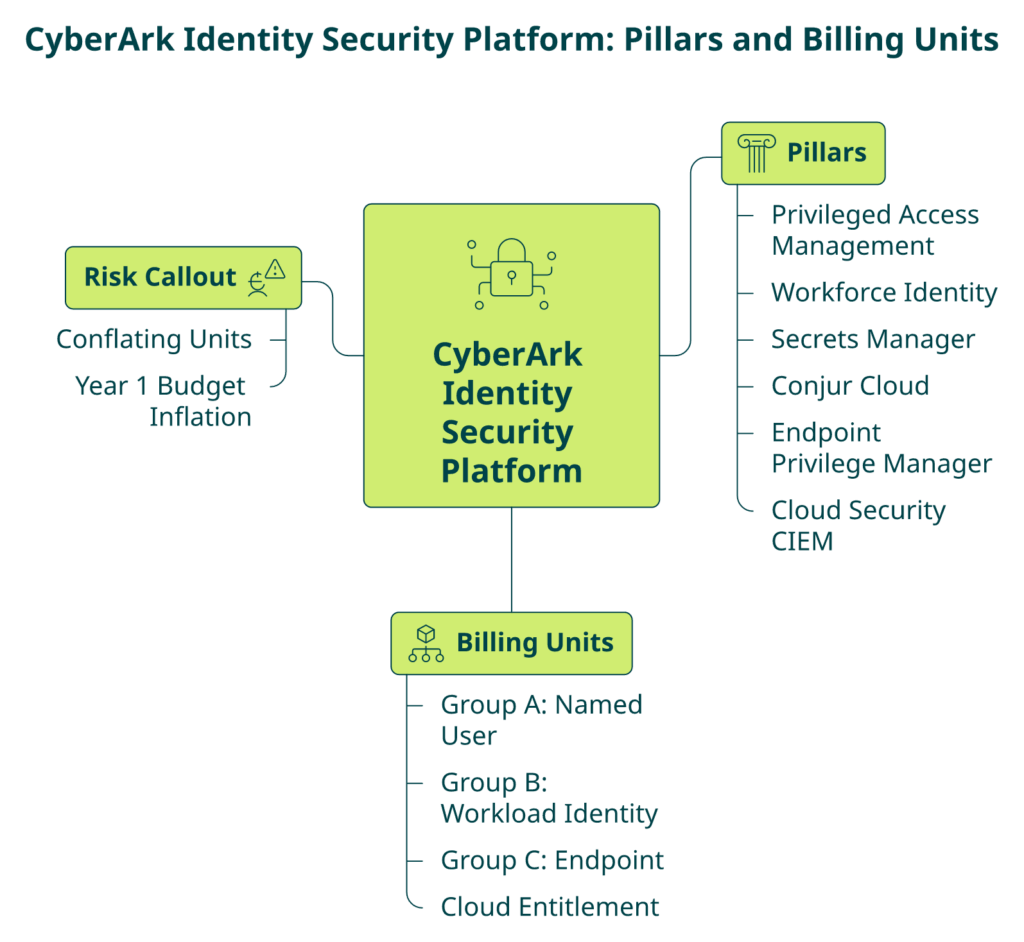
CyberArk bills per named user for PAM (Privileged Access Management) and Workforce Identity, per workload identity for Secrets Manager and Conjur, and per endpoint for EPM (Endpoint Privilege Manager). The platform spans six pillars: Privileged Access Management, Secrets Management, Endpoint Privilege, Workforce Identity, Cloud Security (CIEM), and shared AI/ITDR services. Volume discounts can cut per-user costs by up to 82 percent between the 1-user and 1,000-user tier, but only if you know which tier to target at signing.
The Three Billing Dimensions, Plainly
Conflating these three units is the single most common reason Year 1 budgets blow up. PAM and Workforce Identity scale with named humans. Secrets Manager and Conjur scale with non-human identities, which means service accounts, containers, and CI/CD jobs. EPM scales with the count of managed endpoints. If you ask sales for “a CyberArk quote” without separating these three, you get one number and zero ability to negotiate.
Quick glossary for anyone new to PAM acronyms. PSM is Privileged Session Management (record and proxy admin sessions). ZSP is Zero Standing Privileges (no permanent admin rights, only just-in-time grants). JIT is Just-in-Time access. IGA is Identity Governance and Administration. CIEM is Cloud Infrastructure Entitlement Management. ITDR is Identity Threat Detection and Response.
SKU Taxonomy at a Glance
| Pillar | Top SKUs | Unit | SaaS / Self-Hosted | Status |
|---|---|---|---|---|
| PAM | Privilege Cloud Standard, Privileged, Pro | Named user | Both | Active |
| Secrets Management | Conjur Cloud, Secrets Hub | Workload identity | SaaS | Active |
| Endpoint Privilege | EPM SaaS | Endpoint | SaaS only | On-prem EOL Dec 2023 |
| Workforce Identity | SSO, Adaptive MFA, Lifecycle | Named user | SaaS | Active |
| Cloud Security | Secure Cloud Access, CIEM | Cloud entitlement | SaaS | Active |
| OPM for Linux | Privileged Session Mgmt | Host | Self-hosted | Sunset June 2025 |
A 500-Person IT Team, Costed Honestly
Take a 500-person organization. Realistic counts: 80 privileged human users for PAM, 150 Conjur workload identities (assuming a modest Kubernetes footprint), and 500 EPM endpoints. Run those through Vendr’s tier data and you land roughly 40 percent higher than the initial sales estimate, because sales usually quotes you the human users and assumes you’ll “right-size” Conjur later. Our security stack guide walks through the inventory exercise that should precede any quote.
The Three Numbers to Lock Before Sales Engagement
- ⚠️ Privileged human user count, audited from your AD groups, not guessed.
- ⚠️ Workload identity count, pulled from your container registry and CI/CD inventory.
- ⚠️ Endpoint count for EPM, matched to your MDM source of truth.
The workload identity sprawl trap is the identity equivalent of cloud egress fees. Invisible on the proposal. Devastating on the Year 2 invoice. Buyers license 100 Conjur Cloud workloads and discover 400 inside 18 months as microservices multiply. No competitor pricing article warns you about this. I’m warning you now. For Kubernetes-heavy environments, our Kubernetes security best practices guide complements this checklist.
“The biggest win for me was getting actual control over our security alerts. Before the guys from UD stepped in, we were getting bombarded with alerts from all our security tools.”
— Verified User, Marketing and Advertising Under Defence G2 – Verified Review
Q3. What Is the Real All-In TCO? (License + Hidden Fees at 500, 5,000, and 25,000 Users)
A 500-user all-in Year 1 TCO, including license, implementation, premium support, storage overages, training, and one internal FTE, runs approximately $3.15M. A 5,000-user enterprise hits roughly $8.7M in Year 1. The most under-budgeted line is professional services, which add 15 to 35 percent on top of license cost. CyberArk’s SaaS terms also state that consumption beyond licensed quantities triggers charges “at then-current rates,” and those rates are not publicly disclosed.
Methodology, So You Can Defend It in a Board Deck
I’m assuming a 25 percent negotiated discount off list, one internal FTE loaded at $200K fully burdened, and Premium Support at 18 percent of ACV (Annual Contract Value). Sources are Vendr transaction data (May 2025), checkthat.ai (March 2026), and a cross-verified third-party price list. Where data is directional, I’ve flagged it. Confidence rating: medium-high. Buyers building a similar model for SOC spend can cross-reference our SOC cost calculator.
500-User Year 1 TCO
| Line Item | Cost | Notes |
|---|---|---|
| License (PAM + EPM + Conjur) | $1.65M | Post 25% discount |
| Professional Services / Implementation | $410K | 25% of license |
| Premium Support | $297K | 18% of ACV |
| Session recording storage buffer | $90K | Overages “at then-current rates” |
| Training and certifications | $45K | 4 admins |
| Internal FTE (1.0 loaded) | $200K | $200K fully burdened |
| Tuning toil (Year 1) | $160K | 0.8 FTE diverted |
| Year 1 Total | ~$2.85M to $3.15M |
5,000-User Year 1 TCO
| Line Item | Cost |
|---|---|
| License | $5.1M |
| Professional Services | $1.4M |
| Premium Support | $918K |
| Storage and overages | $310K |
| FTEs (2.5 loaded) | $500K |
| Training | $90K |
| Year 1 Total | ~$8.3M to $8.9M |
3-Year Locked Rate vs. Annual Renewals
💰 Locking a 3-year rate on a 500-user deal saves roughly $861K over annual renewals, mostly by capping the 5 to 7 percent annual uplift CyberArk applies by default.
The Seven Hidden Cost Layers (Plus an Eighth)
CyberArk’s SaaS terms explicitly state consumption beyond licensed quantities triggers charges at then-current rates, which are not published. Here’s the ranked list of where Year 2 and Year 3 budgets quietly break:
- PS (Professional Services) dependency for every major upgrade, $200 to $350 per hour.
- Premium or Platinum Support, 15 to 20 percent of ACV.
- Session recording storage overages, undisclosed per-GB rate.
- Renewal uplift without a contractual cap, 3 to 7 percent per year.
- Workload identity sprawl, 20 to 40 percent Conjur cost increase by Year 2 in microservices environments.
- FedRAMP or GovCloud variant surcharge, often 15 to 25 percent.
- FTE administration burden, 0.5 to 2 dedicated FTEs at $100K to $400K per year loaded.
- The 4-year tuning treadmill. One prospect told us they had been tuning their stack for four years and still weren’t “done”. At a $200K loaded FTE, that’s $800K of tuning cost no vendor proposal accounts for.
What I’d Demand in the Contract
Working with security teams across 500+ environments, what I’ve seen work is three non-negotiable clauses. A renewal cap at 3 percent or below. Volume tier floor language so mid-term add-ons stay at the tier rate you negotiated. CORA AI and future module pricing locked at signing, not “at then-current rates”. For teams sizing the response side of the equation, our MDR service page lays out what an operationalized layer on top of CyberArk actually delivers.
“Their team cleaned up our configurations and got the noise under control within the first week. Now when we get an alert, we know it’s something worth looking into.”
— Verified User, Marketing and Advertising Under Defence G2 – Verified Review
“UnderDefense is surprisingly affordable considering the level of protection we get. Their proactive threat hunting and rapid response have saved us from incidents that could have been incredibly costly.”
— Verified User, Program Development Under Defence G2 – Verified Review
The PAM tool manages the gate. The response work, credential wipes, session revocation, and forced logouts, sits in the SOC, and that’s where the real TCO conversation should land. Our SOC service page details the response-layer economics most CyberArk buyers under-budget.
Q4. SaaS vs. Self-Hosted: Which CyberArk Deployment Model Actually Costs Less?
Privilege Cloud SaaS carries a 10 to 15 percent licensing premium over self-hosted PAM. But self-hosted requires 2 to 5 dedicated FTEs at $300K to $1M per year loaded, plus infrastructure and maintenance. Over five years, SaaS reduces total operational costs by 38 to 50 percent. The break-even point for most mid-market organizations sits at 18 to 24 months. For FedRAMP, air-gapped, or data-sovereignty requirements, self-hosted is the only compliant option, and it costs materially more in every other dimension.
The Problem Most Buyers Don’t Model
Most teams default to SaaS without modeling the 10 to 15 percent licensing premium. Or they default to self-hosted without modeling FTE and upgrade burden. Both errors are costly. The right answer depends on three things: compliance posture, internal SecOps maturity, and how much custom correlation logic you’ve already built into the vault. If you’re weighing similar tradeoffs on log analytics, our managed SIEM pricing guide applies the same modeling discipline.
Side-by-Side on Nine Criteria
| Criteria | Privilege Cloud SaaS | Self-Hosted PAM |
|---|---|---|
| Licensing premium | +10 to 15% | Baseline |
| Year 1 infrastructure | $0 | $80K to $250K |
| FTE requirement | 0.5 to 1.0 | 2 to 5 |
| Upgrade burden | Vendor-managed | PS-dependent every major version |
| FedRAMP / GovCloud | Available via separate SKU | Native |
| FIPS 140-2 | Yes | Yes |
| Time to go-live | 4 to 8 weeks | 4 to 9 months |
| 5-year TCO (500 users) | ~$11.5M | ~$16.8M |
| Migration cost if switching later | Lower | $150K to $500K |
The Self-Hosted Upgrade Trap
⚠️ Every major CyberArk version on self-hosted requires professional services hours, connector reconfiguration, and parallel-run testing before cutover. This line item is routinely missing from Year 2 and Year 3 budget models. I’ve watched a 3,000-employee fintech budget $0 for “upgrade” and pay $340K in PS the following year. It wasn’t malice from the vendor, but a model the buyer never built.
Three Buyer Profiles, Three Right Answers
✅ Regulated federal or air-gap buyer. Self-hosted or GovCloud is the only path. Accept the FTE and upgrade burden as the cost of compliance.
✅ Cloud-first mid-market. Privilege Cloud SaaS. Faster time-to-value, lower FTE drag, and the 10 to 15 percent premium pays for itself inside 24 months.
✅ Hybrid enterprise with data residency needs. SaaS vault with an on-prem connector. You keep the data plane local where regulators care, and outsource the control plane.
Business Logic Lock-In Is the Real Migration Cost
The license fee is not what locks you in. What locks you in is four-plus years of custom correlation rules, account discovery patterns, and institutional memory embedded in the on-prem vault. Reframe the SaaS premium as optionality insurance against that lock-in, not as an extra cost. In our experience operationalizing existing PAM stacks for global enterprises, we don’t rip and replace. We layer an Agentic AI SOC on top of CyberArk logs to do the Response work, credential wipes, session revocation, and forced logouts in under 2 minutes, that monitoring alone cannot do. The Under Defence MAXI WarRoom platform is the workspace where that response actually happens.
“Honestly, some security tools are more complicated than the threats themselves. Underdefense isn’t just about catching bad stuff, but they give proactive tips too.”
— Andriy H., Co-Founder and CTO Under Defence G2 – Verified Review
“UnderDefense MAXI integrates well with our systems, specifically with our SIEM, Splunk. Their team is proactive in identifying and addressing threats, providing 24/7 oversight.”
— Oleg K., Director Information Security Under Defence G2 – Verified Review
Q5. Is CyberArk Worth the Cost? ROI Framework + Compliance Cost Justification
Forrester’s commissioned TEI (Total Economic Impact) study found a composite organization achieved $3.8M in total benefits over three years from CyberArk, with 162 percent ROI and payback under six months. IBM’s 2024 breach report puts the average breach cost at $4.88M, and organizations with mature PAM (Privileged Access Management) shortened breach lifecycles by 108 days. Separately, NIS2, PCI DSS v4.0, SOC 2, and the SEC’s Item 1.05 8-K rule now mandate privileged access controls, making CyberArk a compliance cost, not just a security choice.
CyberArk is expensive. It is also one of the few security investments with a documented positive ROI and a compliance mandate attached. The question stops being “can we afford this?” and becomes “can we afford not to?” If you need to translate that into a wider budget model, pair this section with the 2026 cybersecurity budget playbook.
Pillar 1: Forrester ROI, With the Caveat Nobody Quotes
The $3.8M benefits figure assumes 80 percent feature utilization across the platform. In our work helping security teams operationalize identity stacks, only about 40 percent of organizations reach that level in Year 1. If you sign for Privilege Cloud and only vault 30 percent of your privileged accounts by month 12, your ROI math collapses. Build a Phase 1 success metric into the contract. Otherwise, you’ll be defending sunk cost at the Year 2 renewal.
Pillar 2: Build the EAL Model Your CFO Will Sign
Take IBM’s $4.88M average breach cost. Multiply by the estimated 15 to 25 percent annual probability of a privileged-credential breach. Verizon DBIR consistently shows credentials in 70 percent of breaches. That gives you an Expected Annual Loss (EAL) between $730K and $1.22M before PAM is in place.
Now compare that against a 500-user CyberArk Year 1 cost of roughly $3.15M. The break-even is roughly 18 to 30 months of avoided breach probability. Caveat I’d flag to the CFO: this assumes PAM actually catches the privileged-credential attack. PAM tools manage the gate. If a SAML token gets stolen, like the Cozy Bear/SolarWinds case, the gate is irrelevant. The math only works when paired with detection and response on top.
The NIST CSF Budget Map: One Sheet, 10 Minutes
Pull a single page. List CyberArk spend across Identify, Protect, Detect, Respond, and Recover. What I see across enterprise environments: 70 to 80 percent of identity budget lands on Protect, and zero on Respond. That imbalance is the most expensive blind spot in modern security. Show your board this map, and the next budget cycle gets easier. For response-layer economics, the SOC cost calculator gives you a fast second model.
“It’s reassuring to know they’re always watching for threats, and it doesn’t cost a fortune. They catch and stop problems quickly, which is a huge relief.”
— Serhii B., Chief Information Security Officer Under Defence G2 – Verified Review
Compliance Is the Budget Unlock
NIS2 requires appropriate technical, operational, and organizational measures. PCI DSS v4.0 requires privileged access restriction, logging, and review. SOC 2 auditors ask for access control evidence. The SEC 8-K cyber rule turns material incident disclosure into a board-level timing issue. This is why the ROI case should not be only breach math. It should be breach math plus audit readiness, plus faster evidence production. If audit evidence is your blocker, review the compliance services path before buying more modules.
The board-slide version: “We are pricing $730K to $1.22M of expected annual breach exposure against $3.15M of Year 1 PAM cost, with an 18 to 30 month payback before any compliance savings.”
Q6. How Does CyberArk Compare to BeyondTrust, Delinea, Saviynt, and One Identity on Price?
CyberArk is usually the most expensive PAM option, but it also has the deepest enterprise PAM capability. BeyondTrust often lands 20 to 35 percent cheaper for asset-centric PAM. Delinea is usually 30 to 45 percent cheaper and faster to deploy. Saviynt is strongest where IGA (Identity Governance and Administration) is the primary requirement, not deep session control. One Identity often wins in hybrid Microsoft-heavy estates. The right comparison is not “cheapest.” It is “which tool matches the control depth you actually need?”
I see teams make one mistake here. They compare license lines without comparing operational drag. A cheaper PAM tool that needs two more FTEs can become the expensive one by Year 2. A more expensive PAM tool that blocks a compliance finding can be the cheaper one in board terms. If you want a broader vendor-switching lens, read our guide on why businesses switch cybersecurity providers.
Five-Vendor Pricing Matrix
| Vendor | Pricing Model | Annual Cost, 500 Users (Directional) | SaaS | Implementation | PAM Depth | IGA | Gartner MQ 2024 |
|---|---|---|---|---|---|---|---|
| CyberArk | Per user, workload, and endpoint | $1.6M to $2.2M | Yes | High | Deep PSM, ZSP, and JIT | Add-on | Leader |
| BeyondTrust | Per user, per asset | $1.1M to $1.6M | Yes | Medium | Strong PSM and RPAM | Limited | Leader |
| Delinea | Per user | $900K to $1.4M | Yes | Low to Medium | Solid PAM, simpler UX | Limited | Leader |
| Saviynt | Per identity | $700K to $1.2M | Yes | Medium | Light PAM | Strong IGA | Visionary |
| One Identity | Per user | $800K to $1.3M | Hybrid | Medium | Moderate | Strong IGA | Challenger |
Where CyberArk Wins
CyberArk wins when session isolation, credential rotation, audit evidence, and deep privileged workflow control matter more than price. That usually means banks, healthcare providers, SaaS companies with strict customer audits, manufacturers with OT segmentation, and any organization preparing for stricter cyber insurance underwriting. If the board asks, “Can we show exactly who accessed what, when, and why?” CyberArk usually has the cleanest answer.
Where Competitors Win
BeyondTrust often wins when remote privileged access and asset discovery lead the use case. Delinea often wins when time-to-value and admin usability outrank maximum control depth. Saviynt wins when identity governance is the board issue. One Identity wins when Microsoft-heavy hybrid infrastructure already carries Quest footprint. If your main problem is SOC overload, not PAM architecture, compare the PAM spend against SOC-as-a-service providers before expanding the vault.
The Negotiation Use Case
Even if you never intend to switch, get one competitor quote. A Delinea or BeyondTrust quote gives procurement a price anchor. Without it, CyberArk controls the reference frame. With it, you can say: “We prefer CyberArk because of depth. We need the commercial terms to reflect the premium.”
“No proactive outreach from the account team, no QBRs unless specifically requested, no check in.”
— Security Manager, Global Enterprise Arctic Wolf – Gartner Verified Review
This is why I separate tool depth from operating model. A strong product still fails when the surrounding process is weak. If your team lacks 24/7 coverage, build that into the comparison. Our outsourced vs. in-house SOC guide helps model that tradeoff.
Q7. What Does a Phased CyberArk Rollout Cost? (3-Year Adoption Roadmap)
Most successful CyberArk deployments follow three phases. Phase 1, months 1 to 6, vaults core privileged credentials at $200K to $350K for 500 users, including QuickStart PS (Professional Services). Phase 2, months 7 to 18, adds EPM endpoint least privilege and Secrets Manager for DevOps at $150K to $300K incremental. Phase 3, months 19 to 36, expands to vendor access, Zero Standing Privileges, and Workforce Identity at $200K to $500K. Total 3-year build: $550K to $1.15M in license and PS for a 500-user mid-market organization.
The 3-Phase Roadmap Table
| Phase | Time | Modules | Success Metric | Budget | Internal FTE | PS Engagement |
|---|---|---|---|---|---|---|
| Phase 1 | Months 1 to 6 | PAM Core Vault, PSM | 80% of Tier 0 accounts vaulted | $200K to $350K | 1.0 | QuickStart |
| Phase 2 | Months 7 to 18 | EPM, Secrets Manager | Endpoint least privilege live, DevOps secrets rotated | $150K to $300K | 1.5 | JumpStart |
| Phase 3 | Months 19 to 36 | ZSP, Vendor Access, Workforce Identity | Zero Standing Privileges enforced | $200K to $500K | 2.0 | Enterprise White Glove |
Phase 0: The Free Negotiating Anchor
Before money changes hands, run the free CyberArk Blueprint Assessment. Takes two weeks. Defines privileged account inventory and scope. The output gives you a credible anchor for the Phase 1 contract scope, which is the single most important negotiating leverage you have at signing.
Structure the Contract to Match the Rollout
What I’d put in the paperwork: co-term add-ons priced at the original volume tier, so Phase 2 seats don’t reset to list rate. Module options at pre-agreed rates for Phases 2 and 3. CORA AI inclusion language for Phase 3 at a locked rate or a defined rate card. Without these clauses, you negotiated Phase 1 and paid full list for Phases 2 and 3.
Bake the Toil-Reduction Metric Into Every Phase
Each phase gate needs a measurable toil-reduction metric. Hours of manual security work eliminated per week. Tickets auto-resolved. Accounts vaulted per analyst hour. Without this, the four-year tuning treadmill begins, and the Year 3 renewal conversation has no ROI anchor. Build the evidence from Phase 1, not from Phase 3 panic. For teams trying to reduce analyst load directly, the SOC automation checklist gives a useful operating baseline.
“Underdefense is a great choice for teams like ours that are short on resources. It automates many tasks, plus, with 24/7 monitoring, we know we’re always protected.”
— Inga M., CEO Under Defence G2 – Verified Review
“Their experienced SOC engineers work closely with our team, providing continuous monitoring and threat detection. They delivered the deployment to 1,200 endpoints in just 2 to 3 business days.”
— Oleksii M., Mid-Market Under Defence G2 – Verified Review
I might be wrong here, but when we ran this against our own Under Defence MAXI environment, the biggest win was not “AI speed”. It was forcing every automation to prove saved analyst minutes. The Under Defence MAXI platform makes that visible because analysts, automation, and customer verification live in one workflow.
Q8. How Do You Negotiate a New CyberArk Purchase? (Discount Levers and Contract Clauses)
The best CyberArk discounts come from sequencing, not asking nicely. Start with a formal RFP, secure a BeyondTrust or Delinea quote, time procurement for CyberArk’s December 31 fiscal year-end, and negotiate a 3-year rate lock before you reveal budget. Typical discount bands: 15 to 25 percent for a 3-year commit, 10 to 25 percent for named competitive displacement, 5 to 15 percent for year-end timing, and 3 to 7 percent for annual prepay.
The 8 Negotiation Levers, Ranked by Discount Impact
| Rank | Lever | Likely Discount | When It Works |
|---|---|---|---|
| 1 | Multi-year 3-year commit | 15 to 25% off list | Activates at any ACV. Don’t lead with this. Make sales ask. |
| 2 | Named competitive displacement | 10 to 25% | BeyondTrust or Delinea quote in hand. Threshold: $100K ACV. |
| 3 | Fiscal year-end December timing | 5 to 15% incremental | CyberArk’s year-end is December 31. |
| 4 | AWS or Azure Marketplace co-sell | 5 to 15% | Applies if you have EDP or MACC. Threshold: $250K ACV. |
| 5 | Formal RFP process | 10 to 20% | Documented evaluation forces sales to compete. |
| 6 | Logo or case study commitment | 5 to 10% | Works best for recognizable brands. |
| 7 | CISO escalation to CyberArk executive sponsor | 5 to 10% | Use sparingly, late in cycle. |
| 8 | Upfront annual prepay | 3 to 7% | Only if cash position allows. |
Script the First Commercial Call
Use this wording: “We are evaluating CyberArk, BeyondTrust, and Delinea against a documented privileged-access roadmap. CyberArk is our depth leader, but we need commercial terms that support a phased 3-year rollout. We are not signing an uncapped renewal uplift, and we need Phase 2 modules priced at the same tier.”
That does three things. It names competition. It frames CyberArk as preferred without surrendering leverage. It anchors the conversation on contract mechanics, not discount begging. If procurement needs a wider cost baseline, the MSSP pricing guide gives a useful contrast for managed security operating models.
The Three Contract Clauses to Demand Before Signature
Without these clauses, you have brand protection on the outside and uncapped exposure on the inside. The M&M network problem applied to procurement.
- Renewal cap at 3 percent or lower. Without it, the default uplift is 3 to 7 percent compounding annually.
- Volume tier floor language for mid-term add-ons. Any seats added before renewal year are priced at the committed tier, not list.
- CORA AI and future GenAI module pricing locked. Either at signing rate or a defined rate card. The “at then-current rates” clause is where Year 2 budgets break.
Know When Not to Push
Do not squeeze PS to zero. Implementation quality matters more than a few points of discount. I’ve seen buyers “win” 20 percent off license, underfund implementation, and spend the next year explaining why the vault only covers half the estate. Push on renewal caps, tier floors, and rate cards. Protect services quality. If your team needs outside help building the operating model, our virtual CISO team can pressure-test the board narrative before signature.
“The service is good, but the pricing is a little high for smaller companies.”
— Verified User, Mid-Market Under Defence G2 – Verified Review
That quote is why I like transparent pricing conversations. Security buyers can accept expensive. They hate surprise. A good negotiation does not just lower price. It removes future ambiguity, and that is what your CFO actually wants.
Q9. How Do You Negotiate a CyberArk Renewal, and Win?
Renewal negotiations differ fundamentally from new purchases. Your strongest lever is no longer competitive displacement, but a utilization audit. If your team uses fewer than 60 percent of licensed features or seats, you have documented evidence to right-size the contract. Start 90 days before renewal. Demand the renewal cap clause you may not have negotiated at signing. A formal competitor benchmark resets the price anchor. Migration costs ($150K to $500K) are CyberArk’s leverage, but they are also your negotiating floor.
Here is the governing distinction. CyberArk knows your migration cost, your custom configurations, and your renewal date better than you do. Rebalancing that information asymmetry is the entire task. If you want a wider lens on switching economics, our guide on why businesses switch cybersecurity providers pairs well with this section.
Lever 1: Run a Two-Week Utilization Audit
⏰ Before renewal week, pull three numbers. Licensed seats versus active users in the last 90 days. Modules licensed versus modules actively generating value. Conjur workload identities licensed versus deployed. Any underutilization is a right-sizing argument worth 10 to 25 percent reduction.
Most teams I talk to find at least one underused module. Workforce Identity is the common offender, where SSO sits live and Adaptive MFA never gets enabled. That gap is a budget line you can recover. For wider stack hygiene, see our cybersecurity technical debt framework.
Lever 2: Commission a Competitive Benchmark Quote
✅ Get a BeyondTrust or Delinea quote even if you do not intend to migrate. The quote anchors the conversation. Sales teams treat hypothetical competition very differently from a documented PDF on your screen.
Script that works: “We have a migration estimate of $X from BeyondTrust. We want to stay on CyberArk. What can you do to make that decision easier?” That single sentence shifts the room.
Lever 3: Migration Cost Judo
Do not hide the migration cost. Weaponize it. ⭐
“We acknowledge migration is a $300K project. That is the same as three years of the renewal uplift you are proposing. We need a renewal cap clause and a module rate card to justify staying.”
The business logic lock-in (four-plus years of custom correlation rules and institutional memory in the vault) is what makes migration expensive. It is also what makes your deployment uniquely valuable to CyberArk. Price that lock-in fairly. You are not threatening to leave. You are negotiating a fair number for staying.
The 90-Day Timeline Rule
⚠️ Engagements started fewer than 30 days before renewal hand CyberArk all the leverage. Procurement cycles, internal approval, and legal review on contract clauses do not fit in 30 days. The default outcome is autorenewal at uplift.
💰 If you are within 12 months of renewal, start the process the day this article loads on your screen. Block 90 days. Brief your CFO. Pull the utilization data. Get the competitive quote. Walk into the room with leverage, not deadline pressure. Teams supporting that prep with outside help often pull in a virtual CISO to pressure-test the board narrative.
The Three Clauses You Must Get This Time
✅ Renewal cap at 3 percent or below. The default uplift sits at 3 to 7 percent compounding annually without a cap.
✅ Volume tier floor for any mid-term seat additions.
✅ Locked rate or defined rate card for CORA AI and future GenAI modules.
“Their adherence to SLAs gives me confidence in our infrastructure’s protection.”
— Oleg K., Director Information Security Under Defence G2 – Verified Review
Q10. What Does CyberArk Not Protect You From? (The Identity Response Gap)
CyberArk secures the gate. It does not monitor the behavior of the person who walked through it. Identity Security Intelligence (ITDR, or Identity Threat Detection and Response) is bundled and flags anomalies, but it generates alerts, not responses. When a SAML token is forged (as in the SolarWinds and Cozy Bear breach), a valid privileged account bypasses every PAM control. Response, meaning credential wipe, session kill, and forced logout in under 2 minutes, requires a separate SOC or MDR layer that CyberArk does not provide.
Start With the Truth About CyberArk’s Strengths
CyberArk is, by every measurement, the most capable PAM platform on the market. Forrester TEI: 162 percent ROI. Gartner: Leader for 10+ consecutive years. When deployed correctly, it is a tier-1 security investment. I would recommend it to any 1,000-plus employee security team that needs vault, session management, and credential rotation done seriously.
The point of this section is not to undermine that. The point is to show the architectural gap that no amount of CyberArk spend closes. For a complementary view on the response side, see our guide to MDR services.
The SAML Attack Vector (Cozy Bear, Documented)
Now the complication. In the SolarWinds breach, attackers did not bypass PAM. They became PAM. By compromising the SAML token signing certificate, they could impersonate any privileged user. Session recordings captured legitimate-looking activity. No access control mechanism caught it. CISA Advisory AA21-008A documents this explicitly.
The Verizon DBIR 2024 confirms 77 percent of breaches involve valid credentials, mapped to MITRE T1078. The attacker does not break the gate. The attacker walks through with a borrowed key. Teams modeling this risk should review our business email compromise writeup, which covers the same identity-theft pattern.
The NIST CSF Budget Gap
❌ Most organizations spend 70 to 80 percent of their identity security budget on Protect (CyberArk) and budget zero for Respond. The NIST CSF 2.0 one-page budget map makes this visible in 10 minutes. The gap is not a product failure. The gap is an architecture issue.
✅ What Respond actually looks like in identity-heavy environments. Geographically improbable VPN logins (logged in from France at 10:00 AM, Canada at 10:15 AM, a credential theft indicator regardless of PAM controls). Service account lifecycle anomaly alerts (any Account Life Cycle Event outside the authorized CyberArk service account window). ChatOps confirmation pings via Slack or Teams to validate behavior before escalating to incident. Then the response: credential wipe, password reset, and forced session termination in under 2 minutes. The detection-to-response sequencing maps to SLA-driven SOC detection and response patterns.
What Filling the Gap Costs and What It Catches
This is the layer MDR providers like Under Defence MAXI are purpose-built to fill, integrating CyberArk logs into an Agentic AI SOC to filter 99 percent of the noise and respond to the 1 percent that matters. A UD customer (Carmeuse) detected a $300K payroll fraud scheme that CyberArk’s static access controls had no mechanism to catch. The service paid for itself within three months. The Under Defence MAXI platform is where that response actually happens.
When your SAML token is next compromised, which layer catches it? Vendors offering breach warranties are, from a CISO’s seat, admitting they expect the breach. That is an Orange Suit Acceptance posture. The better posture is a documented 2-minute Alert-to-Triage SLA with 15-minute escalation for critical incidents that prevents the breach from becoming a headline.
“Underdefense protects all our cloud stuff. If something does happen, they react automatically which is amazing.”
— Verified User, Mid-Market Under Defence G2 – Verified Review
“Missing integrations with key products like CyberArk. This is not an extension of our security team as was originally sold.”
— Sr Cybersecurity Engineer, Manufacturing Arctic Wolf – Gartner Verified Review
Q11. What Should You Do Before Your Next CyberArk Quote or Renewal? (Monday Checklist)
Before requesting a CyberArk quote or entering renewal: run the free Blueprint Assessment (2 weeks, zero cost). Audit M365 E5 entitlements, because you may already own SSO and MFA you are about to pay CyberArk to duplicate. Pull a BeyondTrust or Delinea quote for negotiation leverage. Block your calendar 90 days before renewal. Map your NIST CSF spend. Assess your SOC and MDR response gap before expanding your PAM footprint.
You now have more CyberArk pricing intelligence than most vendors will share with you. Here is what to do with it, in priority order. Pair this with the 2026 cybersecurity budget playbook if you are also building Q4 budget guidance.
The Six-Step Monday Checklist
- Blueprint Assessment. Week 1, free, CyberArk-direct. Defines scope before any money changes hands.
- M365 E5 entitlement audit. Week 1 to 2, IT and procurement. SSO, MFA, and Conditional Access features you may already own that overlap with CyberArk Workforce Identity Standard.
- Competitive quote from BeyondTrust or Delinea. Week 2 to 3, procurement. The single most effective negotiation lever per Vendr data.
- Renewal date audit and 90-day calendar block. Day 1, CISO’s EA. Without this block, autorenewal wins by default.
- NIST CSF budget map. Week 1, CISO and GRC lead. Surfaces the Protect versus Respond imbalance before the board presentation.
- 💸 SOC and MDR response gap assessment. Week 2, security operations lead. Specifically test three signals against your current stack: (a) can you detect a geographically improbable VPN login (France 10:00 AM, Canada 10:15 AM)? (b) can you alarm on any Account Life Cycle Event outside the authorized CyberArk service account? (c) can you kill a privileged session and rotate the credential in under 2 minutes? If the answer to any of these is “we would manually investigate,” your CyberArk investment is operating without a response layer. Our MDR service page details what closing this gap looks like operationally.
The Board Slide Test
Board slides do not buy features. They buy outcomes. “We will contain a compromised privileged session in under 2 minutes” is a board slide. “We integrate with CyberArk” is a brochure. Frame the response-layer conversation in SLA language, not feature language. If you want to pressure-test the dollar math behind that slide, run the SOC cost calculator.
“It’s reassuring to know they’re always watching for threats, and it doesn’t cost a fortune. They catch and stop problems quickly, which is a huge relief.”
— Serhii B., Chief Information Security Officer Under Defence G2 – Verified Review
Q12. What I Am Thinking About Next
I keep coming back to one question on this beat. As CyberArk and other PAM vendors fold more agentic AI into their stacks (CORA AI, autonomous discovery, AI-driven session analysis), what happens to the operational reality on the ground? Working with security teams across 500-plus environments, what I have seen is that AI features sell well in slides and break down in the messy middle, where service accounts misbehave, SAML tokens get borrowed, and on-call engineers have 90 seconds to decide.
My current read: the next 18 to 24 months will separate vendors who ship observable, auditable AI from vendors who ship black-box AI with breach warranties attached. PAM tools that expose their decision logic to the SOC will win. PAM tools that hide it will frustrate the CISOs defending board presentations next quarter.
The deeper question for any 1,000 to 10,000 employee security team is this. If your IAM (Identity and Access Management) system is already compromised, what is your detection-and-response posture for the next 60 minutes? That is the conversation I would rather have than a discount discussion. If you want to extend that conversation, our writeup on whether AI kills or saves your SOC is where I would start. I might be wrong on parts of this, and I would happily hear where. ⭐
References
Official Docs / Indian Statutes
- NIST. “Cybersecurity Framework 2.0: PR.AA, DE.CM, RS.MA Function Mapping” Published: February 2024.
- European Union. “Directive (EU) 2022/2555 (NIS2 Directive), Article 21” Published: December 2022.
- PCI Security Standards Council. “PCI DSS v4.0, Requirements 7 and 8” Published: March 2022.
- AICPA. “SOC 2 Type II Trust Services Criteria, CC6 Logical Access Controls” Published: 2022.
- U.S. Securities and Exchange Commission. “Item 1.05 8-K Cyber Disclosure Rule” Effective: December 2023.
- ISO/IEC. “ISO/IEC 27001:2022 Annex A.8.2 Privileged Access Rights” Published: 2022.
- CyberArk. “Product Taxonomy and SaaS Terms of Service” Published: February 2026.
- CyberArk. “Blueprint Assessment Methodology” Published: 2025.
- MITRE ATT&CK. “T1078: Valid Accounts Technique” Updated: 2024.
- CISA. “Advisory AA21-008A: SolarWinds and Active Directory/M365 Compromise” Published: 2021.
- Microsoft. “M365 E5 Feature Matrix: SSO, MFA, Conditional Access Entitlements” Updated: 2025.
Datasets
- Vendr. “CyberArk Marketplace Pricing and Transaction Data,” May 2025.
- Vendr. “CyberArk Transaction Data and Negotiated Discount Ranges,” May 2025.
- Vendr. “CyberArk Renewal vs. New Purchase Discount Patterns,” May 2025.
- Verizon. “Data Breach Investigations Report (DBIR) 2024,” 2024.
- IBM Security. “Cost of a Data Breach Report 2024,” 2024.
- Mandiant. “M-Trends 2024: Identity-Based Initial Access Trends,” 2024.
- SANS Institute. “2024 SOC Survey,” 2024.
- G2. “UnderDefense MAXI Verified Reviews,” 2025.
- Gartner Peer Insights. “Arctic Wolf MDR Reviews,” 2024.
- Clutch. “UnderDefense Cybersecurity Services Verified Reviews,” 2025.
Blogs
- checkthat.ai. “CyberArk Pricing Analysis and 3-Year TCO Tables.” Published: March 2026. [Secondary source]
- checkthat.ai. “CyberArk Pricing and Phased Rollout Analysis.” Published: March 2026. [Secondary source]
- checkthat.ai. “CyberArk Renewal Uplift Analysis.” Published: March 2026. [Secondary source]
- freeitdata.com. “CyberArk Third-Party Price List.” Published: June 2023, cross-verified May 2025. [Secondary source]
- invgate.com. “CyberArk EPM On-Prem End-of-Life and OPM for Linux Sunset Notice.” Published: 2025. [Secondary source]
- labra.io. “AWS Marketplace Private Offer Fee Structure.” Published: November 2025. [Secondary source]
- Forrester Consulting. “The Total Economic Impact of CyberArk Identity Security Platform” Commissioned Study, 2023. [Secondary source]
- Forrester. “PAM Wave 2024” Published: 2024. [Secondary source]
- Gartner. “Magic Quadrant for Privileged Access Management” Published: 2024. [Secondary source]
- UnderDefense. “MAXI AISOC Briefing and Market Strategy.” Internal Document, 2026. [Secondary source]
- UnderDefense. “Nazar Perspective Compilation: Podcasts, LinkedIn, Webinars.” Internal Document, 2026. [Secondary source]
- UnderDefense. “MAXI Platform Sales Playbook.” Internal Document, 2026. [Secondary source]
- UnderDefense. “BOFU Links: SOC Cost Calculator and MDR Services.” Internal Document, 2026. [Secondary source]
1. How much does CyberArk cost per user in 2026?
We see CyberArk Privilege Cloud Privileged transact between $7,000 and $12,000 per user per year for small deployments, dropping to roughly $1,800 per user once volume crosses 1,000 seats. Privilege Cloud Standard typically lands between $2,400 and $4,800 per user per year. EPM SaaS bills per endpoint, in the $30 to $85 range, while Conjur Cloud bills per workload identity at $40 to $180. Workforce Identity is licensed per named user at $5 to $11 per month. CyberArk does not publish list pricing, so every quote depends on three inputs: licensing tier, contract length, and bundled modules. We recommend buyers walk in with three audited numbers, namely privileged human users, workload identities, and endpoint counts, before engaging sales. For a side-by-side commercial benchmark across managed security spend, we cross-reference our MDR price guide so security leaders can frame CyberArk against the broader stack.
2. What is the real all-in TCO for a 500-user CyberArk deployment?
A 500-user Year 1 all-in TCO lands between $2.85M and $3.15M when we include license, professional services, premium support, storage overages, training, and one internal FTE. License after a 25 percent negotiated discount sits near $1.65M. Professional services add 15 to 35 percent on top of license. Premium Support typically costs 18 percent of ACV (Annual Contract Value). Three line items quietly inflate Year 2 budgets: session recording storage overages billed “at then-current rates,” workload identity sprawl as containers multiply, and a 3 to 7 percent renewal uplift without a contractual cap. We help security teams pressure-test these assumptions against their wider operating model, especially when CyberArk replaces or augments existing identity tooling. Pair this estimate with our SOC cost calculator to model the response-layer spend most boards forget.
3. How does CyberArk pricing compare to BeyondTrust, Delinea, Saviynt, and One Identity?
We see CyberArk priced 20 to 45 percent above its closest peers. BeyondTrust generally lands 20 to 35 percent cheaper for asset-centric PAM. Delinea is usually 30 to 45 percent cheaper and faster to deploy. Saviynt wins where IGA (Identity Governance and Administration) is the lead requirement, not deep session control. One Identity often wins in Microsoft-heavy hybrid estates with existing Quest footprint. The right comparison is not “which is cheapest.” It is “which tool matches the control depth I need, and what is the operational drag of the alternative?” A cheaper PAM tool that requires two more FTEs becomes the expensive one by Year 2. We always recommend buyers commission one competitor quote before renewal, even if they have no intention of switching. The quote anchors the room. For broader vendor-switching context, we point teams to our analysis on why businesses switch cybersecurity providers.
4. What hidden fees should we expect with CyberArk?
We track eight recurring hidden cost layers that rarely appear on the proposal:
-
Professional services for every major upgrade at $200 to $350 per hour
-
Premium or Platinum Support at 15 to 20 percent of ACV
-
Session recording storage overages at undisclosed per-GB rates
-
Renewal uplift of 3 to 7 percent annually without a contractual cap
-
Workload identity sprawl, often a 20 to 40 percent Conjur cost increase by Year 2
-
FedRAMP or GovCloud variant surcharges of 15 to 25 percent
-
Internal FTE administration burden of 0.5 to 2 dedicated heads
-
Multi-year tuning toil that no vendor proposal accounts for
CyberArk’s SaaS terms explicitly state that consumption beyond licensed quantities triggers charges “at then-current rates,” and those rates are not publicly disclosed. We help buyers neutralize this by demanding rate-card language at signing. For broader cost discipline, our 2026 cybersecurity budget playbook frames where these surprises fit in the wider envelope.
5. What discounts can we realistically negotiate on a new CyberArk contract?
We have seen five discount levers compound into 25 to 50 percent off list:
-
3-year multi-year commit, worth 15 to 25 percent
-
Named competitive displacement with a BeyondTrust or Delinea quote, worth 10 to 25 percent
-
Fiscal year-end timing in December, worth 5 to 15 percent incremental
-
Formal RFP process, worth 10 to 20 percent
-
AWS or Azure Marketplace co-sell, worth 5 to 15 percent
We tell teams not to lead with the multi-year commit. Make sales ask for it, then trade it for renewal cap language and locked module rate cards. The biggest negotiation mistake we see is squeezing professional services to zero. Implementation quality matters more than a few discount points. Buyers preparing the commercial case usually benefit from outside pressure-testing. Our virtual CISO team has helped many CISOs frame the board narrative before signature.
6. Is CyberArk worth the cost? What is the ROI?
Forrester’s commissioned TEI study found a composite organization achieved $3.8M in total benefits over three years, with 162 percent ROI and payback under six months. Verizon DBIR consistently shows credentials in 70 percent of breaches, and IBM’s 2024 report puts the average breach cost at $4.88M. Our Expected Annual Loss model: a 15 to 25 percent annual probability of a privileged-credential breach against a $4.88M average loss yields $730K to $1.22M of avoided risk per year. Against a $3.15M Year 1 cost for a 500-user deployment, the break-even sits at 18 to 30 months. The caveat we flag: PAM secures the gate, but it does not catch a forged SAML token. The math only holds when paired with detection and response on top. We help close that gap with our MDR service, which integrates CyberArk logs into agentic AI SOC workflows.
7. What does CyberArk not protect us from?
CyberArk secures the gate. It does not monitor the behavior of the person who walked through it. When attackers forge a SAML token, as in the SolarWinds and Cozy Bear breach, a valid privileged account bypasses every PAM control. Identity Security Intelligence flags anomalies, but it generates alerts, not responses. Three signals reveal the gap clearly: a geographically improbable VPN login (logged in from France at 10:00 AM, Canada at 10:15 AM), an Account Life Cycle Event outside the authorized service account window, and an active session that needs to be killed in under 2 minutes. If your team would manually investigate any of these, your CyberArk investment is operating without a response layer. We close this gap by integrating PAM telemetry into a 2-minute Alert-to-Triage workflow with 15-minute escalation for critical incidents. The architecture lives inside our Under Defence MAXI platform, where analysts, automation, and customer verification share one workflow.
8. When should we start negotiating our CyberArk renewal?
We recommend starting 90 days before the renewal date. Anything inside 30 days hands CyberArk all the leverage. Procurement cycles, internal approval, and legal review on contract clauses do not fit in 30 days, and the default outcome becomes autorenewal at full uplift. Use the 90-day window to run three workstreams in parallel:
-
A two-week utilization audit that compares licensed seats and modules against active usage in the last 90 days
-
A competitive benchmark quote from BeyondTrust or Delinea to anchor the conversation
-
A migration cost estimate that you weaponize, not hide, in the negotiation
The three contract clauses to demand this time are a renewal cap at 3 percent or below, volume-tier floor language for mid-term seat additions, and a locked rate or rate card for CORA AI and future GenAI modules. Teams looking to model the wider renewal economics often pair this with our cybersecurity budget for mid-market firms guide.
The post CyberArk Pricing Guide 2026: Real Costs, Hidden Fees & Negotiation Playbook appeared first on UnderDefense.