Best AI SOC for SMBs Under 500 Employees
Choosing an AI-powered Security Operations Center is one of the highest-stakes infrastructure decisions an SMB can make, and getting it wrong means paying for coverage that doesn’t actually protect you. Most listicles in this space are written for enterprise buyers with six-figure budgets and full security teams. This guide is different. We evaluated providers specifically through the lens of businesses with under 500 employees, lean IT teams, and zero existing SOC infrastructure, scoring each on operational fit, real customer validation, and pricing honesty.
Our Evaluation Criteria
Each provider included in this guide was assessed across five weighted areas:
- SMB Setup & Usability (25%): Time to deploy, ease of use for non-security staff, and onboarding friction
- 24/7 Detection & Response Capability (25%) : Monitoring maturity, threat detection depth, incident response ownership, and MITRE ATT&CK coverage
- Pricing Transparency & Affordability (20%) : Published pricing, minimum commitments, and cost predictability for SMB budgets
- Vendor-Agnostic Integration (15%) : Ability to work with existing security tools without requiring rip-and-replace
- Customer Validation (15%) : Verified reviews on G2, Clutch, Gartner Peer Insights, and community sentiment on Reddit
Who This Guide Is For
This shortlist is designed specifically for:
- SMBs with 50–500 employees evaluating outsourced security operations instead of hiring a full internal SOC team
- IT Directors and CTOs preparing for compliance certification (SOC 2, HIPAA, ISO 27001) who need 24/7 monitoring evidence
- PE portfolio companies and growing SaaS businesses seeking proactive ransomware protection and continuous monitoring
- Organizations with one or two IT generalists who need a security force multiplier, not another dashboard to manage
If your organization is moving toward vendor evaluation or preparing an RFP, the providers below represent established AI SOC partners purpose-built for SMBs operating without dedicated security teams.
| Provider | Best For | Key Strength | Compliance |
|---|---|---|---|
| UnderDefense ⭐⭐⭐⭐⭐ | SMBs without a dedicated security team | AI SOC + Human Ally concierge; vendor-agnostic across 250+ tools | SOC 2, ISO 27001, HIPAA, GDPR |
| Huntress ⭐⭐⭐⭐ | SMBs wanting proven scale via MSPs | 150K+ businesses protected; ex-NSA-founded human-led SOC | SOC 2, HIPAA, PCI DSS |
| Arctic Wolf ⭐⭐⭐⭐ | SMBs wanting a dedicated concierge team | Named Concierge Security Team + $3M financial warranty | SOC 2, HIPAA, PCI DSS, NIST |
| Blumira ⭐⭐⭐⭐ | SMBs starting from zero SOC infrastructure | Free SIEM tier; deploy in hours with no security expertise needed | HIPAA, SOC 2, PCI DSS, NIST, CMMC |
| Todyl ⭐⭐⭐⭐ | MSP-served SMBs consolidating security tools | Single platform replaces 8+ tools (SASE, EDR, SIEM, SOAR, GRC) | SOC 2, HIPAA, PCI DSS, CMMC |
| Radiant Security ⭐⭐⭐⭐ | Tech-forward SMBs with existing tooling | 100% AI alert triage with fully transparent, auditable reasoning | SOC 2, HIPAA, GDPR |
🔒 Not Sure Which AI SOC Fits Your Team?
Skip the guesswork. Tell us your stack, team size, and compliance needs, and our security engineers will map the right solution in a 30-minute call. No sales pitch. No commitment.
Trusted by 500+ organizations · No vendor lock-in · Free MAXI platform access included
1. UnderDefense: Best Overall AI SOC for SMBs Without a Security Team ⭐⭐⭐⭐⭐
📋 Overview
UnderDefense is a managed cybersecurity provider purpose-built for organizations that need enterprise-grade security operations without the enterprise-grade headcount. The company’s UnderDefense MAXI platform combines AI-driven detection with a dedicated “Human Ally” concierge model, meaning your alerts don’t just get triaged. They get investigated, verified, and resolved by analysts who communicate directly through your Slack or Microsoft Teams channels.
With 500 clients, 65,000 protected endpoints, and a team of 120 security engineers across three continents, UnderDefense is large enough to deliver serious operational expertise yet small enough to treat every SMB like a priority account, not a logo on a slide deck.
✅ Core Services
- 24/7 Managed Detection & Response (MDR) with AI-powered SOC and dedicated human analysts
- Vendor-agnostic integration across 250+ security tools, works with your existing SIEM, EDR, and cloud stack without forcing replacement
- ChatOps-driven incident response via Slack/Teams with direct user verification and Jira-integrated remediation workflows
- Compliance automation for SOC 2, ISO 27001, HIPAA, and GDPR, built-in, not upsold
- Free UnderDefense MAXI platform tier including external attack surface analysis, dark web monitoring, and AI-powered threat investigation
- Penetration testing and vCISO advisory services for organizations needing strategic security leadership
🎯 Why SMBs Consider UnderDefense
Most MDR providers either hand you a dashboard and wish you luck, or lock you into proprietary tools that replace everything you already own. UnderDefense takes a fundamentally different approach. The AI SOC + Human Ally model means detection happens across your existing stack, whether Splunk, Sentinel, CrowdStrike, or whatever you’re running, while analysts own the outcome, not just the escalation.
⏰ A Track Record That’s Hard to Ignore
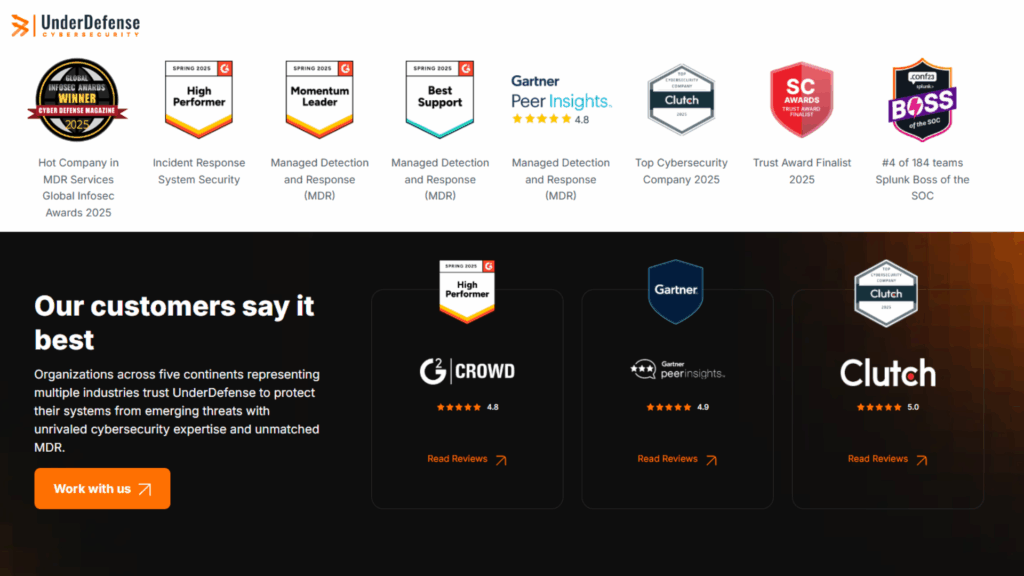
UnderDefense claims a 100% success rate against ransomware with a 15-minute mean-time-to-contain and a 20-minute SLA for critical alerts. The platform covers 99% of the MITRE ATT&CK framework through 1,500 pre-built correlation rules, delivering detection breadth that typically requires enterprise-budget SIEM deployments. They were named Hot Company in MDR Services at Global Infosec Awards 2025 and ranked #4 out of 184 teams at Splunk’s Boss of the SOC competition.
👥 Ideal Customer Profile
- SMBs with 50–500 employees and one or two IT generalists managing security part-time
- Compliance-driven organizations handling customer data under SOC 2, HIPAA, or ISO 27001
- Companies with existing security tools (SIEM, EDR, firewalls) that want to maximize ROI without ripping and replacing
- PE portfolio companies needing rapid security posture improvement across multiple entities
💰 Commercial Model
MDR services start at $11/device, with managed SOC plans starting from $162/asset annually. The UnderDefense MAXI platform offers a genuinely free tier, requiring no credit card and no time limit, so you can evaluate the technology before committing a dollar. This is significantly below Arctic Wolf’s $44,000/year minimum for comparable coverage.
⏰ When to Shortlist
Organizations that want both a technology platform and human-led security operations in a single vendor, particularly those that refuse to accept vendor lock-in or opaque pricing, should include UnderDefense during the RFP stage. If your team already runs Splunk, CrowdStrike, SentinelOne, or Microsoft Sentinel and needs someone to actually operationalize those investments 24/7, this is where to start.
💬 Customer Reviews
“We recently worked with UnderDefense on a penetration testing project, and the experience exceeded our expectations. Their team provided us with clear and detailed insights into security vulnerabilities, along with practical recommendations on how to fix them. This level of transparency made it easy for our team to take action and strengthen our security.”
— Arman N., CTO, Mid-Market (51–1000 emp.) UnderDefense G2 – Verified Review
“The biggest win for me was getting actual control over our security alerts. Before the guys from UD stepped in, we were getting bombarded with alerts from all our security tools. Their team cleaned up our configurations and got the noise under control within the first week. Now when we get an alert, we know it’s something worth looking into.”
— Verified User in Marketing and Advertising, Small-Business (50 or fewer emp.) UnderDefense G2 – Verified Review
2. Huntress: Best for SMBs Wanting the Largest Proven SOC Ecosystem ⭐⭐⭐⭐
📋 Overview
Huntress is the volume leader in SMB cybersecurity, protecting over 150,000 small and mid-sized businesses across 4.5 million endpoints. Founded by former NSA cyber operators Kyle Hanslovan and Chris Bisnett, the company brings offensive expertise to defensive security and distributes primarily through 4,300+ MSP partners. Huntress hit $100 million in ARR in 2024 with 70% year-over-year growth.
✅ Core Services
- 24/7 human-led, AI-assisted SOC with end-to-end investigation, containment, and remediation
- Managed EDR, Identity Threat Detection (ITDR), SIEM, and Security Awareness Training
- Lightweight agent with deployment possible in under 30 minutes
- Free trial available with full functionality and no commitment
- MSP-first distribution model with simple per-endpoint pricing
🎯 Why SMBs Consider Huntress
If you want the safety of knowing 150,000 other businesses trust the same platform, Huntress delivers that confidence at scale. Named the #31 Most Innovative Company by Fast Company in 2025, it earned #1 in EDR for Small Business on G2 for 10 consecutive quarters with 858 reviews and a 4.9/5 rating.
👥 Ideal Customer Profile
- SMBs with existing MSP relationships looking for managed security through their IT partner
- Organizations with 10–500 endpoints wanting proven, battle-tested detection
- Budget-conscious teams seeking the lowest per-endpoint cost in managed EDR
💰 Commercial Model
Huntress operates on per-endpoint pricing starting as low as $1.95/endpoint/month at volume through MSP partners, scaling up to approximately $8/endpoint/month for direct customers. No minimum commitment tiers.
⏰ When to Shortlist
SMBs that already work with an MSP, or plan to, and want the largest community-validated security platform should evaluate Huntress. Its scale provides unmatched threat intelligence across the SMB landscape.
3. Arctic Wolf: Best for SMBs Wanting a Dedicated Concierge Security Team ⭐⭐⭐⭐
📋 Overview
Arctic Wolf delivers a fully outsourced SOC experience to over 10,000 organizations worldwide, processing 65 billion security events daily. The company’s Concierge Security model assigns every customer a named security team rather than rotating analysts, providing strategic guidance alongside tactical monitoring. With $900M+ in total funding and a $4.3B valuation, Arctic Wolf brings enterprise stability to mid-market engagements.
✅ Core Services
- 24/7 Concierge Security Team with named analysts providing ongoing strategic advisory
- Managed Detection & Response, vulnerability management, and cloud monitoring
- Alpha AI platform (launched 2025) for autonomous threat prevention and workflow automation
- $3M financial coverage warranty against security incidents
- 250 technology integrations across endpoint, network, cloud, and identity sources
🎯 Why SMBs Consider Arctic Wolf
The concierge model appeals to SMBs that want a named security team they can build a relationship with, not a faceless SOC behind a ticketing portal. The $3M financial warranty is a risk-transfer feature no other provider on this list matches.
👥 Ideal Customer Profile
- SMBs with 100–500 employees willing to invest in a premium, fully outsourced security operations experience
- Organizations seeking a strategic security partner, not just a monitoring service
- Compliance-heavy industries (healthcare, financial services) needing continuous risk management
💰 Commercial Model
Arctic Wolf operates on subscription-based pricing aligned to organization size, with a $44,000/year minimum for MDR Basic, approximately $38/user/month for core MDR. This minimum commitment can be a barrier for the smallest organizations.
⏰ When to Shortlist
Mid-market SMBs (100–500 employees) with budgets that support premium concierge service, and organizations that value named relationships over technology-first approaches, should include Arctic Wolf during evaluation.
💬 Customer Reviews
“Arctic Wolf provides solid detection and response capabilities, but overly relies on the client’s team for remediation, which really hurts the value of the service.”
— VP of Technology, Services (non-Government), <$50M Revenue Arctic Wolf – Gartner Verified Review
“We received little value from ArcticWolf. The product offered little visibility when we were using it. Anything you want to look at or changes you need to make in the product must go through their engineering team. As an MSP, this is a horrible way to do business for us.”
— Matt C., Manager, Cybersecurity Services, Small-Business (50 or fewer emp.) Arctic Wolf – G2 Verified Review
4. Blumira: Best Free-Tier Entry Point for SMBs Starting From Zero ⭐⭐⭐⭐
📋 Overview
Blumira is a Michigan-based cybersecurity company focused exclusively on making SIEM and automated detection accessible to businesses with zero existing security infrastructure. Founded in 2018 with $28M in funding, Blumira’s cloud-native platform enables IT generalists, not security specialists, to deploy meaningful threat detection in a single afternoon.
✅ Core Services
- Free SIEM edition with 3 cloud integrations and 14 days of data retention, the only fully functional free product on this list
- Automated Detection & Response with sub-30-minute mean time to respond (MTTR)
- Pre-built compliance reports for 13 frameworks including HIPAA, SOC 2, PCI DSS, NIST, and CMMC
- 70+ integrations with flat-rate, per-user pricing (not data-volume-based)
- Deployment in hours requiring ~30 minutes/week of IT generalist time
🎯 Why SMBs Consider Blumira
For organizations that literally have zero SOC infrastructure today, Blumira offers the lowest-risk starting point. Connect Microsoft 365 or AWS in minutes, start seeing security insights immediately, and upgrade to paid monitoring when you’re ready. No vendor lock-in, no data-volume cost surprises.
👥 Ideal Customer Profile
- SMBs with 50–500 employees, zero existing security operations, and a tight budget
- Healthcare, financial services, and government organizations needing compliance-ready monitoring fast
- IT generalists who want to manage security with minimal time investment
💰 Commercial Model
Free tier available with no credit card required. Paid plans start at $12–21/user/month with flat-rate pricing, no data ingestion fees, and no surprise overages.
⏰ When to Shortlist
If your organization has literally zero security monitoring today and needs to start somewhere immediately, particularly ahead of a compliance audit, Blumira’s free tier is the fastest path to visibility.
5. Todyl: Best Unified All-in-One Platform for MSP-Served SMBs ⭐⭐⭐⭐
📋 Overview
Todyl is a New York/Denver-based cybersecurity platform that replaces up to eight separate security tools with a single, unified offering. Founded in 2017, the company raised $50M in Series B funding in 2024 with Datto founder Austin McChord joining the board. Todyl operates exclusively through MSP/MSSP partners, never selling directly to end customers, ensuring SMBs get local, hands-on support.
✅ Core Services
- All-in-one platform: SASE, EDR/NGAV, SIEM, MXDR, SOAR, and GRC from a single vendor with one agent
- Dedicated Risk and Advisory Manager (DRAM) for every customer regardless of size
- Janus AI-powered case analysis (2026) for natural-language threat investigation
- Channel-only model preserving MSP relationships and local support
- Platform base starting at $250/month with modular additions
🎯 Why SMBs Consider Todyl
Tool sprawl is a real operational tax for lean IT teams. Todyl’s pitch, consolidating your firewall, EDR, SIEM, SOAR, and compliance into a single platform managed by your existing MSP, resonates with SMBs drowning in point solutions. One user reported cutting onboarding time from hours to under an hour after consolidation.
👥 Ideal Customer Profile
- SMBs that work through an MSP for IT management and want unified security through that partner
- Organizations seeking to eliminate tool sprawl and reduce total security spend
- Not ideal for SMBs that manage IT internally without an existing MSP relationship
💰 Commercial Model
Platform base starts at $250/month with modular additions for each capability. Pricing flows through MSP partners, making it dramatically cheaper than assembling individual solutions from multiple vendors.
⏰ When to Shortlist
If your SMB already relies on an MSP for IT services and wants that partner to deliver comprehensive security, networking, and compliance through a single platform, Todyl should be on the evaluation list.
6. Radiant Security: Best AI-Native SOC for Tech-Forward SMBs ⭐⭐⭐⭐
📋 Overview
Radiant Security represents the cutting edge of AI-native SOC technology. Founded in 2021 by cybersecurity veterans from Imperva and Exabeam, the California-based startup raised $15M in Series A funding from Next47 (Siemens’ VC arm) and Lightspeed Venture Partners. Radiant currently protects 30 organizations and over 1 million users/endpoints, the smallest customer base on this list but arguably the most advanced AI approach.
✅ Core Services
- 100% alert triage: Radiant’s AI investigates every single alert, including never-before-seen alert types, with transparent reasoning
- Automates 80–90% of SOC workload out-of-the-box
- Built-in security data lake replacing expensive SIEM with claims of 85% logging cost reduction
- 100+ integrations with 30-minute onboarding (one CISO reported detecting a true positive within 30 minutes)
- Explainable AI: every escalation and dismissal includes full traceability of data sources queried, patterns detected, and reasoning
🎯 Why SMBs Consider Radiant Security
Most SOC tools and even human teams only triage a fraction of incoming alerts. Radiant’s differentiator is investigating 100% of them, with adaptive AI that reasons about entirely new alert types it has never seen before. For tech-forward SMBs that already have security tooling but lack the team to make sense of it all, Radiant turns existing investments into actually useful outcomes.
👥 Ideal Customer Profile
- Tech-forward SMBs with 50–500 employees that have existing EDR, cloud platforms, and identity tools but no SOC team
- Organizations seeking to eliminate the human bottleneck in alert investigation
- Companies comfortable with an earlier-stage vendor backed by strong VC funding
💰 Commercial Model
Custom pricing on a flat-rate model (not consumption-based), making costs predictable for SMB budgets. Specific pricing is not publicly disclosed. Prospective customers should request a tailored quote.
⏰ When to Shortlist
Tech-forward SMBs that want maximum AI automation with full transparency, and are comfortable being an early adopter of a well-funded but smaller-scale platform, should evaluate Radiant Security alongside more established providers.
Q2. How Were These AI SOC Providers Evaluated? (Selection Criteria & Star Ratings)
Ranking security providers without a transparent methodology is just opinion dressed up as advice. Here’s exactly how every vendor on this list earned its score, and why the criteria are weighted the way they are.
⚖️ Five Criteria, Weighted to 100%
Each AI SOC provider was scored across five dimensions specifically calibrated for SMBs with under 500 employees:
| # | Criterion | Weight | What It Measures |
|---|---|---|---|
| 1 | SMB Fit & Lean-Team Design | 25% | Suitability for organizations without dedicated security staff; deployment simplicity for IT generalists |
| 2 | AI SOC Capability & Detection Depth | 25% | 24/7 monitoring maturity, MITRE ATT&CK coverage, AI-driven triage, and incident response ownership |
| 3 | Pricing Transparency & Affordability | 20% | Published pricing, minimum commitments, cost predictability, and freemium options for SMB budgets |
| 4 | Review Quality & Volume | 15% | Verified reviews on G2, Clutch, Gartner Peer Insights, Capterra, and community sentiment on Reddit’s r/msp and r/cybersecurity |
| 5 | Onboarding Speed & Setup Simplicity | 15% | Time from contract to operational monitoring; technical complexity required from the buyer’s side |
⭐ Composite Scores & Star Ratings
Scores were compiled from vendor documentation, published pricing pages, verified review platforms, and Reddit community threads, all accessed and confirmed active in March 2026. The star rating scale: 0–20 = ⭐ | 21–40 = ⭐⭐ | 41–60 = ⭐⭐⭐ | 61–80 = ⭐⭐⭐⭐ | 81–100 = ⭐⭐⭐⭐⭐.
| Provider | SMB Fit (25%) | AI SOC Capability (25%) | Pricing (20%) | Reviews (15%) | Onboarding (15%) | Total | Stars |
|---|---|---|---|---|---|---|---|
| UnderDefense | 24 | 23 | 19 | 13 | 14 | 93 | ⭐⭐⭐⭐⭐ |
| Blumira | 22 | 18 | 18 | 11 | 11 | 80 | ⭐⭐⭐⭐ |
| Huntress | 20 | 19 | 16 | 14 | 8 | 77 | ⭐⭐⭐⭐ |
| Radiant Security | 17 | 22 | 14 | 8 | 13 | 74 | ⭐⭐⭐⭐ |
| Todyl | 18 | 17 | 15 | 11 | 10 | 71 | ⭐⭐⭐⭐ |
| Arctic Wolf | 14 | 20 | 10 | 12 | 8 | 64 | ⭐⭐⭐⭐ |
📊 Why UnderDefense Leads This Scoring
UnderDefense scored highest because it uniquely combines a free-tier platform entry point, published per-device pricing starting at $11, vendor-agnostic integration across 250+ tools, and a concierge Human Ally model delivered through Slack and Teams, all designed for organizations with one or two IT generalists. No other provider on this list hits all five criteria at that level simultaneously.
Arctic Wolf scored lowest primarily on pricing transparency (no published rates, $44,000/year minimum) and onboarding speed (requires stack migration to proprietary tooling), despite strong detection capabilities.
🔍 A Note on Data Sources
All scores drew from G2 (Spring 2025 and Winter 2026 reports), Clutch verified reviews, Gartner Peer Insights, Capterra, Reddit sentiment analysis across r/msp and r/cybersecurity, vendor pricing pages, and direct website verification conducted in March 2026.
Q3. Why Do SMBs Need an AI SOC, and How Is It Different From MDR, MSSP, or DIY SIEM?
🔓 The SMB Security Paradox
Here’s the uncomfortable math: 43% of all cyberattacks now target small and mid-sized businesses, yet less than 14% of SMBs are adequately prepared to defend themselves. For companies under 500 employees, the average cost of a data breach hits approximately $3.3 million, a number that doesn’t just hurt margins but ends businesses.
The problem isn’t awareness. Most IT Directors and CTOs know they need monitoring. The problem is that the security industry built its playbook for enterprises with 20-person SOC teams and seven-figure tooling budgets. When an SMB buys a SIEM, an EDR, and a firewall without dedicated analysts to operate them, they don’t get security. They get noise.
🛠️ The Tech Stack in Plain Language
Before comparing models, here’s what the jargon actually means:
- SIEM (Security Information & Event Management): Collects and correlates logs from across your environment. Think of it as a security camera system that records everything but doesn’t stop anyone.
- EDR (Endpoint Detection & Response): Monitors individual devices (laptops, servers) for malicious behavior. It sees what happens on each machine but not the broader organizational context.
- SOAR (Security Orchestration, Automation & Response): Automates response playbooks when threats are detected. Only useful when someone has actually written and maintained those playbooks.
Tools without a team equals noise, not security.
❌ Why Legacy Models Fail SMBs
| Model | What You Get | What’s Missing | Typical SMB Cost |
|---|---|---|---|
| DIY SIEM | Log collection, basic alerting | Analysts to investigate; 24/7 coverage; response capability | $50K–$150K/yr (tool + 1 FTE) |
| Legacy MSSP | Checkbox monitoring, monthly reports | Actionable context; real-time response; organizational understanding | $3K–$8K/mo |
| Traditional MDR | Alert detection, escalation tickets | Full response ownership; vendor-agnostic visibility; user verification | $5K–$15K/mo |
| AI SOC | AI-automated triage + human-led response across your full stack | $1K–$8K/mo |
MSSPs give you monitoring without intelligence, applying rigid playbooks to alerts they’ve never contextualized for your environment. Traditional MDR providers like Arctic Wolf detect and escalate, but remediation still lands back on your team. As one Gartner reviewer put it about Arctic Wolf: “This is not an extension of our security team as was originally sold.”
“This is not an extension of our security team as was originally sold.”
— Sr. Cybersecurity Engineer, Manufacturing Arctic Wolf – Gartner Verified Review
🤖 What an AI SOC Actually Does
An AI SOC automates 80–90% of the triage, investigation, and response cycle that used to require a full analyst team. Detection without response is noise. Response without context is risk. The real shift is a system that reasons across your entire tool stack, correlating endpoint alerts with identity signals, cloud logs, and email activity, then acts on confirmed threats before your team wakes up.
✅ The AI SOC + Human Ally Difference
At UnderDefense, we built the UnderDefense MAXI platform around a principle: AI collects context, accelerates data, and identifies patterns at machine speed, but humans make the final call on sensitive decisions. Our concierge analysts work directly in your Slack and Teams channels, verify suspicious activity with affected users, and contain threats end-to-end, including credential revocation, endpoint isolation, and lateral movement blocking. With 99% MITRE ATT&CK coverage through 1,500+ pre-built correlation rules and integration across 250+ existing tools, UnderDefense MAXI doesn’t replace your security investments but makes them operationally effective.
Q4. How Much Does an AI SOC Actually Cost? Real Pricing by Company Size
This is the section nobody else publishes, and the one SMBs need most. Opaque “contact sales” pages don’t help a 150-person company trying to build a security budget. Here’s what actual AI SOC protection costs at different company sizes, based on published rates and verified documentation.
💰 Pricing Models Explained
AI SOC providers typically price through one of four models:
- Per-device/per-endpoint: You pay for each monitored laptop, server, or workstation. Best for predictable SMB budgets.
- Per-user: Covers all devices a single employee uses. Simpler to forecast when employees have multiple devices.
- Flat subscription: Monthly base fee plus modular add-ons. Works well through MSP partners.
- Data-volume/consumption: Pricing tied to log ingestion volume. Unpredictable and risky for SMBs with growing environments.
For SMBs under 500 employees, per-device and per-user models deliver the most budget predictability. Avoid data-volume pricing unless you can guarantee stable log volumes, which most growing companies cannot.
📊 Estimated Annual Cost by Company Size
| Provider | Pricing Model | 50 Employees | 100 Employees | 250 Employees | 500 Employees |
|---|---|---|---|---|---|
| UnderDefense | $11/device/mo | ~$6,600/yr | ~$13,200/yr | ~$33,000/yr | ~$66,000/yr |
| Huntress | $1.95–$8/endpoint/mo | ~$4,800/yr | ~$9,600/yr | ~$24,000/yr | ~$48,000/yr |
| Blumira | $12–$21/user/mo | ~$7,200/yr | ~$14,400/yr | ~$36,000/yr | ~$72,000/yr |
| Todyl | $250/mo base + modules | ~$6,000/yr | ~$10,000/yr | ~$20,000/yr | ~$40,000/yr |
| Arctic Wolf | Custom (min. $44K/yr) | ~$44,000/yr | ~$44,000/yr | ~$55,000/yr | ~$95,000/yr |
| Radiant Security | Custom flat-rate | Contact sales | Contact sales | Contact sales | Contact sales |
Estimates based on published pricing pages and verified vendor documentation, March 2026. Actual costs may vary based on environment complexity and contract terms.
💸 The Real Comparison: AI SOC vs. Hiring vs. Getting Breached
The numbers above look abstract until you compare them to the alternatives:
- One SOC analyst hire: $77,000–$101,000/year base salary in the US, and that’s one person covering business hours only, not 24/7. True 24/7 coverage requires 4–5 FTEs, pushing total cost to $350K–$500K/year before tools, training, and 18-month average turnover.
- Average SMB breach cost: $3.3 million for businesses with fewer than 500 employees. Even at the lower end, $120,000–$1.24 million covers incident response, legal, lost revenue, and higher insurance premiums.
- Hidden costs of DIY: Separate compliance tools ($15K–$50K/yr), SIEM licensing ($20K–$100K/yr depending on data volume), and the opportunity cost of your IT generalists spending 10–15 hours per week on alert triage instead of their actual job.
✅ Why Transparent Pricing Matters
UnderDefense publishes its pricing directly: $11/device for MDR, with a freemium UnderDefense MAXI platform tier that costs nothing. We also offer a SOC Cost Calculator that lets you model in-house vs. outsourced costs for your specific environment. Compare that to “contact sales” competitors where the first number you see is on the contract, not the website. When you’re building a business case for your CFO, the last thing you need is a vendor who won’t tell you what they charge until you’re three meetings deep into a sales cycle.
Q5. How to Choose the Right AI SOC, and Where to Start With Zero Infrastructure
Choosing an AI SOC provider is a multi-year security commitment. Get it wrong, and you’re locked into a vendor-specific stack that creates more work than it eliminates. Get it right, and your lean IT team operates with the coverage of a 20-person SOC. Here’s how to make that decision with confidence.
✅ Security Operations Readiness Checklist
Before evaluating any vendor, score your current posture. Be honest: this is for you, not a compliance auditor.
- ☐ Do you have true 24/7/365 threat monitoring, not just during business hours?
- ☐ Does your team verify suspicious user activity directly via Slack, Teams, or phone before escalating?
- ☐ Can you contain a critical threat within 30 minutes of detection?
- ☐ Are your SIEM, EDR, cloud, and identity alerts correlated in one unified view?
- ☐ Does your security monitoring automatically generate compliance evidence (SOC 2, HIPAA, ISO 27001)?
- ☐ Can your team focus on strategic initiatives, or are they consumed by alert triage?
- ☐ Do you have direct access to Tier 3–4 analysts, not just ticket-based support?
📊 Score Interpretation
| Score | Assessment | What It Means |
|---|---|---|
| 6–7 ✅ | Mature | Focus on optimization and proactive threat hunting |
| 3–5 ⚠️ | Critical gaps | You’re likely missing threats or burning out your team on alert noise |
| 0–2 ❌ | High risk | Reactive processes dominate; coverage gaps are exposing you to breach risk |
🔍 The 7-Criteria Evaluation Framework
Score each AI SOC provider 0–2 on these criteria. Providers scoring 10+ represent genuine operational partnership; below 7 means you’re buying an alert feed, not managed detection and response.
- Vendor-Agnostic Integration: Does it work with your existing stack (SIEM, EDR, cloud), or force proprietary tool replacement?
- Human Analyst Access: Do you get direct communication with Tier 3–4 analysts, or just ticket-based escalations?
- Response Capability: Can they contain and remediate threats, or just detect and notify?
- ChatOps User Verification: Can they communicate directly with affected users to validate alerts, or escalate back to your team?
- Pricing Transparency: Is cost published and predictable per-endpoint, or hidden behind “contact sales”?
- Compliance Automation: Does security monitoring generate audit evidence automatically (SOC 2, HIPAA, ISO 27001, cyber insurance), or require separate GRC tools?
- Onboarding Speed: Does it require 6-month deployment and professional services, or 30-day turnkey implementation?
⭐ Where UnderDefense Stands: 14/14
| Criterion | Score | Why |
|---|---|---|
| Vendor-Agnostic Integration | 2 | 250+ integrations; works with your existing stack |
| Human Analyst Access | 2 | Direct Tier 3–4 analyst communication via concierge model |
| Response Capability | 2 | Full containment and remediation; 0.5h MTTR for critical incidents |
| ChatOps User Verification | 2 | Only MDR that contacts users directly via Slack/Teams/Email |
| Pricing Transparency | 2 | Published $11–$15/endpoint/month pricing |
| Compliance Automation | 2 | Forever-free compliance kits included with MDR |
| Onboarding Speed | 2 | 30-day turnkey deployment with custom detection tuning |
| Total | 14/14 |
🗺️ “Zero to Protected” Roadmap
For organizations starting with literally no SOC infrastructure, here’s the phased approach we recommend:
- Week 1: Deploy UnderDefense MAXI Free, and get immediate visibility into Microsoft 365, cloud, or firewall environments. Zero cost, zero risk.
- Weeks 2–4: Review initial findings. Use free-tier data to identify your actual threat surface and build the business case for your CFO.
- Month 2: Upgrade to the paid 24/7 tier, adding human-led monitoring and incident response.
- Month 3+: Expand to compliance automation (SOC 2, HIPAA, ISO 27001) and penetration testing to close remaining gaps.
🔒 Compliance Triggers That Force the Decision
Most SMBs don’t choose an AI SOC proactively. They’re forced into it by SOC 2 client demands, HIPAA regulations, or cyber insurance mandates requiring 24/7 monitoring. We include forever-free compliance kits and automated evidence collection with every MDR engagement, eliminating separate GRC spend entirely. Most teams go from 0 to 7/7 on the checklist within 30 days of onboarding.
Q6. Ready to Protect Your SMB With 24/7 AI SOC Coverage?
You’ve seen the providers, the scoring methodology, the real pricing, and the deployment roadmap. The next step is straightforward: either test-drive the UnderDefense MAXI platform for free or request a custom SOC quote tailored to your environment and compliance needs.
📋 Before You Request a Quote
Have these four details ready to get the most accurate proposal:
- Current endpoint count: Laptops, servers, and workstations your organization needs monitored
- Existing security tools: EDR (CrowdStrike, SentinelOne, Defender), SIEM (Splunk, Sentinel), identity (Okta, Azure AD)
- Compliance frameworks: SOC 2, HIPAA, ISO 27001, PCI DSS, or cyber insurance requirements driving the decision
- Deployment timeline: When 24/7 coverage needs to be operational (most UnderDefense MAXI deployments go live within 30 days)
🚀 Two Paths Forward
Whether you want to estimate costs first or talk to a human, both paths are available:
This analysis is based on verified G2 and Clutch reviews, published pricing data, MITRE ATT&CK documentation, and operational outcomes across 500+ MDR deployments protecting 65,000+ endpoints.
Q7. FAQ: AI SOC for Small Businesses, Your Questions Answered
Can AI Replace SOC Analysts?
AI replaces the triage grunt work, specifically the repetitive 80–90% of investigation steps that burn out human analysts, but it doesn’t replace the analysts themselves.
⚠️ AI excels at automated context collection: querying SIEMs, pulling logs, enriching with threat intel, and correlating signals across data sources at machine speed.
⚠️ AI falls short on decision-making: in roughly 30% of cases, AI-generated answers are not accurate enough for security-sensitive decisions, which is why humans still solve this problem better.
✅ The right model is augmentation, not replacement: AI collects context and you decide, then experienced analysts handle edge cases, user verification, and business-critical judgment calls.
UnderDefense MAXI exemplifies this balance. AI-driven investigation delivers structured findings to analysts in seconds, while concierge analysts own the final response.
Can You Get 24/7 Protection Without Hiring Anyone?
Yes. An AI SOC with outsourced analyst coverage delivers round-the-clock monitoring and response starting at $11–$21/endpoint/month, versus the $350K–$500K annual cost of staffing 4–5 FTEs for true 24/7 in-house coverage.
💰 UnderDefense MDR starts at $11/device/month with the UnderDefense MAXI free tier available at zero cost for initial assessment.
💸 A single SOC analyst hire costs $77K–$101K/year and covers business hours only, not nights, weekends, or holidays.
⏰ Hidden costs of DIY: 18-month average analyst turnover, separate compliance tools ($15K–$50K/yr), and 10–15 hours/week of IT generalist time diverted to alert triage.
What Compliance Does an AI SOC Help With?
A properly configured AI SOC generates continuous compliance evidence for SOC 2, ISO 27001, HIPAA, PCI DSS, NIST CSF, and cyber insurance mandates. UnderDefense includes forever-free compliance kits with every MDR engagement: automated evidence collection for audit readiness without separate GRC tools or additional vendor spend.
❌ Red Flags When Evaluating AI SOC Vendors
Five warning signs that a provider won’t deliver what they promise:
- Opaque pricing: “Contact sales” with no published per-endpoint rates means unpredictable costs and aggressive upselling.
- Proprietary lock-in: Forcing you to replace your existing SIEM or EDR with their stack means you lose data ownership and prior investments.
- Detection-only: If they detect but don’t contain, remediate, or respond, you’re buying an alert feed, not managed security.
- No MTTR SLAs: If response time commitments aren’t documented and published, they probably aren’t fast.
- No free trial or free tier: Vendors confident in their platform let you validate before you commit.
“This is not an extension of our security team as was originally sold.”
— Sr. Cybersecurity Engineer, Manufacturing Arctic Wolf – Gartner Verified Review
SOC-as-a-Service vs. AI SOC: What’s the Difference?
SOC-as-a-Service (SOCaaS) is a delivery model: outsourced security operations provided as a managed service. AI SOC is a technology approach: using artificial intelligence to automate triage, investigation, and response at machine speed.
The best providers combine both: AI-powered detection and investigation delivered as a fully managed service with human analyst oversight. UnderDefense MAXI is precisely this, combining AI-driven detection across 250+ tools with concierge analyst response, deployed as a managed service starting at $11/device/month. The result is 99% alert noise reduction and documented response times 2 days faster than CrowdStrike OverWatch.
1. What is an AI SOC, and how does it differ from a traditional SOC for small businesses?
An AI SOC combines artificial intelligence-driven detection, triage, and investigation with human analyst oversight to deliver security operations at a fraction of the cost of a traditional SOC. In a traditional model, you need 4–5 full-time analysts ($350K–$500K/year) to maintain true 24/7 coverage. An AI SOC automates 80–90% of the repetitive investigation steps, including log correlation, alert enrichment, and context collection, then escalates only confirmed threats to human analysts for final decision-making.
For SMBs under 500 employees, this means you get enterprise-grade monitoring without hiring a single security specialist. The AI handles alert volume at machine speed, while dedicated analysts own containment and remediation. We built UnderDefense MAXI around this exact model: AI collects context, humans make the call, and your IT generalist stays focused on their actual job.
The key distinction from legacy MSSPs or traditional MDR is response ownership. An AI SOC doesn’t just detect and escalate; it investigates, verifies with affected users, and contains threats end-to-end.
2. How much does an AI SOC cost for a company with 50 to 500 employees?
AI SOC pricing for SMBs varies significantly by provider and pricing model. Based on our research of published rates in March 2026:
-
Per-device pricing (most predictable): Starts at $11/device/month with UnderDefense, scaling to approximately $66,000/year for a 500-employee organization.
-
Per-user pricing: Ranges from $12–$21/user/month (Blumira), reaching $72,000/year at 500 employees.
-
Flat subscription: Todyl starts at $250/month base with modular add-ons through MSP partners.
-
Premium concierge: Arctic Wolf requires a $44,000/year minimum regardless of company size.
For context, one SOC analyst hire costs $77K–$101K/year and only covers business hours. True 24/7 coverage with in-house staff runs $350K–$500K/year. We publish our MDR pricing transparently so you can build a business case without sitting through three sales calls. If you want to model costs for your specific environment, our SOC cost calculator lets you compare in-house vs. outsourced scenarios.
3. Can a small business get 24/7 security monitoring without hiring a security team?
Yes. This is precisely what AI SOC providers are designed for. By combining AI-automated triage with outsourced analyst coverage, SMBs with one or two IT generalists can achieve round-the-clock protection starting at $11–$21/endpoint/month.
Here’s what that looks like operationally:
-
AI handles the first 80–90% of investigation steps automatically: log queries, threat intel enrichment, cross-tool correlation.
-
Human analysts, available 24/7/365, review escalated findings, verify suspicious activity directly with affected users via Slack or Teams, and execute containment actions like credential revocation and endpoint isolation.
-
Your IT team receives resolved incidents, not raw alerts, freeing 10–15 hours/week that would otherwise go to manual triage.
We designed our managed detection and response service specifically for organizations that can’t justify $350K+ in annual SOC staffing. The UnderDefense MAXI free tier lets you start with zero cost and zero risk before committing to paid 24/7 coverage.
4. What is the difference between AI SOC, MDR, MSSP, and SOC-as-a-Service?
These terms overlap in the market, but they describe distinct models:
-
MSSP (Managed Security Service Provider): Provides checkbox monitoring and monthly reports based on rigid playbooks. Lacks actionable context, real-time response, and organizational understanding. Typical cost: $3K–$8K/month.
-
MDR (Managed Detection & Response): Detects threats and escalates via tickets, but remediation often lands back on your team. Traditional MDR providers like Arctic Wolf still require you to investigate and close incidents.
-
SOC-as-a-Service (SOCaaS): A delivery model where security operations are outsourced as a managed service. Doesn’t specify the technology approach.
-
AI SOC: A technology approach that uses AI to automate triage, investigation, and response at machine speed, combined with human analyst oversight.
The best providers combine SOCaaS delivery with AI SOC technology. We’ve detailed this comparison in our guide on outsourced SOC vs. in-house SOC, which breaks down the operational and financial trade-offs for mid-market companies.
5. What compliance frameworks does an AI SOC help with?
A properly configured AI SOC generates continuous compliance evidence across multiple frameworks:
-
SOC 2: Automated evidence collection for trust service criteria (security, availability, confidentiality).
-
ISO 27001: Continuous monitoring mapped to Annex A controls with audit-ready documentation.
-
HIPAA: Protected health information monitoring, access logging, and incident documentation for healthcare organizations.
-
PCI DSS: Cardholder data environment monitoring and log retention for payment processors.
-
NIST CSF: Detection and response capabilities aligned to the NIST Cybersecurity Framework.
-
Cyber insurance: 24/7 monitoring evidence that many insurers now require for policy issuance or renewal.
Most SMBs don’t choose an AI SOC proactively. They’re forced into it by client demands for SOC 2 reports, HIPAA regulations, or cyber insurance mandates requiring 24/7 monitoring. We include forever-free compliance kits with every MDR engagement, eliminating the need for separate GRC tools or additional vendor spend.
6. What red flags should I watch for when evaluating AI SOC vendors?
After evaluating dozens of providers across hundreds of deployments, we’ve identified five consistent warning signs:
-
Opaque pricing: If there’s no published per-endpoint rate and the first number you see is on a contract, expect aggressive upselling and unpredictable costs.
-
Proprietary lock-in: Providers that force you to replace your existing SIEM or EDR with their stack are prioritizing their revenue over your operational continuity.
-
Detection-only service: If the provider detects threats but doesn’t contain, remediate, or respond, you’re buying an alert feed, not managed security.
-
No MTTR SLAs: Response time commitments that aren’t documented and published likely mean they aren’t fast.
-
No free trial or free tier: Confident vendors let you validate before you commit.
We’ve written a deeper analysis of these patterns in our AI SOC red flags guide. The core principle is simple: if a vendor can’t show you exactly how they work before you sign, that opacity will persist after you’re locked in.
7. How quickly can an SMB deploy an AI SOC with zero existing infrastructure?
With the right provider, you can go from zero SOC infrastructure to operational 24/7 monitoring in under 30 days. Here’s the phased approach we recommend:
-
Week 1: Deploy the free tier. Connect Microsoft 365, cloud environments, or firewall logs to get immediate visibility into your threat surface. Zero cost, zero risk.
-
Weeks 2–4: Review initial findings with the provider. Use free-tier data to identify your actual risk profile and build the business case for paid coverage.
-
Month 2: Upgrade to the paid 24/7 tier with human-led monitoring and incident response.
-
Month 3+: Expand to compliance automation and penetration testing to close remaining security gaps.
The critical factor is onboarding complexity. Some providers require 6-month deployments with professional services. Others, like UnderDefense MAXI, offer 30-day turnkey implementation with custom detection tuning included. Always ask for documented onboarding timelines before signing.
8. Is an AI SOC worth it for a company with fewer than 100 employees?
Absolutely. In fact, companies under 100 employees often have the most to gain because they face the same threats as larger organizations but with a fraction of the resources. The math is straightforward:
-
Average SMB breach cost: $3.3 million for businesses under 500 employees. Even a minor incident can cost $120K–$1.24M in response, legal fees, and lost revenue.
-
AI SOC cost for 50 employees: As low as $6,600/year ($550/month) with per-device pricing at $11/device.
-
One SOC analyst hire: $77K–$101K/year for business-hours-only coverage.
At $550/month, a 50-person company gets 24/7 AI-driven detection, human analyst response, and compliance evidence generation for less than 10% of a single analyst’s salary. We built our managed SOC pricing structure specifically to make this accessible. The free UnderDefense MAXI tier means you can validate the value before spending anything, which eliminates the risk entirely for organizations evaluating their first security investment.
The post Best AI SOC for SMBs: 6 Vendors Scored With Real Pricing (2026) appeared first on UnderDefense.