Q1. What Does Netskope Actually Cost in 2026? (Real Benchmarks, Not Marketing Ranges)
Netskope does not publish list pricing. Based on 12 verified enterprise purchases (Vendr, May 2026), Netskope Max Advantage costs $50 to $98 per user per year at median, depending on seat count, and a 500-seat deal lands at roughly $39,000 annually at P50. The NG-SWG Professional tier runs $64 to $125 per user per year across the same volume range. Every figure below is a planning benchmark. Your actual quote will vary by scope, term length, and negotiation leverage.
A CISO at a 4,000-person SaaS firm called me on a Saturday last quarter. His Netskope quote had landed at $620K for 5,000 seats. He wanted to know if that was a good number or a bad one. We pulled the Vendr P50 in 90 seconds. The answer was, “you are at P75, walk back in on Monday.” That is what these benchmarks exist for, and it is the same logic our team applies inside every MDR buyers guide conversation.
How the percentile method works
Vendr’s dataset comes from procurement teams uploading their actual signed contracts. P10 represents the best-negotiated outcome (a buyer with strong leverage or a competitive RFP). P50 is the median paid by a typical mid-market or enterprise buyer. P75 reflects an add-on-heavy deal with CASB API, DLP, and Premium Support stacked on top. The spread between these percentiles is the most useful planning tool you can carry into a Netskope negotiation. It tells you, in plain dollars, how much room exists before your CFO walks.
What the Vendr dataset confirms
- ⭐ Median 500-seat Max Advantage ACV: ~$39,000/year
- ⭐ Median PUPM: $6.50 to $8.16 (Max Advantage)
- ⭐ NG-SWG Pro PUPM: $5.33 to $10.42
- ⚠️ Max Advantage P25 to P75 spread on a 5,000-seat deal: roughly 38%
Confidence levels matter to the CFO
Not all numbers are equally reliable. ✅ Vendr-verified figures come from real signed contracts. ✅ Government procurement data (Cloud Ingenuity, GSA, UK G-Cloud 14) is public record and auditable. ❌ Field estimates from practitioner conversations are directionally useful but not contractually citable. Mark each tier in your internal model so legal and finance know which numbers can hold up in a board memo and which are planning aids only.
Master pricing anchor table (5,000-user baseline)
| SKU | User Tier | P50 Annual ACV | P25 Annual ACV | P50 PUPM | Source Confidence |
|---|---|---|---|---|---|
| Max Advantage | 500 seats | ~$39,000 | ~$31,000 | $6.50 | High (Vendr 12 purchases) |
| Max Advantage | 5,000 seats | ~$408,000 | ~$326,000 | $6.80 | High (Vendr) |
| NG-SWG Pro | 500 seats | ~$32,000 | ~$26,000 | $5.33 | Medium (Vendr small N) |
| NG-SWG Pro | 5,000 seats | ~$485,000 | ~$390,000 | $8.08 | Medium (Vendr + GSA) |
| CASB API add-on | per app-seat | ~$52.50/seat/yr | ~$41/seat/yr | n/a | High (Vendr + partner price list) |
In our experience helping mid-market and enterprise security teams negotiate SASE renewals, the single biggest unlock is not getting under P10. It is avoiding the P75 outcome by walking in with a defendable benchmark on day one. These numbers exist because procurement professionals submitted their actual contracts. Netskope did not disclose them. Use the benchmark to frame your opening counter, and then validate against your own scope before signing.
Q2. How Is Netskope Priced? The SKU Model, Licensing Units, and the App-Seat Trap
Netskope uses a named-user, per-year model for most SKUs. CASB API is the exception. It is billed per app-seat, where one user multiplied by one managed app equals one seat. A 500-user company managing 5 SaaS apps per user is not paying for 500 seats of CASB API. They are paying for 2,500. That single misunderstanding has inflated enterprise budgets by six figures more than once. The platform sits under the Netskope One umbrella, organized as SSE, Max Advantage, and SASE bundles.
The Netskope One platform tiers, in plain English
Think of Netskope One as the umbrella brand. Underneath it are three tiers. SSE is the Security Service Edge bundle, which includes SWG (Secure Web Gateway), CASB inline, and basic DLP. Max Advantage adds inline DLP at full strength, Cloud Firewall, and threat protection modules. SASE adds SD-WAN and full network convergence. CASB API, UEBA (User and Entity Behavior Analytics), DSPM (Data Security Posture Management), and DEM (Digital Experience Monitoring) all live as add-ons. They are not in the base bundle.
SKU and licensing unit map
| SKU | Licensing Unit | Edge-Case Warning |
|---|---|---|
| SSE Essentials | Per named user/year | Confirm DLP identifier count |
| Max Advantage | Per named user/year | Inline DLP only, API is extra |
| SASE bundle | Per named user/year | SD-WAN appliance billed separately |
| CASB API | Per app-seat/year | Multiplies by # of managed SaaS apps |
| UEBA | Per named user/year | Often discounted bundled, list price stiff |
| Dedicated Egress IP | Per unit/year | Required for some SaaS allowlists |
| China Elite Connectivity | Per unit/year | Surcharge for PRC traffic |
| Premium Support | % of ACV | Typically 8 to 15% |
⚠️ The app-seat trap, with numbers
Imagine a 500-user firm managing five SaaS apps under CASB API at a P50 rate of $52.50 per app-seat per year. The math is not 500 multiplied by $52.50, which would yield $26,250. The actual math is 500 multiplied by 5 multiplied by $52.50, or $131,250 per year. That is a five-times surprise hidden inside one licensing footnote. ❌ If your procurement team scopes CASB API on user count alone, you will sign a quote that cannot be undone for 36 months. Our managed SIEM team has audited this exact line item across dozens of renewals.
Business logic lock-in is the deeper cost
The license fee is not the worst lock-in. The real cost is the institutional memory you build inside Netskope’s DLP correlation engine. Years of custom regex patterns, fingerprinted documents, and tuned exception rules become an irreplaceable asset that lives only inside the vendor. When a CISO at a mid-market client of ours started a Netskope-to-alternative bake-off, the migration estimate alone was four engineer-quarters. The license number on the renewal sheet is the small number. The business logic you cannot extract is the big one, which is why our analysis of why businesses switch providers keeps coming back to data ownership.
Non-user billing units that arrive as surprises
✅ SD-WAN appliances are priced per item, not per seat. ✅ Dedicated Egress IPs are priced per unit and are often required for SaaS partner allowlists. ❌ China Elite Connectivity is a per-unit surcharge that buyers rarely notice on the first quote. ❌ Premium Support is typically 8 to 15% of total ACV, and that percentage compounds every renewal. The “M&M Network” framing applies here. The hard outer shell, proxy and inline DLP, looks unified. The soft center, UEBA, DSPM, and DEM, costs as much as the shell once properly scoped.
Q3. What Are the Hidden Fees That Will Inflate Your Netskope Bill?
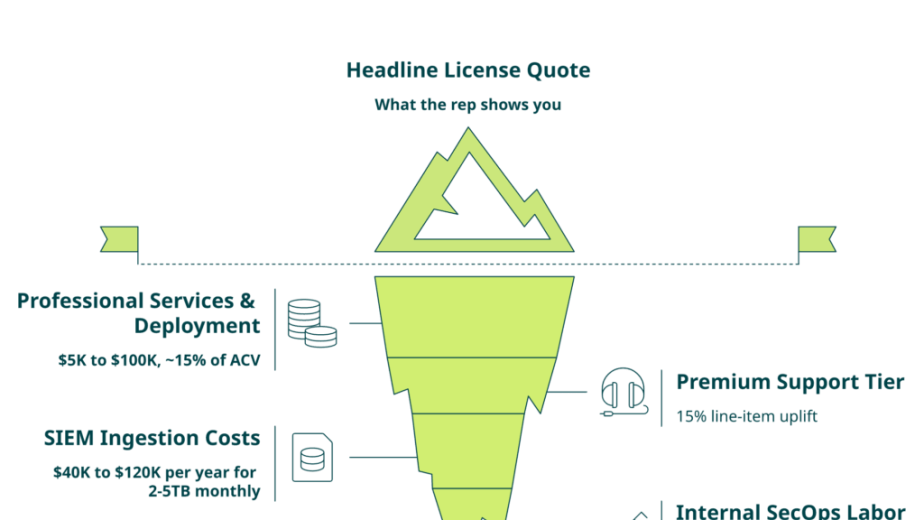
The seven most common Netskope cost surprises are: (1) Professional Services at $150,000 to $225,000 in Year 1, (2) DLP tuning labor not in the license, (3) CASB API app-seat multiplication, (4) Premium Support at 8 to 15% of ACV, (5) annual renewal uplift around 10% unless capped at signing, (6) AWS EC2 infrastructure for Cloud Exchange, and (7) bandwidth performance costs from missing peering with hyperscalers. Together, these inflate a headline quote by 30 to 60% in Year 1.
Why this section matters
Buyers consistently report Year 1 spend that lands 30 to 50% above the quoted license cost. The gap is not malice. It is structural. Netskope’s modular architecture moves cost from the SKU sheet into operations, professional services, and infrastructure. Mapping each fee to a dollar trigger and a contract clause is the only way to neutralize it before signing. Our 2026 cybersecurity budget playbook walks through the same exercise for an entire stack.
💰 Fee 1: Professional Services (Year 1)
Year 1 PS engagements typically land between $150,000 and $225,000 for a mid-enterprise rollout. The trigger is policy migration, identity integration, and DLP rule design. ✅ Neutralize it by capping PS at a fixed scope with milestone-based acceptance, and by negotiating a credit pool that rolls into Year 2 if unused.
💸 Fee 2: The DLP tuning treadmill
DLP licenses do not include the human labor needed to tune false positives down to a workable rate. Ponemon’s State of DLP 2024 documents an average of 17,000 daily DLP violations with a 74% false positive rate. ⏰ One client of ours admitted they were still tuning their legacy DLP four years after rollout. Plan for at least 0.5 FTE of dedicated tuning labor, every year, forever.
⚠️ Fee 3: CASB API app-seat multiplication
Covered in Q2 in detail. The neutralization clause is a “per-user-equivalent” cap written into the order form, not a per-seat metric.
Fee 4: Premium Support
Typically 8 to 15% of ACV, and the percentage often steps up at renewal. ✅ Lock the support percentage to the original ACV, not the renewed ACV, in writing.
Fee 5: Renewal uplift
Around 10% per year is standard unless you cap it at signing. On a $400,000 contract over three years, an uncapped 10% uplift adds roughly $84,000 of cumulative cost. ✅ Negotiate a CPI-linked or hard-capped renewal clause on day one.
Fee 6: AWS EC2 infrastructure for Cloud Exchange
Cloud Exchange, Netskope’s integration hub, runs on customer-owned AWS infrastructure. The compute and egress costs are not in the SKU.
Fee 7: The Peering Roadmap test
If the vendor lacks direct data center peering with Google, Amazon, and Microsoft, you pay in latency and user experience. This cost never shows up on an invoice. It shows up in help desk tickets and shadow IT adoption. ✅ Demand the peering roadmap in writing as part of the technical evaluation.
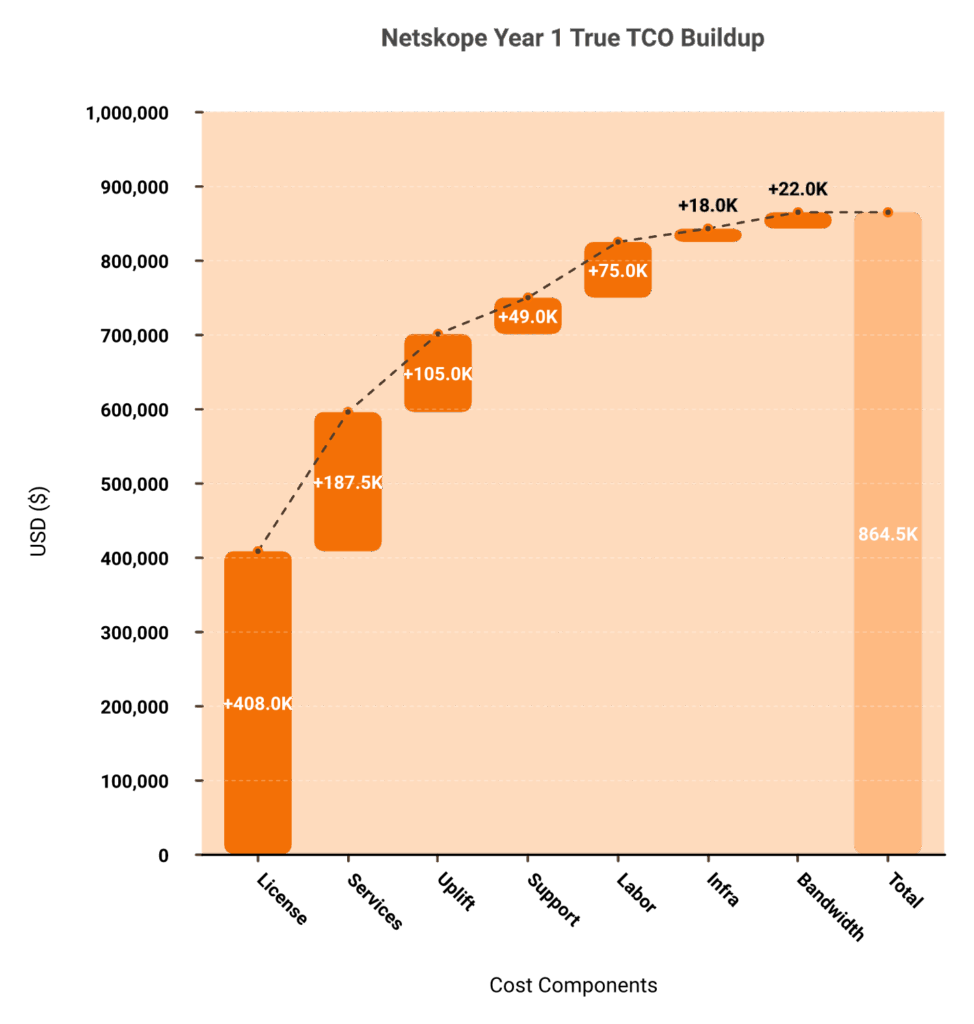
Worked example: 500-user Max Advantage, true Year 1 TCO
| Line Item | Headline Quote | True Year 1 Cost |
|---|---|---|
| Max Advantage licenses | $39,000 | $39,000 |
| Professional Services | not listed | $150,000 |
| Premium Support (12% ACV) | not listed | $4,680 |
| DLP tuning labor (0.5 FTE) | not listed | $75,000 |
| Total Year 1 | $39,000 | $268,680 |
“The biggest win for me was getting actual control over our security alerts. Before the guys from UD stepped in, we were getting bombarded with alerts from all our security tools.”
— Verified User in Marketing and Advertising, Small-Business Under Defence G2 – Verified Review
“We had a complex project, and UnderDefense did their best to help us.”
— Senior Product Manager, Identity Management Startup Under Defence Clutch – Verified Review
“Lack of true remediation in the response, costing us significantly in resources and introducing risks in security.”
— VP of Technology Arctic Wolf – Gartner Verified Review
Q4. Netskope vs. Zscaler vs. Palo Alto Prisma vs. Cato: 3-Year TCO Comparison
At 5,000 seats over three years, Netskope’s fully-loaded TCO lands at approximately $6.0M, versus Zscaler at $5.4M, Cato at $5.1M, and Palo Alto Prisma at $8.0M, or roughly $33.46 per user per month all-in. Netskope costs about 12% more than Zscaler on a capability-adjusted basis, but 25% less than Palo Alto Prisma. The premium over Zscaler is justifiable only when advanced inline DLP (3,000+ identifiers), multi-cloud CASB API, or FedRAMP and HIPAA compliance dashboards are hard requirements.
How the comparison was built
All four vendors are scoped at 5,000 users, three-year term, with Professional Services normalized to a $175,000 baseline, internal labor (0.5 FTE for tuning) included, and DLP parity add-ons leveled across vendors. The CFO can audit the math line by line. We did not include outlier discounts or single-tenant deployments. For a parallel framework on endpoint economics, see our CrowdStrike vs. SentinelOne teardown.
The counterintuitive finding
Most buyers assume Palo Alto Prisma is roughly comparable to Netskope on price. The data says otherwise. Netskope is roughly $2M cheaper than Prisma over three years at 5,000 seats. The Palo Alto premium is rarely justified outside of customers already deeply committed to Cortex XDR and the broader Palo Alto ecosystem.
Master 3-year TCO table (5,000 users)
| Vendor | 3-Year TCO | PUPM (all-in) | Best-Fit Profile |
|---|---|---|---|
| Cato Networks | ~$5.1M | $28.33 | Distributed branch, SD-WAN-first |
| Zscaler | ~$5.4M | $30.00 | SaaS-heavy, M365-integrated |
| Netskope | ~$6.0M | $33.46 | Multi-cloud CASB, advanced DLP |
| Palo Alto Prisma | ~$8.0M | $44.44 | Existing Cortex XDR commitment |
Working with security teams across SaaS-native and hybrid enterprises, what I have noticed is that buyers anchor on the wrong number. They compare list-price PUPM. The number that actually moves the board is the 3-year all-in PUPM with PS, support, and tuning labor included. That is the number Prisma loses on, and Cato wins on. Use our SOC cost calculator to layer the response budget onto whichever SASE you choose.
Choose by profile
✅ Choose Netskope when your organization has a multi-cloud SaaS estate, needs deep CASB API coverage across 5+ regulated apps, and has a hard regulatory requirement for FedRAMP or HIPAA dashboards. The advanced inline DLP with 3,000+ identifiers is genuinely differentiated when content inspection is mission-critical.
✅ Choose Zscaler when your environment is M365-centric, your remote workforce drives most traffic, and your DLP needs are moderate. Zscaler’s ZIA peering footprint is mature, and the operating model is simpler.
✅ Choose Cato when you have a meaningful branch-office or SD-WAN footprint and want network plus security convergence in one bill. Cato’s single-vendor architecture lowers operational overhead for lean IT teams.
The NIST CSF Budget Mapping problem
Map this entire $6M Netskope spend onto the NIST Cybersecurity Framework, and a structural gap appears. Every dollar in the table covers Identify and Protect. Zero dollars cover Respond and Recover. SASE platforms detect and block. They do not own the human investigation, user verification, or incident closure work that defines Respond. That gap is not a Netskope problem specifically. It is shared by all four vendors. It is also the honest setup for the response-layer conversation later in this guide, which connects directly to our MDR service.
In our experience running MDR for global enterprises, the SASE plus MDR architecture works when each layer owns a clear outcome. SASE owns Identify and Protect. The MDR layer owns Respond and Recover, with vendor-agnostic visibility across SASE, EDR, and identity signals on the Under Defence MAXI Platform. Trying to make a SASE platform do response work it was not built for is how teams end up with a $6M Identify-and-Protect investment and a 4 a.m. bridge call with no clear owner.
“Underdefense act as an extension of our team, so we don’t need additional resources, ensuring 24/7 protection. It also solved our problem of having separate security tools that didn’t work well together.”
— Inga M., CEO, Mid-Market Under Defence G2 – Verified Review
“UnderDefense MAXI integrates well with our systems, specifically with our SIEM, Splunk. Their team is proactive in identifying and addressing threats, providing 24/7 oversight.”
— Oleg K., Director Information Security Under Defence G2 – Verified Review
Q5. Which Netskope Modules Are Worth the Premium, and Which Can You Replace for Free?
Netskope’s inline CASB (Cloud Access Security Broker) and Advanced DLP (Data Loss Prevention) are genuinely differentiated when you need real-time protection across 50+ SaaS apps with 3,000+ data identifiers. If your estate is primarily Microsoft 365, you likely already own 60 to 70% of this capability through M365 E5 Purview DLP and Defender for Cloud Apps. Most organizations have never fully activated those entitlements. Before renewing any Netskope DLP or CASB module, run a 2-hour M365 entitlement audit. You may recover six figures in unnecessary license spend.
The contrarian thesis up front
Most CISOs assume that if their CASB module exists, it is worth its line item. That assumption skips the audit step. Shadow IT discovery, basic DLP, and OAuth consent governance are already inside your M365 E5 or Google Workspace license. The real question is not whether Netskope’s CASB is good. The question is whether you have activated what you already own, and what the residual gap actually costs. Our MDR for Microsoft 365 team runs this exact audit before recommending any new SaaS security spend.
Inline vs. API mode, in plain English
Inline CASB sits in the network path and inspects traffic in real time. This is architecturally differentiated and hard to replicate cheaply. API mode connects to SaaS apps through their admin APIs and scans data at rest. ✅ Inline is irreplaceable for real-time DLP enforcement. ❌ API mode is partially replicable with Defender for Cloud Apps if you already own M365 E5. SSPM (SaaS Security Posture Management) similarly overlaps with Microsoft Secure Score.
The DLP tuning economics nobody quotes
Ponemon’s 2024 State of DLP study found 17,000 daily DLP violations on average with a 74% false positive rate. ⚠️ Advanced DLP without a dedicated tuning resource creates negative ROI fast. The “Release Button mess” is the operational reality: aggressive quarantine policies crush help desks, and every false positive becomes a ticket. ⏰ At 0.5 FTE of tuning labor, you are spending roughly $75,000 annually just to make the module behave. Pairing the deployment with our managed SIEM absorbs that triage queue.
Buy vs. already own decision matrix
| Netskope Module | M365 E5 Equivalent | Coverage Gap | Recommendation |
|---|---|---|---|
| Advanced Inline DLP | Purview DLP (endpoint, app) | Real-time inline at network layer | ✅ Buy if multi-cloud SaaS |
| CASB Inline | Defender for Cloud Apps (limited) | Real-time SaaS proxy | ✅ Buy if 50+ SaaS apps |
| CASB API | Defender for Cloud Apps | Minimal, mostly overlap | ❌ Audit before buying |
| SSPM | Secure Score plus Defender for Cloud | Cross-SaaS posture only | ❌ Often replaceable |
| Shadow IT Discovery | M365 OAuth consent logs | Non-M365 SaaS visibility | ❌ Free with audit |
| UEBA | Microsoft Sentinel UEBA | Network-layer behavior | ⚠️ Compare carefully |
When Netskope DLP and CASB earn their premium
✅ Multi-cloud SaaS estate beyond M365 (Salesforce, ServiceNow, Workday, Box, and Slack on a separate tenant).
✅ Regulated content with 3,000+ identifiers (PHI, PCI, and source code fingerprinting).
✅ Real-time inline blocking is a hard policy requirement, not nice-to-have.
❌ Mostly M365 with light Salesforce: Purview likely covers you.
❌ No FTE budget for DLP tuning: you will pay the license and underuse the engine.
The 6-step M365 entitlement audit
- Pull your current E5 license SKUs from the M365 admin center.
- List every Purview DLP policy currently active vs. available.
- Export OAuth consent logs and map shadow SaaS use.
- Run Defender for Cloud Apps discovery for 30 days.
- Score overlap against your Netskope CASB and SSPM scope.
- Quantify the displaceable spend in dollars before renewal.
“Underdefense act as an extension of our team, so we don’t need additional resources, ensuring 24/7 protection.”
— Inga M., CEO Under Defence G2 – Verified Review
“Lack of true remediation in the response, costing us significantly in resources and introducing risks in security.”
— VP of Technology Arctic Wolf – Gartner Verified Review
Q6. What Does Netskope’s GenAI Security Cost, and Is “Blocking” the Wrong Strategy?
As of May 2026, Netskope has no discrete standalone GenAI SKU with published pricing. AI capabilities are bundled inside existing platform editions. Netskope One DSPM (Data Security Posture Management) is the nearest dedicated AI-era product. Budget $5 to $15 per user per year as a planning assumption for AI Access Governance when it separates from bundles. More importantly, using a proxy to ban ChatGPT does not eliminate GenAI risk. It moves usage to personal devices and removes CISO visibility entirely. Monitor the agent. Do not ban the tool.
Where AI lives inside the Netskope platform today
SkopeAI and AI-powered DLP are embedded inside the Max Advantage and SASE platform editions. There is no à la carte SKU yet that says “GenAI Module: $X per user per year.” DSPM is the beachhead product that sees AI training data and model exposure surfaces. ⚠️ The lack of a discrete SKU is a double-edged sword. Buyers do not pay an explicit AI line item today, but contractual rights to future AI modules are usually missing from current renewals. Our MDR for AI team sees this gap on nearly every renewal walkthrough.
The AI-Washing warning
Many proxy and DLP vendors have relabeled existing engines as “AI-aware” without rebuilding the underlying detection logic. Operational data shows AI is correct in roughly 30% of security investigation cases. ❌ Leading with AI as a “decision-maker” is risky without human Tier 3 to Tier 4 analysts validating intent. Distinguish real agentic threat detection from rebranded regex. Demand a live demo before paying any AI premium, and read our AI SOC red flags teardown before you sign.
The “Banning Never Works” reality
Netskope Threat Labs reported that 96% of enterprises had employees actively using GenAI apps in 2025, while only 19% enforced AI usage policies at the network layer. When a proxy blocks ChatGPT at the corporate gateway, employees move to personal phones on personal LTE. The CISO loses visibility entirely. ⏰ Shadow AI created by aggressive blocking is harder to govern than monitored AI on a managed device.
Three contract clauses to demand in 2026
✅ AI Module Pricing Rights: lock the right to add future GenAI SKUs at a documented per-user ceiling, not “then-current list price.”
✅ AI Telemetry Data Residency: specify where prompts, embeddings, and metadata are stored, and require regional residency where GDPR or NIS2 applies.
✅ Agentic AI Monitoring Scope: define explicitly whether the contract covers human GenAI use only, or also autonomous AI agents acting on behalf of users (the harder problem).
The practical posture
Working with security teams across 1,000 to 10,000 employee enterprises, what I have noticed is the winners do not block. They monitor, they classify prompts by sensitivity, and they coach users in real time through ChatOps. ✅ That posture preserves productivity. ✅ It preserves visibility. ❌ A pure block-and-pray strategy buys six months of comfort before the Shadow AI tail catches up. We have built our own Under Defence MAXI Platform workflows around this principle: detect AI use, validate intent with the user in Slack or Teams, and respond with context, not a hard 403 page.
“I really like how straightforward UnderDefense’s dashboards are. It shows me all I need to know about my computer’s safety in a very simple way.”
— Alexey S., CEO Under Defence G2 – Verified Review
Q7. How Do You Build the ROI and Compliance Business Case for Netskope?
The Forrester Total Economic Impact study (October 2024) found Netskope SSE delivered 109% ROI over three years, with payback in under six months. Drivers included $5.4M in legacy tool consolidation savings, $1.8M in productivity recovery, and an 80% reduction in IT support tickets. Map these against your compliance cost exposure: a single GDPR Article 33 breach notification fine can reach €20M or 4% of global turnover. The DLP module cost is not a security line item. It is a compliance insurance premium.
The Forrester numbers, with the honest caveat
The 109% ROI assumes a well-deployed, well-tuned platform with PS engagement absorbed and DLP false positives under control. ⚠️ Year 1 PS and tuning costs typically push the realized payback timeline 6 to 12 months later than the abstract figure suggests. CFOs reading the TEI cold often miss this. Anchor the conversation in the headline number, then contextualize it against your own deployment maturity before promising the board the same return. Our 2026 cybersecurity budget playbook shows how to phase that maturity over four quarters.
NIST CSF 2.0 budget map
| CSF Function | Netskope Coverage | Modules | Coverage Level | Board Risk |
|---|---|---|---|---|
| Identify | High | DSPM, SSPM, Discovery | ✅ Strong | Low |
| Protect | High | SWG, CASB, DLP, Cloud FW | ✅ Strong | Low |
| Detect | Partial | UEBA, SkopeAI | ⚠️ Limited | Medium |
| Respond | Absent | None native | ❌ Zero | High |
| Recover | Absent | None native | ❌ Zero | High |
Mapping the spend visually surprises nearly every CISO who does it for the first time. Every dollar in a SASE renewal funds Identify and Protect. Respond and Recover get nothing from this line item. That is not a Netskope flaw specifically. It is shared by every SASE platform on the market today. Our incident response team fills exactly that gap.
The compliance penalty offset calculation
IBM’s Cost of a Data Breach 2024 reported a $4.88M global average breach cost, with $2.2M average savings from AI-driven prevention. Combine that with GDPR Article 33, PCI DSS v4.0, and SEC Item 1.05 disclosure exposure to build a risk-adjusted ROI that complements the operational Forrester TCO. The compliance offset is often larger than the platform’s operational savings, which is why our compliance services team builds the risk-adjusted model alongside the operational TCO.
Compliance penalty offset table
| Regulation | Netskope Module Mapping | Coverage Level | Residual Gap | Penalty Exposure |
|---|---|---|---|---|
| GDPR Art. 33/34 | DLP, CASB, DSPM | Partial | Response and notification ownership | €20M or 4% turnover |
| HIPAA | DLP, CASB | Partial | BAA, breach response | $50K to $1.5M per violation |
| PCI DSS v4.0 | DLP, SWG, CASB | Strong on data, weak on response | IR documentation | $5K to $100K monthly |
| SEC Item 1.05 | DSPM, UEBA | Detect only | Material incident disclosure (4 days) | Stock-price and litigation risk |
The board-ready ROI formula
Risk-adjusted ROI = (Breach Probability × Breach Cost × Prevention Rate) minus 3-year Netskope TCO.
✅ Plug in your sector-specific breach probability from Verizon DBIR 2024.
✅ Use the IBM $4.88M figure (or your own actuarial number if you have cyber insurance data).
✅ Apply the Forrester prevention rate as the upper bound.
The output is a single dollar figure your CFO can defend in a board memo.
The last time I presented this exact framework to a PE Operating Partner, the question that closed the conversation was not about ROI. It was, “what is our SEC Item 1.05 exposure if this fails?” Lead the deck with that number. Forrester’s 109% closes the deal, but the disclosure exposure opens the room.
In our experience presenting MDR business cases to PE Operating Partners, the number that closes the room is not the operational ROI. It is the compliance penalty offset combined with the SEC Item 1.05 disclosure exposure. Boards understand existential risk faster than operational efficiency. ⭐ Lead the deck with the compliance number, follow with Forrester’s 109%, and close with the NIST Respond and Recover gap surfaced by our MDR service.
Q8. The Negotiation Playbook: How to Cut Your Netskope Quote by 25 to 45%
Netskope’s fiscal year ends January 31. Deals signed in November through January consistently deliver the deepest discounts, 25 to 35% below initial quote for prepared buyers, and up to 45 to 50% at the P10 outcome level in Vendr’s dataset. Your five most powerful levers, in order, are: a credible Zscaler or Cato competitive quote, a 3-year commit, a volume expansion commitment, quarter-end urgency, and unbundling add-ons for separate negotiation rather than accepting a “bundled deal.”
The setup: why preparation is worth $15K to $40K
Vendr’s transaction data shows that buyers who negotiate actively save an average of $15,000 to $40,000 versus passive renewals at the same seat count. ⭐ The five levers below are ranked by observed deal impact, not theoretical leverage. Walk into the room with the benchmark, the alternative quote, and the calendar on your side. Calibrate the response budget alongside the SASE spend using our SOC cost calculator.
Step 1: The credible competitive quote
Get a real Zscaler ZIA and Cato SASE quote in writing before opening Netskope renewal talks. ✅ Forward the redacted PDF to your Netskope rep. ✅ Say, “We are evaluating both. Match this price or justify the premium.” Expected outcome: 10 to 20% discount on day one. ⚠️ Independent benchmarks (Vendr, costbench.com) protect against the “Shadow Economy of Procurement” where vendor-CISO financial relationships can quietly shape recommendations.
Step 2: The 3-year commit
Trade duration for price. ✅ A 3-year commit unlocks an additional 8 to 15% versus 1-year. ⚠️ Cap renewal uplift at 6% in writing on day one. Otherwise the multi-year savings evaporate by Year 4. Our analysis of why businesses switch providers shows uncapped uplift as the leading switching trigger.
Step 3: Volume expansion commitment
Commit to a documented seat ramp tied to your hiring plan. ✅ Expected outcome: 5 to 10% additional discount and protected per-user pricing through the ramp. ❌ Do not commit to seats you do not have hiring approval for. Shelfware is the worst negotiation outcome.
Step 4: Quarter-end urgency
Netskope sales reps carry quarterly quotas. ⏰ A deal that closes on January 30 is worth more to your rep than a deal that closes on February 2. ✅ Time your final counter to the last 5 days of the fiscal quarter. Expected outcome: an additional 5 to 12% in motion.
Step 5: Unbundle the add-ons
Bundled “savings” hide line-item premiums. ✅ Ask for CASB API, UEBA, DSPM, and DEM priced separately. ❌ Refuse the “package discount” framing until you see each unit price. Renegotiate any line that prices above your benchmark.
Netskope FY negotiation calendar
| FY Quarter | Calendar Months | Discount Opportunity | Recommended Tactic |
|---|---|---|---|
| Q1 | Feb to Apr | 💰 Lowest | Use only for forced renewals |
| Q2 | May to Jul | 💰 Moderate | Begin RFP, get competitive quotes |
| Q3 | Aug to Oct | 💰💰 Strong | Pre-position alternatives, draft term sheet |
| Q4 | Nov to Jan 31 | 💰💰💰 Deepest | Close with quarter-end urgency |
Six contract clauses to demand
- Renewal uplift cap at 6% (not 10%, not “CPI plus”)
- True-up mechanics defined in writing (no surprise overages)
- Professional Services cost ceiling with milestone acceptance
- Multi-year module lock-in at current per-unit rates
- AI SKU pricing rights for future GenAI modules
- Exit data portability and migration assistance language
The 5-year compounding math
A $1.4M Year 1 license at 10% annual uplift becomes roughly $2.05M by Year 5. Capping that uplift at 6% in writing at signing is worth approximately $350,000 over the same 5-year horizon. 💸 That single sentence justifies a hard negotiation conversation, even if every other lever fails. The cap clause costs nothing to ask for. It costs hundreds of thousands not to.
Q9. When Does Netskope Become the Wrong Choice, Four Scenarios to Know Before You Sign
Netskope underperforms in four scenarios: (1) hybrid or OT (Operational Technology, factory-floor) environments where a SaaS-heavy proxy creates visibility gaps; (2) M365-native organizations that have not audited E5 Purview entitlements; (3) sub-200-seat buyers who cannot achieve volume economics; and (4) teams without a dedicated DLP tuning resource. In all four cases, Cato or Zscaler typically deliver better-fit economics. The best pricing guide is the one that tells you when not to buy.
Why “not recommended for” matters more than the spec sheet
Misfit deployments cost more than the license itself in operational debt. The architectural decision drives 80% of the realized cost over five years. Spec sheets do not capture that. ⚠️ Every CISO who has signed the wrong SASE contract describes the same pattern, the price was fine, the fit was wrong, and the renewal came with no clean exit. Our MDR buyers guide walks through the same fit-first decision process for response tooling.
Scenario 1: Hybrid and OT environments
❌ A SaaS-heavy proxy was never designed to inspect Modbus, OPC-UA, or factory-floor PLC traffic. ✅ For environments with on-prem manufacturing, energy, or healthcare device estates, Cato Networks or a dedicated OT security platform (Claroty, Dragos) are stronger fits. Decision signal: more than 30% of your traffic does not originate from a managed user endpoint. Our hybrid cloud security playbook covers the inspection architecture in detail.
Scenario 2: M365-native, light SaaS estate
❌ If your SaaS estate is essentially M365 plus three or four supporting apps, Netskope’s CASB premium is hard to justify. ✅ Activate M365 E5 Purview DLP and Defender for Cloud Apps first. Decision signal: more than 70% of SaaS traffic terminates inside Microsoft endpoints. Pair the activation with our MDR for Microsoft 365 for full coverage.
Scenario 3: Sub-200-seat buyers
❌ Per-seat economics break below ~200 seats. PS minimums and Premium Support floors absorb the savings of small contracts. ✅ Zscaler ZIA Essentials or Cato’s small-business tiers deliver better unit economics at this size. Decision signal: your seat count is under 200, and growth is flat.
Scenario 4: No dedicated DLP tuning resource
Without a 0.5 FTE tuning resource (or an MDR partner absorbing the triage load), advanced DLP creates negative ROI fast. The Ponemon 74% false-positive rate quickly buries help desks. ❌ The “Release Button” backlog crushes IT support within a quarter. ✅ Either budget the FTE or pair the deployment with an MDR service partner that owns the triage queue.
Buyer-profile decision matrix
| Buyer Profile | Recommended Platform | Rationale | Key Deciding Condition |
|---|---|---|---|
| SaaS-native, 1,000+ seats, multi-cloud | ✅ Netskope | Inline DLP, CASB depth | 50+ regulated SaaS apps |
| M365-heavy, light SaaS | ⚠️ Audit M365 E5 first | Purview likely covers 60 to 70% | Microsoft-dominant estate |
| Branch-heavy, SD-WAN-first | ✅ Cato Networks | Network plus security convergence | 20+ branch offices |
| OT or factory-floor hybrid | ❌ Not Netskope | Proxy blind to OT protocols | OT traffic over 30% |
| Remote-first, M365-centric | ✅ Zscaler | Mature ZIA peering, simpler ops | 80%+ remote workforce |
The “National Geographic switch” pattern
Practitioners report at least one major enterprise client (National Geographic) migrated off Netskope when the platform became too cumbersome, and SIEM integration friction grew unmanageable. Even market leaders lose deployments when the operational tax outpaces the protection delivered. This is a practitioner-reported pattern, not a public statement. Treat it as a directional signal, and read our analysis of why businesses switch providers for the broader pattern.
“Lack of true remediation in the response, costing us significantly in resources and introducing risks in security.”
— VP of Technology Arctic Wolf – Gartner Verified Review
“Despite the capabilities of the technical platform and the strength of the analysts providing the service, there is still a limit to the environmental/organizational knowledge inherent in the service.”
— Verified User in Computer Software, Mid-Market Expel – G2 Verified Review
Q10. What Netskope Cannot Do, and the MDR Layer That Fills the Gap (+ Free Stack Audit)
Netskope excels at blocking. Inline DLP drops the connection, CASB quarantines the file, and the proxy denies the request. What it cannot do is investigate, triage, and respond. The $300,000 payroll fraud caught by UnderDefense MAXI was not flagged by a single DLP pattern match. It was found through behavioral correlation across identity, endpoint, and CASB signals that no proxy-only posture can perform. Resolution is a different capability from blocking. It requires a different budget line.
The Situation: a complete-looking stack
Picture the well-deployed Netskope environment. Inline DLP is tuned. CASB API is mapped to your SaaS estate. The proxy is blocking shadow IT consistently. The CISO walks into the board meeting with a green dashboard. The stack feels complete. ⏰ It is not complete. Logs and events are not the same as investigations and outcomes, which is the gap our SOC service closes.
The Complication: a $300K accidental discovery
A mid-market client of ours had Netskope in production and a tuned DLP policy. A payroll fraud scheme moved $300,000 over several weeks. ❌ The proxy saw normal HTTPS traffic to a sanctioned SaaS app. ❌ DLP rules looked for files and patterns. Neither fired. The scheme did not involve a “malicious file” anywhere in the chain.
The Resolution: behavioral correlation across signals
Our Under Defence MAXI Platform MDR layer correlated CASB alerts, identity sign-in anomalies, and endpoint behavioral telemetry. ✅ The pattern emerged from cross-signal context, not from any single rule. ✅ A human analyst then reached the affected user through ChatOps, validated intent, and locked the session. The fraud was contained inside an hour. “Silence is a detection failure” is the lesson here. If your SASE tool passes a pen test quietly, that is not success. It is the proxy missing lateral movement, which our incident response team sees repeatedly during retainer kickoffs.
NIST CSF coverage gap, side by side
| CSF Function | Netskope | UnderDefense MAXI |
|---|---|---|
| Identify | ✅ DSPM, SSPM | ⚠️ Complement |
| Protect | ✅ SWG, CASB, DLP | ⚠️ Complement |
| Detect | ⚠️ Partial (UEBA) | ✅ Cross-signal correlation |
| Respond | ❌ None native | ✅ Concierge analyst action |
| Recover | ❌ None native | ✅ Forensic timeline, IR |
Ingestion economics and sovereignty
✅ We use ingestion tuning to cut SIEM and SASE telemetry volume by 50 to 90%, which is a hard-dollar offset to rising Netskope renewal costs. ✅ MAXI supports on-prem, hybrid, or sovereign deployment, keeping telemetry inside GDPR and NIS2 trust boundaries. ❌ Cloud-only SASE platforms cannot guarantee that residency posture for regulated environments. Pair this with our managed SIEM for end-to-end data ownership.
Resolution vs. Blocking, named explicitly
Netskope drops a connection. UnderDefense MAXI wipes credentials, logs out the user, and generates a forensic timeline. These are not the same action. The combined posture, Netskope plus MAXI, is not redundant spend. It is complete stack coverage where Identify and Protect, Detect, Respond, and Recover all have an owner. Tell us what your current Netskope deployment looks like, and our team will map the gap for free through our contact us page.
What I’m Thinking About Next
The question I keep circling is whether the next 18 to 24 months will see SASE vendors try to absorb the Respond and Recover layer organically, or whether the architecture stays cleanly split between block-and-protect and detect-and-respond. My current read is that proxy-native vendors will struggle to genuinely own response, because owning an outcome means talking to a user, validating intent, and accepting accountability when the call goes wrong. That is a service muscle, not a software feature. I might be wrong here, but every “AI SOC” demo I have watched in the last year still hands the hard call back to a human. If you are sitting with this same question on your renewal cycle, I would love to compare notes through our book a demo page.
“Underdefense act as an extension of our team, so we don’t need additional resources, ensuring 24/7 protection. It also solved our problem of having separate security tools that didn’t work well together.”
— Inga M., CEO, Mid-Market Under Defence G2 – Verified Review
“UnderDefense MAXI integrates well with our systems, specifically with our SIEM, Splunk. Their team is proactive in identifying and addressing threats, providing 24/7 oversight.”
— Oleg K., Director Information Security Under Defence G2 – Verified Review
References
Official Docs / Indian Statutes
- NIST. “Cybersecurity Framework 2.0” Published: 2024.
- EU Parliament. “GDPR Article 33 and 34: Breach Notification” Penalty up to €20M or 4% global turnover.
- PCI Security Standards Council. “PCI DSS v4.0” Published: 2024.
- SEC. “Cybersecurity Disclosure Rule, Item 1.05 of Form 8-K” Effective: December 2023.
- EU Parliament. “GDPR and NIS2 Data Residency Requirements” Published: 2023 to 2024.
- Microsoft. “M365 E5 Purview DLP Documentation” Published: 2024 to 2025.
- UK Crown Commercial Service. “G-Cloud 14 Pricing Document, Netskope SKUs” Published: 2024.
- Cloud Ingenuity / GSA. “Netskope Reseller Contract Data” US Government procurement record.
Datasets
- Vendr Marketplace. “Netskope Pricing Benchmarks,” 2026.
- costbench.com. “Netskope 2026 Pricing Data,” 2026.
- Netskope. “Partner Price List,” 2023. [Source URL not provided]
- Ponemon Institute. “State of Data Loss Prevention 2024,” 2024.
- Forrester Research. “Total Economic Impact of Netskope SSE,” 2024.
- IBM Security. “Cost of a Data Breach Report 2024,” 2024.
- Netskope Threat Labs. “Cloud and Threat Report: AI Apps in the Enterprise 2025,” 2025.
- Vendr. “Buyer Guide: SaaS Negotiation Patterns and Discount Curves,” 2025 to 2026.
- Gartner Peer Insights. “Security Service Edge (SSE) Reviews 2026,” 2026.
Blogs
- technologymatch.com. “SASE Buyer’s Guide 2026” Published: 2026. [Secondary source]
- UnderDefense. “Zscaler Alternatives 2025” Published: 2025. [Secondary source]
- UnderDefense. “MAXI Platform Sovereign Deployment Documentation” Published: 2025 to 2026. [Secondary source]
- UnderDefense. “MAXI MDR $300K Payroll Fraud Case Data” Internal practitioner case. [Secondary source]
- UnderDefense MAXI. “G2 Reviews” [Secondary source]
- UnderDefense. “Clutch Reviews” [Secondary source]
- Arctic Wolf. “Gartner Peer Insights Reviews, Managed Detection and Response” [Secondary source]
- Expel. “G2 Reviews” [Secondary source]
1. How much does Netskope actually cost per user in 2026?
We see Netskope Max Advantage land between $50 and $98 per user per year at median across verified enterprise purchases, while NG-SWG Professional ranges from $64 to $125 per user per year. A 500-seat Max Advantage deal sits at roughly $39,000 annually at P50, and a 5,000-seat deal sits near $408,000 at P50. The spread between P25 and P75 on a 5,000-seat contract is roughly 38%, which means preparation alone can shift your outcome by six figures.
Key planning anchors we use:
-
Max Advantage P50 PUPM: $6.50 to $8.16
-
NG-SWG Pro PUPM: $5.33 to $10.42
-
CASB API add-on: roughly $52.50 per app-seat per year
We pull these benchmarks from the same Vendr-verified dataset our team uses inside every MDR buyers guide conversation. Treat any number above P75 as a signal to renegotiate before signing.
2. What is the Netskope CASB API "app-seat trap" and how does it inflate budgets?
CASB API is the one Netskope SKU that does not bill per named user, it bills per app-seat, where one user multiplied by one managed SaaS app equals one seat. A 500-user company managing five SaaS apps under CASB API does not pay 500 seats. It pays 2,500 seats, which at $52.50 per app-seat per year is $131,250 annually instead of the $26,250 a user-count assumption suggests.
What to demand in the order form:
-
A per-user-equivalent cap, not a per-app-seat metric
-
An explicit list of which SaaS apps count toward seat math
-
A renegotiation trigger when app count grows beyond scope
We have audited this exact line item across dozens of renewals alongside our managed SIEM deployments. If procurement scopes CASB API on user count alone, you sign a 36-month commitment you cannot unwind.
3. What hidden fees should we plan for in a Netskope contract?
We consistently see Year 1 spend land 30 to 60% above the quoted license cost because seven structural fees sit outside the SKU sheet. Professional Services typically run $150,000 to $225,000 in Year 1, DLP tuning labor adds roughly 0.5 FTE annually, and Premium Support takes another 8 to 15% of ACV.
The seven we plan against:
-
Professional Services (Year 1 implementation)
-
DLP tuning labor (ongoing 0.5 FTE)
-
CASB API app-seat multiplication
-
Premium Support (% of ACV)
-
Renewal uplift (~10% per year if uncapped)
-
AWS EC2 infrastructure for Cloud Exchange
-
Bandwidth and peering performance costs
Our 2026 cybersecurity budget playbook walks through the same exercise for an entire stack. Map each fee to a contract clause before signing.
4. How does Netskope compare to Zscaler, Palo Alto Prisma, and Cato on 3-year TCO?
At 5,000 seats over three years with PS, support, and tuning labor included, we see Cato near $5.1M, Zscaler near $5.4M, Netskope near $6.0M, and Palo Alto Prisma near $8.0M. Netskope sits about 12% above Zscaler on a capability-adjusted basis and roughly 25% below Prisma.
Fit signals we use:
-
Choose Netskope when you have multi-cloud SaaS, 50+ regulated apps, or FedRAMP and HIPAA dashboards
-
Choose Zscaler for M365-centric, remote-heavy estates
-
Choose Cato for branch-office and SD-WAN-first footprints
-
Avoid Prisma unless already committed to Cortex XDR
For a parallel framework on endpoint economics, see our CrowdStrike vs SentinelOne teardown.
5. When is Netskope the wrong choice for our environment?
We see four scenarios where Netskope underperforms relative to alternatives. Hybrid or OT environments expose blind spots a SaaS-heavy proxy cannot inspect, M365-native estates often already own 60 to 70% of CASB and DLP through E5 Purview, sub-200-seat buyers cannot reach volume economics, and teams without dedicated DLP tuning resources create negative ROI fast.
Decision signals we test against:
-
OT traffic above 30% of total
-
More than 70% SaaS traffic terminating in M365
-
Seat count under 200 with flat growth
-
No 0.5 FTE budgeted for DLP tuning
For environments where the gap shows up as response, not protection, our MDR service closes the Detect and Respond layer that no SASE platform owns natively.
6. How do we negotiate 25 to 45% off our Netskope quote?
Netskope’s fiscal year ends January 31, so deals signed November through January consistently deliver the deepest discounts, 25 to 35% for prepared buyers and up to 45 to 50% at the P10 outcome level. Active negotiators save $15,000 to $40,000 versus passive renewals at the same seat count.
Our five highest-leverage moves, in order:
-
Bring a credible Zscaler or Cato competitive quote in writing
-
Commit to a 3-year term with renewal uplift capped at 6%
-
Tie volume expansion to a documented hiring plan
-
Time the final counter to the last 5 days of Netskope’s fiscal quarter
-
Unbundle CASB API, UEBA, DSPM, and DEM for separate negotiation
Calibrate response budget alongside SASE spend with our SOC cost calculator.
7. What does Netskope's GenAI security cost, and is blocking the right strategy?
As of May 2026, Netskope has no discrete standalone GenAI SKU with published pricing, AI capabilities are bundled inside Max Advantage and SASE editions. We plan for $5 to $15 per user per year when AI Access Governance separates from bundles. The bigger question is strategic, not financial.
Netskope Threat Labs reported 96% of enterprises had employees actively using GenAI in 2025, while only 19% enforced AI usage policies at the network layer. Blocking ChatGPT at the gateway moves usage to personal devices and removes CISO visibility entirely.
Three contract clauses we demand in 2026:
-
AI Module Pricing Rights at documented per-user ceilings
-
AI Telemetry Data Residency for GDPR and NIS2 regions
-
Explicit Agentic AI Monitoring scope
Our MDR for AI team builds the monitor-not-ban posture around this principle.
8. What does Netskope not cover, and where does MDR fit in?
Netskope excels at Identify and Protect, but the NIST Cybersecurity Framework Respond and Recover functions receive zero coverage from any SASE platform, including Netskope. Inline DLP drops a connection, CASB quarantines a file, the proxy denies a request, none of those actions investigate intent, validate with a user, or close an incident.
A $300,000 payroll fraud our team caught at a mid-market client was not flagged by any DLP pattern, the proxy saw normal HTTPS to a sanctioned SaaS app. Behavioral correlation across identity, endpoint, and CASB signals on the Under Defence MAXI Platform surfaced the pattern, and a human analyst contained it inside an hour.
What MDR adds:
-
Cross-signal Detect (CASB, identity, endpoint)
-
2-minute Alert-to-Triage and 15-minute escalation
-
Forensic timeline and recovery ownership
-
Vendor-agnostic visibility across SASE, EDR, and identity
The post Netskope Pricing Guide 2026: Actual Costs, Hidden Fees & Negotiation Tactics appeared first on UnderDefense.