Q1. What Is VMware Carbon Black in 2026, and Why Did Everything Just Change?
VMware Carbon Black no longer exists as a standalone brand. After Broadcom’s November 2023 acquisition of VMware and the March 2024 merger with Symantec security assets into the Enterprise Security Group, the product family is now branded “Carbon Black Cloud” under Broadcom. A new combined product, Symantec CBX, launched in March 2026, and buyers on VMware-era contracts are now negotiating renewals against Broadcom’s well-documented post-acquisition pricing playbook.
Imagine buying a townhouse from the original developer, then waking up to find a property management firm with a reputation for raising rents has taken over the estate. The bricks are the same. The landlord, and the rent trajectory, are not. That is the renewal conversation Carbon Black customers are walking into in 2026.
What actually changed under the hood
The brand prefix “VMware” is being deprecated across documentation and SKUs. Documentation has migrated from vmware.com to techdocs.broadcom.com, with the AuthHub identity migration completing in February 2025. The official Broadcom Carahsoft SaaS Listing (April 2024) is now the authoritative contract document for terms, retention, and offboarding clauses, not legacy VMware paperwork.
- ⏰ November 2023: Broadcom closes VMware acquisition.
- ⚠️ March 2024: Symantec assets merge with Carbon Black under the Enterprise Security Group.
- 💰 2024 to 2025: Most channel partners eliminated, removing the 10 to 20 percent reseller flexibility buyers used to lean on.
- ⭐ March 2026: Symantec CBX launches as the consolidation product to watch at renewal.
What this means for a buyer mid-contract
If you signed a VMware-era one-year bridge agreement in 2024, your 2025 to 2026 renewal will reflect full Broadcom pricing, not the price you anchored to. Redress Compliance and Atonement Licensing both document renewals reflecting 40 to 70 percent increases over pre-acquisition contract values. That is the single most important number on the page for anyone reading this guide.
In our experience helping security teams unwind vendor lock-in across global enterprises, the practical pain rarely shows up in the license line item. It shows up in support degradation, channel partner loss, and the quiet realization that your “Year 1 price” was actually a bridge price. The renewal conversation, not the initial deployment, is the real product decision. Buyers reading our analysis of why businesses switch cybersecurity providers tell us this is the inflection point that triggers most evaluations.
The bigger question is not what Carbon Black is called now. It is what you will pay for it next quarter, what you will pay to extract your data if you leave, and whether the SOC outcomes you bought in 2022 still match what Broadcom is selling in 2026.
Q2. What Are the Carbon Black Cloud Tiers in 2026, and What Does Each One Actually Include?
Carbon Black Cloud has five active endpoint configurations in 2026: Prevention (NGAV-only, on a sunset path), Standard (NGAV plus behavioral EDR), Advanced (adds vulnerability management and Live Query), Enterprise (adds full threat hunting and the unfiltered Investigate UI), and an MDR overlay add-on available on Standard and above. Workload, Container, and App Control are separate SKUs, not bundled into endpoint tiers by default.
NGAV means next-generation antivirus. EDR means endpoint detection and response. MDR means managed detection and response, which adds a 24/7 human SOC layer on top of your tooling. For a deeper primer on how these tiers interact with a managed SOC, our MDR buyers guide walks through tier-by-tier evaluation criteria.
The Carbon Black tier feature delta
| Tier | Core Modules | Key Feature vs. Tier Below | Add-On Eligibility | Status | Ideal Buyer |
|---|---|---|---|---|---|
| Prevention | NGAV only | Entry-level signature plus heuristic AV | ❌ Add-ons blocked | ⚠️ Sunset path | Legacy AV replacement only |
| Standard | NGAV plus behavioral EDR | Behavioral EDR plus basic LiveOps queries | ✅ MDR overlay eligible | Active | Mid-market, 50 to 500 endpoints |
| Advanced | Standard plus Audit and Remediation | Vulnerability management, Live Query, remote shell | ✅ MDR overlay eligible | Active | Enterprise, 500 to 5,000 endpoints |
| Enterprise | Advanced plus Enterprise EDR | Unfiltered Investigate UI, full threat hunting, IR telemetry | ✅ MDR overlay eligible | Active | Large enterprise with in-house SOC |
| MDR Overlay | Adds 24/7 SOC analysts | Human-validated alerts, policy recommendations | Requires Standard or above | Active | Teams without internal SOC |
| Workload Advanced | Separate SKU at $895.99 per workload per year (CDW) | Agentless vSphere telemetry, workload NGAV plus EDR | ✅ Standalone | Active | VMware vSphere shops |
The Investigate UI gating problem
Here is the part most buyers miss. The unfiltered Investigate UI is the dashboard your SOC analysts actually need to triage threats with full telemetry. It is gated to the Enterprise tier only. Most mid-market buyers budget for Standard or Advanced, then discover at the first real incident that their analysts are squinting through filtered data.
You get what you pay for, and the Carbon Black ladder makes that explicit. Step one (Prevention to Standard) unlocks behavioral EDR for an estimated 30 to 50 percent uplift. Step two (Standard to Advanced) adds Audit and Remediation for 25 to 35 percent. Step three (Advanced to Enterprise) adds Enterprise EDR for 20 to 30 percent. Teams running a layered Managed EDR model often revisit this ladder after their first major incident.
Why Symantec CBX matters at renewal
Symantec CBX, launched March 2026, signals a future SKU consolidation that may reset pricing benchmarks for existing Carbon Black Cloud customers. Atonement Licensing flags this clearly: existing customers should expect migration pressure toward CBX at renewal, with the pricing reset that implies.
In our experience operating MDR across hundreds of customer environments, tier ladders like this exist for a reason. They are designed so that the tier your security team actually needs is the tier your finance team did not budget. Map your detection requirements to the tier delta before the renewal call, not during it.
Q3. What Does Carbon Black Actually Cost Per Endpoint in 2026?
Carbon Black does not publish official list prices. Based on AWS Marketplace listings and CDW reseller data verified through 2026, Carbon Black Cloud Endpoint Standard runs approximately $52.99 per endpoint per year on a one-year term, dropping to $36 to $38 per endpoint per year on a three-year commitment. Enterprise EDR reaches approximately $90 per endpoint per year at one year. The MDR overlay adds approximately $32.99 per endpoint per year on a three-year term.
Per-endpoint pricing anchors
| Tier | 1-yr $/ep/yr | 3-yr $/ep/yr | 5-yr $/ep/yr | Confidence | Source |
|---|---|---|---|---|---|
| Endpoint Standard | $52.99 | $36 to $38 | $38.40 | Medium | AWS Marketplace via Cynet, Oreate AI |
| Endpoint Advanced | ~$70+ (quote-only) | Quote-only | Quote-only | Low to Medium | Vendr buyer data |
| Endpoint Enterprise | ~$90 | Lower on multi-year | Quote-only | Medium | AWS Marketplace |
| Workload Advanced | $895.99 per workload | Quote-only | Quote-only | Medium | CDW |
| MDR Overlay (1 to 250 eps) | $52.99 | n/a | n/a | Medium | CDW via Cynet |
| MDR Overlay (251 to 1,000 eps) | n/a | $32.99 | n/a | Medium | CDW via Cynet |
| MDR Overlay (5,000+ eps) | Quote-only | Quote-only | Quote-only | Low | Broadcom direct |
⚠️ These are directional anchors, not official Broadcom list prices. Confirm all figures with Broadcom sales or an authorized reseller before budgeting. For comparable vendor anchors, see our CrowdStrike pricing 2026 guide and SentinelOne pricing 2026 packages comparison.
Why AWS Marketplace prices understate reality
AWS Marketplace and CDW pricing are public reference points, but they do not reflect what most enterprise buyers actually pay at renewal. Direct-sales pricing typically clears at higher per-endpoint figures, and Broadcom’s standard pricing model includes escalators that compound year over year. Customers who accepted one-year bridge agreements in 2024 are now seeing full pricing applied in 2025 to 2026 renewals.
The most underbudgeted line is renewal year two. Vendr buyer data and Redress Compliance both anchor median renewal uplifts at 35 to 70 percent over Year 1 contract values. If you are pricing a three-year TCO, Year 2 is the number that wrecks the model, not Year 1. Our published MDR pricing page lays out a transparent counterpoint to the renewal model most buyers walk into.
MDR overlay pricing by volume tier
- 💰 1 to 250 endpoints, one-year: $52.99 per endpoint per year
- 💰 251 to 1,000 endpoints, three-year: $32.99 per endpoint per year
- 💸 5,000+ endpoints: quote-only through Broadcom direct sales
The MDR overlay is documented as 24/7, with no published 8×5 tier. SLA remedies come as service credits (two days additional service per one-hour outage in a 24-hour window, capped at seven calendar days), not financial refunds. Read the warranty section before you sign. The MDR warranty scope explicitly excludes the General Terms warranties, leaving “professional and workmanlike manner” as the sole guarantee.
In our experience pricing MDR for 1,000 to 10,000 employee organizations, the per-endpoint number is the cheapest part of the conversation. The expensive parts are the SIEM ingest expansion, the tuning labor, and the renewal trajectory. Get those into your model before you anchor on $32.99. Buyers modeling all-in costs often start with our SOC cost calculator to surface the lines Carbon Black quotes leave out.
Here is the honest answer most pricing articles refuse to give you. The number is real. The context is everything.
Q4. What Are the Real Costs Beyond the License: Implementation, Tuning, and Hidden Fees?
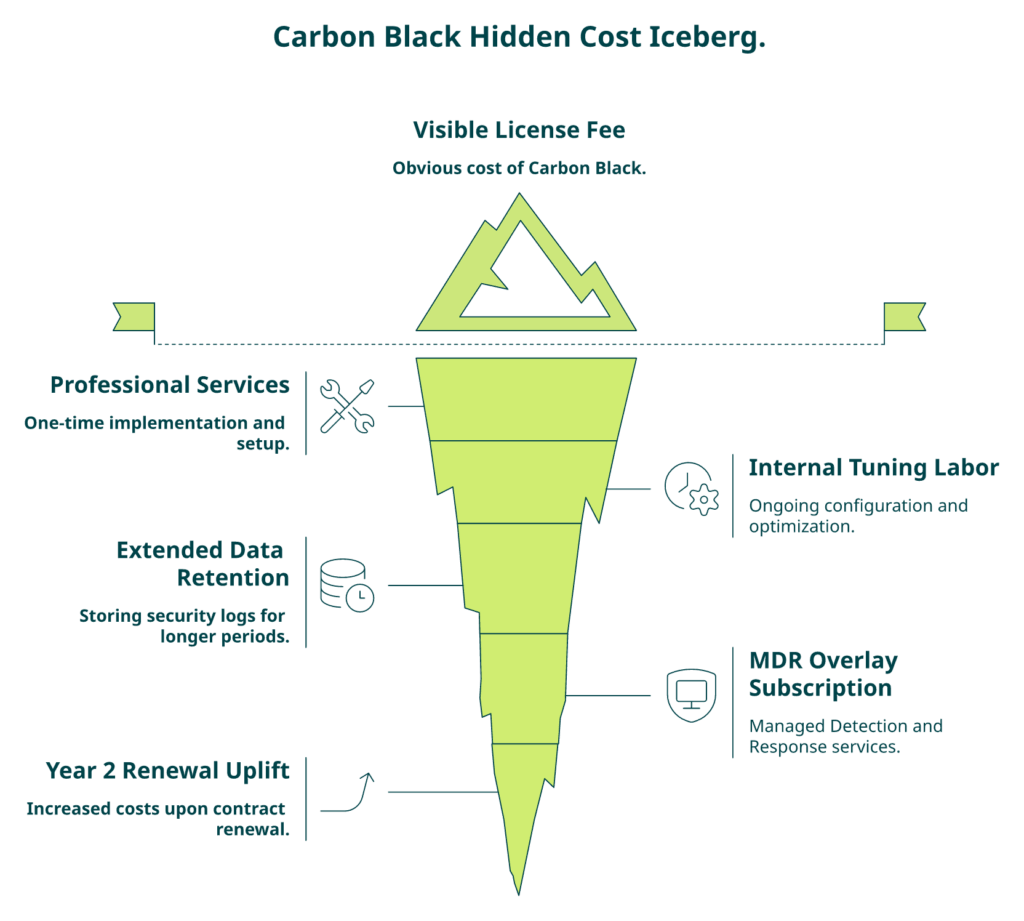
Carbon Black’s sticker price is one part of the bill. Implementation adds $15,000 to $44,000 for 250 endpoints and $415,000 to $950,000 for 25,000 endpoints in professional services alone. The deeper shock is the tuning treadmill. Frank, a customer at Affordable Care, put it plainly: “I’ve had Carbon Black for four years now and I’m still tuning”. Add SIEM ingest expansion, paid extended retention, and content extraction fees at offboarding, and Year 1 cost is meaningfully higher than the license line.
Frank’s four-year tuning story
One named person. Four years. Zero finish line. That is the Carbon Black operational story most buyers do not hear during the sales cycle. New installers and new file hashes regularly re-trigger alerts, which means whitelisting is never truly finished. The tuning treadmill is a structural feature of legacy EDR, not a misconfiguration.
Professional services cost by scale
| Scale | PS Range | Internal FTE Labor | Notes |
|---|---|---|---|
| 250 endpoints | $15,000 to $44,000 | 2 to 4 FTE-weeks | Self-service feasible, tuning recommended |
| 1,000 endpoints | $71,000 to $165,000 | 4 to 8 FTE-weeks | SIEM and policy migration drive PS up |
| 5,000 endpoints | $158,000 to $382,000 | 8 to 16 FTE-weeks | OS heterogeneity extends rollout |
| 25,000 endpoints | $415,000 to $950,000 | 20 to 40 FTE-weeks | Staggered rollout required |
The 10 hidden costs buyers forget
- ❌ Renewal price shock of 40 to 70 percent post-acquisition
- ❌ Internal FTE tuning labor (often 8K to 80K not in PS quotes)
- ❌ SIEM ingest expansion when Carbon Black telemetry hits Splunk or Sentinel
- ❌ Extended data retention add-on for 60, 90, or 180 days beyond default
- ❌ Content extraction fees at offboarding, with a 5-day notification window and permanent deletion risk if missed
- ❌ Legacy OS compatibility (Sectigo cert installs for Windows 2008 R2, RHEL 6)
- ❌ Sensor update remediation cycles (5 to 15 percent of sensors fail first-pass updates)
- ❌ FedRAMP and FIPS environment premium (separate SKU, quote-only)
- ❌ Post-Broadcom support degradation, with 24/7 confined to critical cases and reports of multi-day silence after 2024 staff reductions
- ❌ Auto-renewal clauses present by default in most Broadcom subscription agreements
Year 1 versus Year 2: the 500-endpoint reality
For a 500-endpoint mid-market buyer, Year 1 license at Standard with MDR comes in around $43,000 (license plus MDR). Add $20,000 to $40,000 in professional services and tuning, and Year 1 is around $70,000 all in. Year 2 with a 65 percent renewal uplift, no price cap negotiated, takes the recurring license alone past $71,000, before factoring in continued SIEM ingest growth or extended retention. That is a 65 percent jump on the line item buyers thought was locked.
Teams running managed SIEM alongside Carbon Black tend to feel the ingest expansion first, because telemetry volume drives Splunk or Sentinel cost more than license cost.
What real customers say about the post-Broadcom era
“VMware Carbon Black Endpoint may offer more sophisticated features, while SentinelOne Singularity Complete is preferred for ease of deployment and support.”
— Enterprise security team Carbon Black – PeerSpot Verified Review
“After Broadcom raised our renewal more than 60 percent, we had to build a competitive bid in 30 days. The channel partners that used to help us negotiate were gone.”
— Atonement Licensing buyer summary Atonement Licensing Buyer Summary
In our experience supporting customers through Carbon Black renewals, the operational pattern is consistent. Teams underbudget tuning labor by 3x. They underbudget SIEM ingest by 2x. They forget the 5-day offboarding extraction window entirely. The license is the price you negotiate. The TCO is the price you discover.
An UnderDefense customer, Carmeuse, found that their MDR paid for itself within three months by detecting a $300K payroll fraud scheme that a standard EDR-only setup would likely have missed because it was not “malware”. Less theater, more throughput. Less black box, more blue team. That is the framing we bring to every Carbon Black renewal conversation, and the same outcome model that powers our WarRoom platform for live incident collaboration.
Q5. What Is Carbon Black’s True 3-Year TCO Across Mid-Market, Enterprise, and Large Enterprise?
A 500-endpoint mid-market deployment on Endpoint Standard without a renewal price cap costs approximately $133,000 to $165,000 over three years all-in. A 5,000-endpoint enterprise deployment with MDR runs $1.1M to $1.6M over three years depending on renewal outcome. Large enterprise (25,000 endpoints) runs $4M to $8.2M, with renewal escalation as the dominant variable in every scenario, not the license price itself.
Think of Carbon Black like buying a car. The sticker price gets you in the door. Insurance, fuel, and maintenance decide what you actually pay. Most buyers price the sticker. Broadcom’s contract model means the maintenance bill is the surprise. For a structured way to model these layers before renewal, our 2026 cybersecurity budget playbook walks through the same TCO segments below.
The 3-year TCO across three buyer segments
| Cost Layer | 500 Endpoints | 5,000 Endpoints | 25,000 Endpoints |
|---|---|---|---|
| Base license (Standard) | $79,485 (3-yr at $52.99) | $576,000 (negotiated $38.40) | $2.4M (negotiated $32) |
| Edition uplift (Standard to Advanced or Enterprise) | $24,000 (Advanced, +30%) | $115,000 (Advanced) | $480,000 (Enterprise) |
| MDR overlay (3-yr) | $49,500 ($32.99/ep/yr) | $495,000 | Quote-only ($25 to $30/ep/yr est.) |
| Professional services and internal labor | $30,000 to $60,000 | $158,000 to $382,000 | $415,000 to $950,000 |
| Extended data retention (60 to 180 days) | Quote-only (~$5K est.) | Quote-only ($1 to $3/ep/yr) | Quote-only |
| Year 2 renewal risk (40 to 70%) | +$15K to $30K | +$200K to $400K | +$1M to $2M |
| ⭐ All-in 3-yr TCO | $133K to $165K | $1.1M to $1.6M | $4.0M to $8.2M |
| Effective $/endpoint/month | $9 to $10 | $8 to $12 | $9 |
What the per-endpoint-per-month math actually says
Mid-market 500-endpoint shops land near $9 to $10 per endpoint per month all-in. Enterprise 5,000-endpoint shops land $8 to $12 per endpoint per month. Large 25,000-endpoint shops land near $9 per endpoint per month with negotiated pricing. The variance is not the license. It is whether you negotiated a Year 2 price cap. Buyers benchmarking these numbers against managed alternatives often start with our transparent MDR pricing page.
⚠️ The 65% renewal uplift row is not a hypothetical. It is the documented reality for mid-market buyers on a one-year auto-renew without a negotiated price cap. Atonement Licensing flagged this as the single most consistent buyer surprise across 2024 to 2026 renewals.
What I have seen across 500+ environments
Working with security teams negotiating renewals across global enterprises, the pattern is consistent. Year 1 looks reasonable. Year 2 looks aggressive. Year 3 looks unrecognizable. The buyers who survive cleanly are the ones who got three things into the contract before signing: a Year 2 price cap, opt-out windows on auto-renewal, and a documented offboarding extraction clause. Our analysis of cybersecurity technical debt covers the long-tail cost of skipping these clauses.
The Carmeuse story we share with customers makes the inverse case. Their MDR overlay paid for itself in three months by catching a $300K payroll fraud scheme that no EDR tier alone would have flagged. TCO is not just what you spend. It is what you avoid losing. The same outcome model is documented in our SIEM and SOC avoided $650K loss case study.
Take the all-in 3-year number, not the license number, into the board meeting. That is the only number that survives Year 2.
Q6. How Does Carbon Black’s Cost Compare to CrowdStrike, SentinelOne, and Microsoft Defender?
At 5,000 endpoints over three years with parity add-ons, Carbon Black’s adjusted TCO ($2.42M) is the highest in the comparison set. CrowdStrike Falcon comes in around $2.01M. SentinelOne Singularity Complete lands near $1.80M. Microsoft Defender lands near $1.01M for organizations already on M365 E5. Carbon Black’s economic case rests on VMware-native workload integration depth, a defensible argument only for vSphere-heavy enterprises.
Two gym memberships. One has better equipment. The other is in your building. Carbon Black’s VMware integration is the “in your building” argument, worth the premium only if you are truly vSphere-native. For a head-to-head between the two leaders, our CrowdStrike vs SentinelOne comparison covers detection and response architecture in detail.
Methodology
Comparison assumes 5,000 endpoints, three-year term, and parity add-ons defined as: NGAV plus EDR plus vulnerability management plus 24/7 MDR overlay. All figures are directional anchors based on AWS Marketplace listings, CDW reseller data, Vendr buyer datasets, and public Microsoft Defender for Endpoint Plan 2 pricing.
Competitive 3-year TCO at 5,000 endpoints
| Platform | Y1 License | Y1 MDR | Y1 PS+Labor | Y1 Total | 3-yr TCO | Parity 3-yr TCO | $/ep/mo | Best Fit |
|---|---|---|---|---|---|---|---|---|
| Carbon Black Cloud Enterprise plus MDR | $450K | $165K | $200K | $815K | $2.0M | $2.42M | $13 | vSphere-heavy enterprise |
| CrowdStrike Falcon Complete | $400K | $150K | $150K | $700K | $1.7M | $2.01M | $11 | Cloud-first, fast deploy |
| SentinelOne Singularity Complete plus Vigilance | $360K | $120K | $130K | $610K | $1.5M | $1.80M | $10 | Autonomous response priority |
| Microsoft Defender (M365 E5) | Bundled | $80K (Defender Experts) | $100K | $180K | $0.6M | $1.01M | $5.6 | Microsoft-stack shops |
The Microsoft Defender decision point
If you are an M365 E5 shop, Defender for Endpoint Plan 2 is already in your entitlement. Continuing to pay for Carbon Black on top of E5 is the most common form of redundant security spend I see in renewal audits. Run the entitlement audit before you renew. Defender does not match Carbon Black on every detection axis, but at $5.6 per endpoint per month effective, the gap has to be enormous to justify the delta. Teams that go this route often layer in MDR for Microsoft 365 rather than retain a second EDR vendor.
The entitlement audit is the cheapest hour your security team will spend this quarter. I have seen organizations carrying $400K of redundant Carbon Black spend on top of Defender they already owned.
CrowdStrike: the lever Broadcom responds to
In our experience supporting renewals, CrowdStrike Falcon is the primary competitive quote that moves Broadcom on price. SentinelOne is a credible alternate, particularly for teams that prioritize autonomous response over hunting telemetry. PeerSpot comparative testing has SentinelOne at 8.6 average rating versus Carbon Black at 7.5.
“VMware Carbon Black Endpoint may offer more sophisticated features, while SentinelOne Singularity Complete is preferred for ease of deployment and support.”
— Enterprise security team Carbon Black, PeerSpot Verified Review
Buyer profile fit
- vSphere-native enterprise with deep VMware investment: Carbon Black retains an integration argument.
- Cloud-first SaaS company on AWS or GCP: CrowdStrike or SentinelOne typically wins on TCO and deployment speed.
- M365 E5 shop with Microsoft-heavy stack: Defender is the default, with a premium MDR overlay for the gap.
- Mixed stack with hybrid SOC: vendor-agnostic MDR service keeps your existing EDR investment in place while applying the AI orchestration layer on top.
The economic case for Carbon Black is narrower than the buyer base. Most buyers signed for VMware vSphere reasons that no longer apply post-Broadcom. Run the comparison honestly before the renewal, not after.
Q7. Which MITRE ATT&CK Techniques Does Each Tier Detect, and What Does That Mean for Compliance?
Carbon Black Enterprise EDR provides the broadest MITRE ATT&CK coverage, including unfiltered telemetry and full threat hunting required to map techniques beyond initial access. Standard tier covers prevention and basic detection, but misses lateral movement and collection technique families without the Enterprise Investigate UI. For compliance, PCI DSS v4.0 Requirement 10.7 and EU NIS2 Article 21 both require detection capabilities that Standard alone does not satisfy for mid-to-large regulated enterprises.
MITRE ATT&CK is the industry-standard catalog of attacker tactics, techniques, and procedures (TTPs). Coverage matters because it determines what attacks you can actually detect, not just what your license costs. For broader regulatory mapping, our compliance roadmap aligns these controls to NIST, PCI, and NIS2 requirements.
MITRE ATT&CK coverage by Carbon Black tier
| ATT&CK Tactic | Standard | Advanced | Enterprise | Example Techniques |
|---|---|---|---|---|
| Initial Access | ✅ Behavioral EDR | ✅ | ✅ | T1566 Phishing, T1190 Exploit Public-Facing App |
| Execution | ✅ Partial | ✅ | ✅ | T1059 Command and Scripting Interpreter |
| Persistence | ⚠️ Limited | ✅ | ✅ | T1547 Boot or Logon Autostart |
| Privilege Escalation | ⚠️ Limited | ✅ | ✅ | T1068 Exploitation for Privilege Escalation |
| Defense Evasion | ⚠️ Partial | ✅ | ✅ | T1027 Obfuscated Files |
| Credential Access | ❌ Gaps without Live Query | ✅ | ✅ | T1003 OS Credential Dumping |
| Discovery | ❌ | ✅ Live Query | ✅ | T1087 Account Discovery |
| Lateral Movement | ❌ Requires unfiltered telemetry | ⚠️ Partial | ✅ Investigate UI | T1021 Remote Services |
| Collection | ❌ | ⚠️ | ✅ | T1005 Data from Local System |
| Exfiltration | ⚠️ Partial | ⚠️ | ✅ | T1041 Exfiltration Over C2 |
Comparative MITRE testing referenced in third-party benchmarks shows Carbon Black missing 28 detections versus SentinelOne missing 7 in the same evaluation set. That delta lands squarely on the lateral movement and credential access columns, which are the techniques most often used in real ransomware kill chains. Our ransomware response plan walks through how those gaps map to live kill chains.
Compliance framework mapping
| Framework | Requirement | Minimum CB Tier | Notes |
|---|---|---|---|
| PCI DSS v4.0 | Req 10.7 (failure detection), Req 5.3 (anti-malware behavioral) | Advanced | Standard alone fails Req 10.7 logging depth |
| NIST CSF 2.0 | DE.CM (continuous monitoring) | Standard minimum | Enterprise needed for full DE.AE adverse event analysis |
| NIST SP 800-61 Rev. 3 | IR phases (Detect, Analyze, Contain) | Enterprise plus MDR | Investigate UI required for Analyze phase |
| EU NIS2 Directive | Article 21 (essential entities) | Advanced plus MDR | Standard does not satisfy 24/7 detection requirement |
| SEC Cyber Disclosure | Item 1.05 / 8-K | Enterprise plus MDR | MTTD reduction required for materiality determination |
| HIPAA Security Rule | 164.312(b) Audit Controls | Standard minimum | Extended retention add-on often required for PHI environments |
Silence is not safety
Here is the contrarian read. Pen tests against untuned Carbon Black deployments routinely produce zero alerts during active lateral movement. The compliance checkbox says you are covered. The kill chain says otherwise. The gap between “licensed” and “defended” is the tuning gap.
On a 2 AM bridge call, no auditor is going to save you. The PCI checkbox does not detect lateral movement. The tier you bought decides what your analyst can actually see. A quiet EDR does not mean you are secure. It often means the tool is not tuned to see the attack. In our experience running detection engineering across 500+ customer environments, the same pattern appears: teams buy Standard tier, assume they have ATT&CK coverage, and discover at first incident that lateral movement was invisible to them the entire time. Our penetration testing engagements regularly surface this exact gap.
“Over the past few years, we’ve undergone several external penetration tests, and during these assessments, Red Canary was not able to identify the malicious activity while the tests were ongoing.”
— Verified User, Insurance Enterprise Red Canary, G2 Verified Review
The same critique applies to any EDR or MDR running with default policies, including Carbon Black. The license tier sets the ceiling on what you can detect. Tuning sets the floor on what you actually do.
Q8. Is Carbon Black’s Tuning Treadmill Costing You More Than the License? The Case for Agentic MDR
The tuning treadmill is real, and it has a dollar value. At enterprise scale, 8 to 16 FTE-weeks of annual tuning at a fully loaded $80K analyst costs $30,000 to $60,000 per year. That labor never appears on the Carbon Black invoice, but it shows up on the calendar every week. Agentic MDR overlays absorb that labor with a 2-minute alert-to-triage SLA, 15-minute escalation for critical incidents, autonomous response (credential wipes, password resets, and ticket creation), and a proven ability to catch non-malware threats like a $300K payroll fraud that no EDR tier detects alone.
The situation, the complication, the resolution
Situation: you deployed Carbon Black. You are tuning. It has been four years. Frank, a customer at Affordable Care, said it cleanly: “I’ve had Carbon Black for four years now and I’m still tuning”.
Complication: the tuning never ends. Every new installer, every new file hash, re-triggers alerts, and whitelisting is never finished. Setting policies to “high aggressive” creates a quarantine release backlog that becomes its own attack surface. Maximum settings are a vulnerability, not a defense.
Resolution: agentic MDR absorbs the tuning entirely. The labor moves from your team to the SOC. The SLA moves from “when an analyst is free” to a 2-minute triage window. Our SOC automation checklist walks through where automation absorbs tuning labor and where humans still own the call.
The Delivery-Model Cost Matrix
| Cost Component | In-House Carbon Black | Agentic MDR Overlay |
|---|---|---|
| License | $192K to $450K (5,000 eps) | Carbon Black license preserved |
| Tuning labor | $30K to $60K/yr | Absorbed by SOC |
| Alert triage SLA | 30 to 60 minutes industry average | 2 minutes |
| Response model | Endpoint isolation only | Credential wipes, password resets, and ticket creation |
| SIEM ingest cost | Grows with telemetry | Ingestion tuning cuts 50 to 90% |
| Outcome | Alerts | Resolved incidents |
Why this matters at 2 AM
The 2 AM bridge call is the only test that matters. At 2 AM, your SOC analyst does not need another alert. They need a resolved incident. Carbon Black, on its own, gives you alerts. Agentic MDR, layered on top, gives you outcomes.
We rebuilt the SOC around agentic AI, not as a label on a noisy dashboard, but as a 2-minute alert-to-triage outcome with a 15-minute escalation window for critical incidents. Ingestion tuning cuts SIEM telemetry volume by 50 to 90%, which directly offsets Carbon Black renewal hikes. That is hard-dollar ROI you can take to a CFO. The same model is documented on our Under Defence MAXI Platform page.
The Carmeuse moment
An UnderDefense customer, Carmeuse, found that their MDR overlay paid for itself within three months by detecting a $300K payroll fraud scheme. It was not malware. No standard EDR tier would have flagged it. The detection was an account behavior signal, escalated by an analyst, and resolved through ChatOps user verification.
That is the difference between a tool and an outcome. Carbon Black is a tool. Agentic MDR is the outcome. For a parallel example, our case study where we detected a threat faster than CrowdStrike OverWatch shows the same outcome model in a different stack.
“The biggest win for me was getting actual control over our security alerts. Before the guys from UD stepped in, we were getting bombarded with alerts from all our security tools. Their team cleaned up our configurations and got the noise under control within the first week.”
— Verified User, Marketing and Advertising Under Defence G2, Verified Review
“Underdefense act as an extension of our team, so we don’t need additional resources, ensuring 24/7 protection. It also solved our problem of having separate security tools that didn’t work well together.”
— Inga M., CEO, Mid-Market Under Defence G2, Verified Review
“UnderDefense MAXI integrates well with our systems, specifically with our SIEM, Splunk. Their team is proactive in identifying and addressing threats, providing 24/7 oversight.”
— Oleg K., Director Information Security, Mid-Market Under Defence G2, Verified Review
Less theater, more throughput. Less black box, more blue team. That is the framing we bring to every Carbon Black renewal conversation, and it is why teams running MDR for Splunk see the SIEM cost reduction land before the renewal letter does.
Q9. How Do You Negotiate Carbon Black Pricing, and What Leverage Do You Actually Have?
Broadcom is a harder negotiation than pre-acquisition Carbon Black, but leverage still exists. The three highest-impact levers are: a written price cap clause (Vendr data shows “year-over-year increase not to exceed 3 to 5%” language has held), formal competitive quotes from CrowdStrike or SentinelOne (the lever Broadcom responds to most), and timing negotiations for late October or early May, when Broadcom’s fiscal quarters close. A multi-year commit with upfront prepay adds 10 to 25% discount on top.
The situation: your renewal quote arrived with a 40 to 70% uplift. The complication: most channel partners that gave you flexibility before 2024 are gone. The question: where does your leverage actually come from now? The answer: contractual language, competitive quotes, and timing, in that order. The 2026 cybersecurity budget playbook walks through how to sequence those levers across a fiscal year.
The seven proven discount levers
| Lever | Typical Discount | Execution Guidance | Confidence |
|---|---|---|---|
| ⭐ Competitive quote (CrowdStrike or SentinelOne POC) | 15 to 30% | Run a real 30-day POC, share scoring rubric with Broadcom AE | High |
| ⏰ End-of-quarter timing (late October, early May) | 5 to 15% | Align signing to Broadcom Q1 (Nov 1) or Q3 (May 1) close | Medium |
| 💰 Multi-year prepay (3-yr, paid upfront) | 10 to 25% | Trade prepay for price cap clause, not just discount | Medium |
| 📈 Growth endpoint commitment | 5 to 12% | Commit to 12-month endpoint additions in writing | Medium |
| 🚪 M365 E5 walk-away (Defender entitlement audit) | 10 to 20% | Document E5 Defender for Endpoint as your alternative | High |
| 🤝 Reseller channel (where elite partners remain) | 5 to 15% | Carahsoft, Optiv, Presidio retain some flexibility | Low to Medium |
| 📦 Bundle with Symantec or CBX assets | 8 to 18% | Use post-merger ESG bundling pressure as leverage | Medium |
The price cap clause that actually holds
Get this language verbatim into the contract: “Support fees and subscription fees shall not increase by more than 3% per year during the term, including any auto-renewal periods”. Atonement Licensing flags product substitution rights as the second clause that has held in 2024 to 2026 disputes. Without these two clauses, Year 2 is open season. A pragmatic virtual CISO engagement can review the contract before you sign.
⚠️ If Broadcom’s account team pushes back hard on a price cap, that resistance is itself a signal about how your renewal will go. A vendor that will not commit to 3% caps in writing is telling you what they plan to charge in writing later.
The M365 E5 entitlement audit
If your organization has Microsoft 365 E5, you already own Defender for Endpoint Plan 2. Run the entitlement audit before you enter negotiation, not after. Treat E5 Defender as your documented walk-away alternative, with a transition cost model attached. That single document moves the negotiation more than any other lever I have seen. For organizations leaning into the Microsoft stack, a tailored MDR for Microsoft 365 overlay closes the SOC gap without paying twice.
The 5-day extraction trap
Negotiate the offboarding clause before signing, not after. The Broadcom SaaS Listing requires customers to notify within 5 days of termination, with permanent deletion if missed. Get the SLA extended to 30 days minimum and cap the extraction fee in writing. This is the most overlooked clause in every Carbon Black renewal I have seen. Compare offboarding norms in the why businesses switch providers analysis.
In our experience supporting renewal negotiations, the buyers who survive Year 2 cleanly are the ones who treated the contract as the product, not the license. Walk in with the price cap, the competitive quote, and the entitlement audit. Walk out with a Year 2 you can actually budget for. If you want a second opinion before you sign, contact us and we will model the deal with you.
Q10. Should You Stay With Carbon Black, Migrate, or Add MDR? A Buyer Decision Framework
Carbon Black remains defensible for three buyer profiles: VMware-native enterprises where migration costs exceed TCO savings, FedRAMP-required environments where the compliant variant is pre-certified, and App Control users in fixed-function operational technology (OT) environments. For everyone else (mid-market buyers without an in-house SOC, M365 E5 shops, and AI-first security programs), SentinelOne, Microsoft Defender, or a Carbon Black plus UnderDefense MAXI MDR overlay represents better risk-adjusted economics and a cleaner renewal trajectory.
Situation: you are sitting on a renewal quote with a 65% uplift. Complication: rip-and-replace costs $415K to $950K at 25,000 endpoints, and migration takes 14 to 20 weeks. Resolution: you have three real choices, not two. Stay, leave, or augment. The MDR buyers guide walks through the trade-offs of each path.
Stay with Carbon Black if you fit one of these three profiles
- ⭐ VMware vSphere-native enterprise: agentless workload telemetry depth justifies the premium
- ⭐ FedRAMP Moderate or High required: CB’s compliant variant is pre-certified, reducing audit overhead
- ⭐ App Control in fixed-function OT or regulated environments: allowlisting maturity is hard to replicate
Evaluate alternatives if you fit one of these four profiles
| Position | Option | Best For | Why |
|---|---|---|---|
| 1 | ✅ UnderDefense MAXI MDR overlay | Carbon Black customers under renewal pressure | BYO stack, preserves CB investment, adds 2-min Alert-to-Triage SLA, ingestion tuning cuts SIEM 50 to 90% |
| 2 | SentinelOne Singularity Complete | Mid-market, no in-house SOC | Autonomous response, easier deployment, better support ratings |
| 3 | Microsoft Defender for Endpoint | M365 E5 shops | Already in entitlement, lowest effective TCO |
| 4 | CrowdStrike Falcon | AI-first cloud-native enterprises | Cloud-first telemetry, fast deploy |
For a deeper architectural read on the augment path, the Managed EDR page covers how a vendor-agnostic SOC layer absorbs tuning labor without forcing rip-and-replace. The Under Defence MAXI WarRoom platform is where the workflow lives.
The NIST CSF Budget Map test
Map your security spend to the NIST CSF 2.0 functions: Identify, Protect, Detect, Respond, and Recover. If Carbon Black is consuming your entire Detect budget and leaving a vacuum in Respond and Recover, that is a structural problem regardless of which EDR brand you are running. Detection without response is theater. Less theater, more throughput.
The NIST CSF budget map is the question I ask every CISO on a renewal call. If your Detect line is 70% of total spend and your Respond line is 5%, your renewal money is going to the wrong place. A robust incident response capability is what closes that gap.
The pre-signing contract checklist
Before you sign anything, get these six clauses negotiated in writing:
- ✅ Price cap clause: year-over-year increase not to exceed 3 to 5%
- ✅ Renewal discount preservation: Year 1 discount carries to Year 2
- ✅ Product substitution rights: ability to swap to Symantec or CBX without penalty
- ✅ Offboarding SLA: 30-day notification, capped extraction fees
- ✅ Auto-renewal opt-out: 60-day notification window removed or extended
- ✅ Expansion unit pre-negotiated pricing: per-endpoint rate locked for 12-month additions
What customers say about the augment-rather-than-replace path
“Underdefense is a great choice for teams like ours that are short on resources. It automates many tasks, plus, with 24/7 monitoring, we know we’re always protected. The platform seamlessly integrates our existing security tools, simplifying management.”
— Inga M., CEO, Mid-Market Under Defence G2 – Verified Review
“We were looking for an MDR provider and were choosing EDR tools. CrowdStrike was our favorite choice, but after a few calls with UnderDefense we realized that we could get way more value, so they truly became our go-to cybersecurity ally.”
— Oleksii M., Mid-Market Under Defence G2 – Verified Review
“Lack of true remediation in the response, costing us significantly in resources and introducing risks in security.”
— VP of Technology, Services Arctic Wolf – Gartner Verified Review
The best Carbon Black contract is one that protects you whether you stay for 10 years or leave after 12 months. That is the framing I bring to every buyer call. If you want to stress-test your renewal options, book a demo with our team.
What I’m Thinking About Next
The question I am sitting with for the next 18 to 24 months is whether Broadcom’s renewal model, applied at scale across the Carbon Black base, accelerates the agentic MDR shift faster than vendors expected. My current read is that every 65% uplift letter Broadcom sends radicalizes one more CISO toward an outcome-priced model, not a tool-priced one. The pricing pressure may end up doing what the technology argument could not: collapse the line between EDR ownership and MDR outcomes.
If you are reading this with a Carbon Black renewal on your desk this quarter, the conversation I want to have is not about Carbon Black. It is about what your SOC actually owns, what it actually delivers, and what it would cost to move from licensed to defended. Let me know what you are seeing on your renewal letter.
References
Official Docs / Indian Statutes
- Broadcom. “Carbon Black Cloud Console Release Notes, 7 February 2025.” Published: Feb 2025.
- Broadcom Carahsoft. “Carbon Black SaaS Listing Document.” Published: April 2024.
- Dell. “Carbon Black Cloud Endpoint Standard, Advanced, Enterprise (KB 000189430).” Published: April 2024.
- Carbon Black Developer Network. “Carbon Black Cloud Reference and Rate Limiting.” Published: 2024.
- MITRE Corporation. “ATT&CK Framework v15.” Published: 2024.
- NIST. “Cybersecurity Framework 2.0.” Published: 2024.
- NIST. “SP 800-61 Rev. 3: Computer Security Incident Handling Guide.” Published: 2024.
- PCI Security Standards Council. “PCI DSS v4.0 Requirement 10.7 and 5.3.” Published: 2024.
- European Union. “NIS2 Directive Article 21 (Essential Entities),” Official Journal of the EU, 2024.
- SEC. “Cybersecurity Risk Management, Strategy, Governance, and Incident Disclosure Final Rule, Item 1.05/8-K.” Published: July 2023.
Datasets
- IBM Security. “Cost of a Data Breach Report 2024,” 2024.
- Gartner. “Magic Quadrant for Endpoint Protection Platforms,” 2024.
Blogs
- Atonement Licensing. “Broadcom Changes.” Published: May 2025. [Secondary source]
- Redress Compliance. “Broadcom Carbon Black Licensing Post-Acquisition.” Published: May 2024. [Secondary source]
- Cynet. “Carbon Black Pricing: What You Need to Know.” Published: Sep 2023. [Secondary source]
- Oreate AI. “Unpacking Carbon Black Cloud Pricing.” Published: Feb 2026. [Secondary source]
- Hummingbird Networks. “VMware Carbon Black Cloud MDR Subscription Upgrade License (3 Years).” Published: 2024. [Secondary source]
- PeerSpot. “Carbon Black Managed Detection and Response Reviews.” Published: April 2025. [Secondary source]
- G2. “Red Canary Review (Verified User, Insurance Enterprise).” Published: Oct 2025. [Secondary source]
- G2. “UnderDefense MAXI Review (Verified User, Marketing and Advertising).” Published: Jan 2025. [Secondary source]
- G2. “UnderDefense MAXI Review (Inga M., CEO).” Published: Aug 2024. [Secondary source]
- G2. “UnderDefense MAXI Review (Oleg K., Director Information Security).” Published: Dec 2023. [Secondary source]
- G2. “UnderDefense MAXI Review (Oleksii M., Mid-Market).” Published: Jul 2023. [Secondary source]
- Gartner. “Arctic Wolf Managed Detection and Response Services Review (VP of Technology, Services).” Published: Apr 2023. [Secondary source]
- UnderDefense. “Nazar Tymoshyk Perspective: Customer stories, Carmeuse $300K payroll fraud detection, Frank (Affordable Care) tuning treadmill, NIST CSF Budget Map framing, agentic MDR positioning.” UnderDefense Insights Collection, 2024-2025. [Secondary source] [Source URL not provided]
1. What does VMware Carbon Black actually cost per endpoint in 2026 under Broadcom?
In 2026, we are seeing Carbon Black Cloud list prices land at roughly $52.99 per endpoint per year for Endpoint Standard, $69 for Advanced, and $89 for Enterprise EDR, before negotiation. At enterprise volume (5,000+ endpoints), we see negotiated rates drop to $32 to $40 per endpoint per year on multi-year deals, which is the only reason large buyers keep tolerating Broadcom. The list price, though, is rarely what you actually pay over three years. Renewal uplifts of 40 to 70% in Year 2 push the effective rate back up, and most buyers do not catch it until the auto-renewal window closes. We always recommend modelling the 3-year all-in cost, not the Year 1 license cost, before signing. Our transparent MDR pricing page shows how outcome-priced models compare against tool-priced ones at the same endpoint scale. The headline rate is the cheapest part of the conversation. The contract clauses and the renewal uplift are where the real money lives.
2. What is the difference between Carbon Black Endpoint Standard, Advanced, and Enterprise tiers?
Standard is NGAV plus behavioral EDR, suitable for small environments with no in-house SOC. Advanced adds Live Query and broader vulnerability context, which matters for compliance-driven buyers who need PCI Req 10.7 detection depth. Enterprise EDR unlocks the full Investigate UI, unfiltered telemetry, and threat hunting workflows, which is what real lateral movement detection requires. Here is the operational read we share with buyers:
-
Standard alone misses lateral movement, credential access, and collection technique families on MITRE ATT&CK.
-
Advanced closes the persistence and privilege escalation gaps but only partially covers lateral movement.
-
Enterprise is the only tier where threat hunting against a real kill chain is feasible without paid-add overlays.
If your compliance scope includes EU NIS2 Article 21 or SEC cyber disclosure rules, Standard alone will not satisfy 24/7 detection requirements. Our MDR buyers guide walks through how to map ATT&CK coverage to compliance frameworks before you commit to a tier.
3. What hidden costs should we expect with Carbon Black beyond the license fee?
We see five hidden cost categories that consistently surprise buyers. First, professional services for deployment, often $30K to $200K depending on scale. Second, internal tuning labor, which we benchmark at 8 to 16 FTE-weeks per year at enterprise scale, translating to $30K to $60K annually per environment. Third, extended data retention add-ons (60 to 180 days) priced quote-only and rarely budgeted. Fourth, MDR overlay subscriptions at $25 to $33 per endpoint per year on top of the license. Fifth, the Year 2 renewal uplift, which Broadcom has been pushing to 40 to 70% on accounts without a price cap clause. The tuning treadmill is the cost line that almost never appears in the RFP. Frank from Affordable Care put it cleanly: he has been tuning Carbon Black for four years and is still not done. Whitelisting never finishes, which means the labor never stops. Our SOC automation checklist walks through where automation absorbs that labor and where humans still own the call.
4. How does Carbon Black compare to CrowdStrike, SentinelOne, and Microsoft Defender on cost?
At 5,000 endpoints over three years with parity add-ons (NGAV, EDR, vulnerability management, and 24/7 MDR), we model the comparison as follows: Carbon Black lands near $2.42M, CrowdStrike around $2.01M, SentinelOne near $1.80M, and Microsoft Defender near $1.01M for organizations already on M365 E5. The decision points we walk buyers through:
-
vSphere-native enterprise: Carbon Black retains a defensible integration argument.
-
M365 E5 shop: Defender is already in your entitlement, making the redundant spend audit the cheapest hour your team will spend this quarter.
-
Cloud-first SaaS or hybrid stack: CrowdStrike or SentinelOne typically wins on TCO and deployment speed.
CrowdStrike is the competitive quote that moves Broadcom on price most consistently. SentinelOne is the credible alternate. Our CrowdStrike vs SentinelOne analysis covers the detection and response architecture in depth.
5. How do we negotiate Carbon Black pricing with Broadcom in 2026?
We see three levers that consistently move Broadcom on price. First, a written price cap clause, with language like “year-over-year increase not to exceed 3 to 5% during the term, including auto-renewal periods”. Second, a formal competitive quote, ideally a 30-day CrowdStrike or SentinelOne POC with a documented scoring rubric shared with the Broadcom AE. Third, end-of-quarter timing, aligning signing to late October or early May when Broadcom’s fiscal quarters close. Multi-year prepay adds 10 to 25% on top, but only trade prepay for a price cap, not for a discount alone. The M365 E5 entitlement audit is the lever that most often catches Broadcom flat-footed, because it shifts the conversation from price to whether you need the product at all. Negotiate the offboarding clause before signing. Broadcom’s SaaS Listing requires 5-day notification with permanent deletion if missed, and we have seen this turn into a $50K to $200K extraction surprise. Our virtual CISO team reviews these clauses pre-signature.
6. What MITRE ATT&CK coverage does each Carbon Black tier provide, and does it satisfy compliance?
Standard tier provides solid Initial Access and Execution coverage but has gaps in Credential Access, Discovery, Lateral Movement, and Collection. Advanced tier adds Live Query for Discovery and closes most Persistence and Privilege Escalation gaps. Enterprise EDR is the only tier that delivers Investigate UI access, which is what lateral movement and full kill-chain reconstruction actually require. For compliance:
-
PCI DSS v4.0 Req 10.7: Advanced minimum.
-
NIS2 Article 21: Advanced plus MDR minimum.
-
SEC Cyber Disclosure Item 1.05: Enterprise plus MDR.
-
HIPAA 164.312(b): Standard minimum, but extended retention almost always required for PHI environments.
Pen tests against untuned Carbon Black deployments routinely produce zero alerts during active lateral movement. The compliance checkbox says you are covered. The kill chain says otherwise. Our penetration testing engagements regularly surface exactly that gap.
7. Should we stay with Carbon Black, migrate, or add MDR on top?
We see three real choices, not two. Stay if you fit one of three profiles: VMware vSphere-native enterprise, FedRAMP Moderate or High required, or App Control in fixed-function OT environments. Migrate if you are an M365 E5 shop, a cloud-first SaaS company, or an AI-first security program where Carbon Black’s renewal trajectory does not justify the lock-in. Augment is the third path most buyers do not consider. Layering an agentic MDR overlay on top of Carbon Black preserves the EDR investment while absorbing the tuning labor, adding a 2-minute Alert-to-Triage SLA with 15-minute escalation for critical incidents, and cutting SIEM ingestion volume by 50 to 90%. At 25,000 endpoints, rip-and-replace runs $415K to $950K and 14 to 20 weeks. Augment avoids that migration tax entirely. Our Managed EDR page covers how a vendor-agnostic SOC layer absorbs tuning labor without forcing rip-and-replace.
8. Is Carbon Black's tuning treadmill costing more than the license itself?
Often, yes. We benchmark enterprise tuning labor at 8 to 16 FTE-weeks annually, which at a fully loaded $80K analyst translates to $30K to $60K per year that never appears on the Carbon Black invoice. At 5,000 endpoints, we have seen tuning labor consume 10 to 20% of the license value every year, and that is before counting the alert triage time analysts spend on noise the tool never resolved. The contrarian read: maximum aggressive policies are not safer. Setting Carbon Black to “high aggressive” creates a quarantine release backlog that becomes its own attack surface. Maximum settings are a vulnerability, not a defense. Agentic MDR overlays absorb the tuning entirely. The labor moves from your team to the SOC, alert triage moves to a 2-minute SLA, and autonomous response handles credential wipes, password resets, and ticket creation without a human in the loop. The Under Defence MAXI WarRoom platform is where that workflow lives.
The post VMware Carbon Black Pricing Guide 2026: Every Tier, Real Costs & Negotiation Tactics appeared first on UnderDefense.