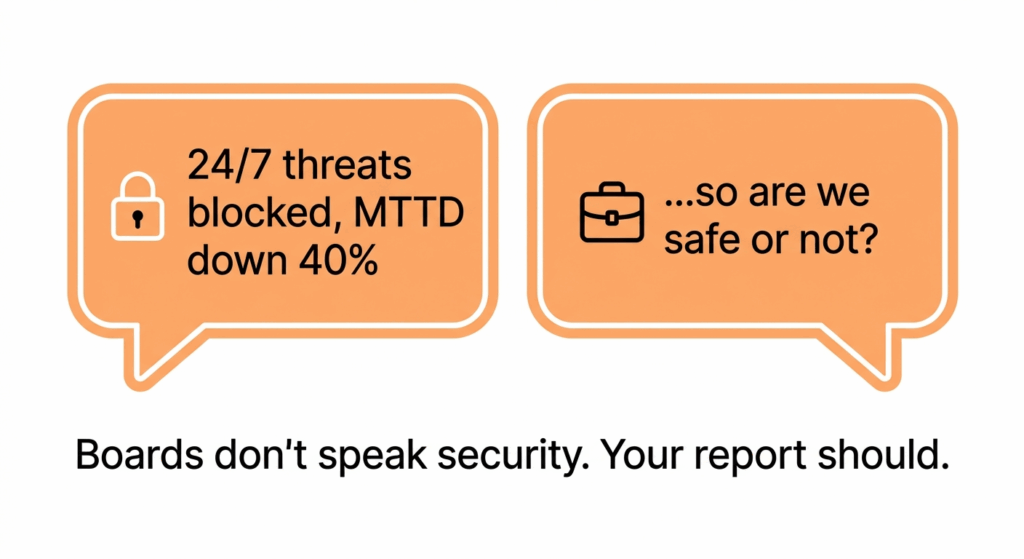
Your security report isn’t failing because your program is weak. Your reports are failing because boards and CISOs process risk in fundamentally different languages. Boards care deeply about organizational risk. What they struggle with is translating the way security professionals describe that risk into the terms boards use to evaluate everything else: financial exposure, operational continuity, competitive position, and regulatory liability. The CISSP covers threat modeling. The CISM covers risk frameworks. Neither spends meaningful time on what it actually takes to communicate security risk to a non-technical person in a way that produces decisions. But this gap is fixable.
The Three Filters Every Security Metric Must Pass Before It Goes on a Board Slide
Here is a test worth running on your last board report: for each data point you included, ask whether a board member could connect it, without explanation, to a dollar figure and a business consequence. If the answer is no for most of them, you’re not alone.
Boards process information through a specific lens: how likely is something bad to happen, and what would it cost if it did? A metric that doesn’t carry both dimensions gets processed as background noise. It might demonstrate that your team is busy, but it doesn’t help the board make a decision.
Before any metric goes on a board slide, run it through three questions:
1. Does this report an outcome, or just an activity?
2. Does it carry a financial dimension?
3. Does it connect to something the business actually cares about?
There’s a useful editorial rule that follows from these three filters: if you removed a data point from your report and the board would make the same decision without it, cut it. Every element should earn its place by informing a choice or building the necessary context.
How to Quantify the Risk You’re Managing So the Board Can Weigh It Against the Risk They’re Accepting
Start with what the organization stands to lose. Then show what it costs to reduce that risk exposure.
Before any budget conversation, identify the five or six assets whose compromise would cause the greatest business damage, including customer data, core financial systems, intellectual property, critical operational infrastructure, and compliance-sensitive records. These are the assets that define your actual risk profile.
For each of those assets, identify realistic attack scenarios; the patterns actually being used against organizations like yours. Then anchor the probability figures to external data: sector breach statistics, insurance actuarial data, and regulatory incident reports. An exposure estimate grounded in third-party incident data carries far more weight in a boardroom than one developed internally.
Your next board report could be the one that changes the conversation.
The Seven-Section Board Report Architecture That Gets Read, Understood, and Acted Upon
Structure matters as much as content. Here is a report architecture that consistently produces engaged boards and clear decisions.
Threat Landscape Snapshot
Open with three to five external threats currently relevant to your specific industry and operating model. The goal here is context, not urgency. Each threat should connect directly to your organization: what the attack pattern looks like, how it’s been used against peers, and where your controls sit relative to it. This section explains why everything that follows is worth the board’s attention.
Security Posture Score
Give the board one consistent metric that reflects your program’s overall maturity. The specific methodology matters less than the consistency: the same measure, calculated the same way, every quarter, so the trend becomes visible. A score improving from 2.1 to 2.6 over twelve months tells a more compelling story than a static 4.0 with no trajectory.
Top Five Risk Register
Your five most significant current risks, each with a financial exposure estimate, a current status (improving, stable, worsening), and the residual risk that remains after your controls are factored in. Dollar figures, not color codes.
90-Day Incident Summary
What happened, what was the business impact, what changed as a result? But don’t limit this to failures. Significant attacks that your controls detected and stopped are evidence that your program works. Mean time to detect and mean time to respond, shown as trends, demonstrate whether your security operations are getting faster. If a real incident occurred, report it directly and pair it immediately with the response timeline, the containment outcome, and what it changed in your approach.
Investment vs. Exposure Dashboard
Show your security spend and your estimated risk exposure on the same visual, against an industry benchmark when available. When a rising investment line correlates with a declining expected loss figure over time, the value of the program is demonstrated.
Roadmap and Board Asks
This section belongs near the front of the report, not the back. A board that only has forty-five minutes shouldn’t encounter your most important requests in the final ten. Be explicit: what is already funded and progressing, what requires a new decision, and what you’re recommending for the next period. For every new ask, include the risk of deferral alongside the ROI case.
Five Board Objections Every CISO Will Face And How to Reframe Them
Q: “We’ve never had a major breach — why would we increase the budget now?”
The logic here is: past safety predicts future exposure. It doesn’t. The response is to show the board that the environment their past investment was designed for has materially changed. Identify two or three specific incidents from your sector in the past twelve months. Peer incidents make this concrete in a way that general statistics never do.
Q: “Can’t we just rely on cyber insurance instead?”
This is a risk transfer framework being applied correctly, and it deserves a response that takes it seriously. Insurance is a legitimate part of any risk strategy. But the cyber insurance market has fundamentally shifted: carriers now require evidence of specific controls as a condition of coverage, and organizations that can’t demonstrate those controls face either exclusions, material premium increases, or both. The investment in controls and the insurance strategy reinforce each other.
Q: “What are we actually getting for what we already spend?”
This question reads like a challenge, but it’s actually an opening. The prepared response is a one-page performance summary: here is what last year’s investment produced in measurable terms, including incidents detected and contained, exposure reduced, compliance findings closed, and response time improved. If you have that summary ready, this question is the best one you’ll get in the meeting.
Q: “Can this wait until next year?”
The instinct is to agree to defer and move on. Don’t. The professional response is to make the deferred risk explicit and documented: “I can defer this. I want to make sure the board understands what we’re formally accepting by doing so: we will carry (specific risk) at (estimated financial exposure) for an additional twelve months without the mitigating control. I’ll document this as an accepted risk for board acknowledgment.” Most boards, when asked to formally own a documented unmitigated risk, find a way to revisit the timeline.
The full reporting framework, templates, and board objection scripts
Board Reporting Is a Year-Round Relationship Investment, Not a Quarterly Transaction
There are four practices that consistently build that foundation. An annual threat landscape briefing, not tied to any budget ask, not connected to any specific program need. Just something that simply keeps the board updated on how the environment is evolving and what it means for organizations like yours. Tabletop exercises that include one or two board members or senior executives: experiencing a simulated incident changes how people understand what’s at stake in a way that no slide deck replicates. Post-incident briefings, even for minor events, that walk the board through what happened, how you responded, and what you learned.
The post Why Your Board Isn’t Acting on Your Security Reports And How to Change That appeared first on UnderDefense.