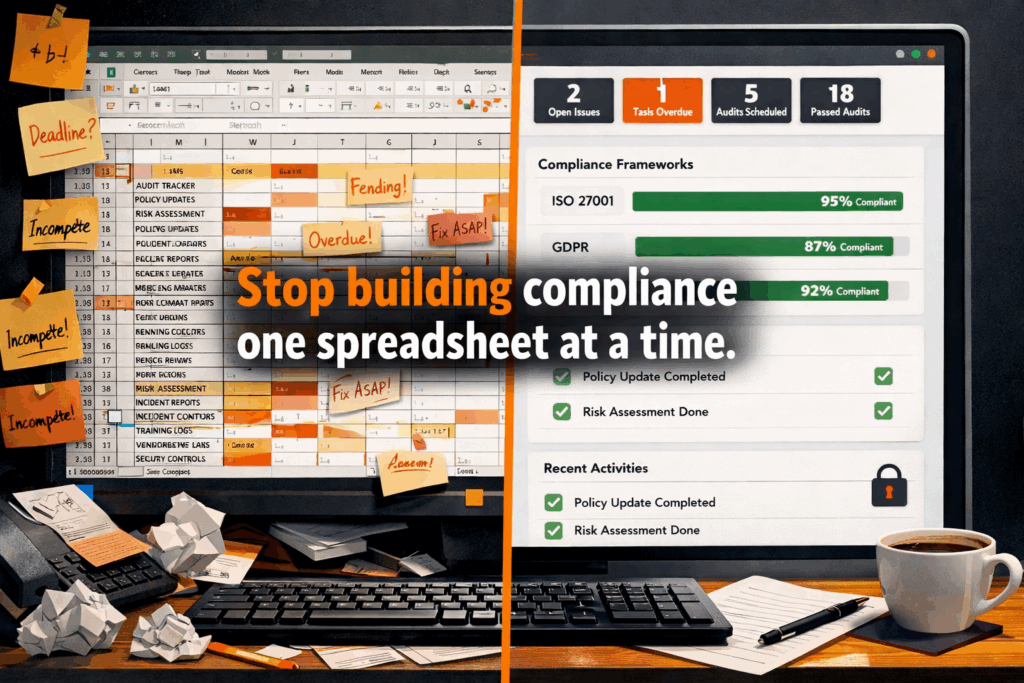
If you work in GRC, you know this scene intimately: a shared Excel workbook, color-coded by risk level, updated quarterly before audits, and quietly maintained by one or two people who are the only ones who understand it. It works – until it doesn’t.
As regulatory requirements multiply and cyber threats grow more sophisticated, the question is no longer whether to move beyond spreadsheets. The question is: what do you move to – a standalone GRC tool, or a modern compliance platform? And more importantly, which model actually fits your team?
This guide breaks down the real differences, the hidden costs most vendors don’t talk about, and how to match your GRC operating model to the resources you actually have – not the ones you wish you had.
1. What Is GRC, and Why Does the Spreadsheet Problem Keep Coming Back?
GRC stands for Governance, Risk, and Compliance. In practice, it is the operational layer that connects your organization’s policies, risk appetite, and regulatory obligations into a set of working controls.
The spreadsheet problem keeps returning for a simple reason: Excel is the path of least resistance. It requires no procurement, no onboarding, and no training. A risk register, a control tracker, an audit evidence folder – all of it can be assembled in an afternoon.
The problem is that GRC work does not scale in spreadsheets. Controls multiply. Regulations change. Evidence needs to be collected continuously, not reconstructed from memory days before an audit. And when GRC lives in a shared file, version control becomes a fiction and auditability becomes a hope.
❗ The real cost of spreadsheet GRC:
Evidence gaps discovered during audits, not before them
Compliance status that is a snapshot, not a live view
Key-person dependency – when that one person leaves, the whole program suffers
No connection between security controls and compliance evidence – your team operates two separate programs
2. What Is the Difference Between a GRC Tool and a GRC Platform?
These terms are often used interchangeably, but they describe fundamentally different operating models. Getting the distinction right is the first step to making the right choice.
GRC Tools: Powerful, Customizable, Resource-Intensive
Standalone GRC tools – typically on-premise or self-hosted systems – are built for flexibility above everything else. They can be shaped into highly tailored environments that reflect your exact control framework, your specific workflow, and your internal audit logic.
The trade-off is real: that flexibility comes with significant overhead. These tools rarely arrive fully operational. They require substantial upfront configuration, dedicated IT ownership, ongoing tuning as regulations evolve, and continuous effort to keep integrations and data aligned.
For large, well-resourced teams with dedicated GRC engineers, that overhead is manageable. For leaner organizations, it competes directly with the actual GRC work that needs to get done.
GRC Platforms: Designed for Lean Teams and Continuous Compliance
SaaS GRC platforms take a fundamentally different approach. Instead of asking your team to engineer a compliance environment from scratch, they provide prebuilt control structures aligned to common frameworks, embedded guidance for implementation and audit preparation, continuous monitoring rather than periodic checks, and infrastructure that is maintained and updated by the provider.
The result is a compliance program that can run without a team of specialists to maintain it – one that stays current as frameworks evolve and surfaces gaps in real time, not just before audits.
| Standalone GRC Tool | SaaS GRC Platform | |
| Setup time | Months of configuration | Days to first value |
| IT overhead | High – your team manages infrastructure | Low – provider-managed |
| Framework updates | Manual – requires internal effort | Automatic – built into the platform |
| Best for | Large teams with dedicated GRC engineers | Lean and mid-sized teams |
| Compliance monitoring | Periodic, manual reviews | Continuous, automated |
| Customization | Extremely high | Moderate to high |
| Cost model | High upfront + ongoing maintenance | Predictable subscription |
| Risk when understaffed | Program degrades; Excel returns | Program continues; gaps surface automatically |
3. Who Should Actually Use a Standalone GRC Tool?
Standalone GRC tools are not inherently wrong – they are simply optimized for a specific kind of organization. The fit is strongest when several conditions are true simultaneously.
- Large, specialized teams: You have dedicated GRC engineers whose primary job is configuring and maintaining the system, not running the compliance program itself.
- Complex, non-standard requirements: Your regulatory environment is highly specific – sector-specific regulations, defense contractor requirements, or government frameworks – that no off-the-shelf platform can address without extensive customization.
- Strong IT support: Your infrastructure team can manage on-premise deployments, integrations, and updates without drawing resources away from GRC work.
- Stable, long-term investment: You can commit to a multi-year implementation cycle and the ongoing resources to sustain it.
If any of those conditions are absent, a standalone tool is likely to create a different problem than the one it solves. The most common outcome: teams spend more time maintaining the tool than using it, and Excel quietly returns to fill the gaps.
⚠️ The key signal to watch for:If your GRC team frequently uses the phrase ‘we’ll configure that later,’ your tool has already become a liability. Later never comes in compliance programs under deadline pressure.
4. What Are the Hidden Costs of On-Premise GRC Tools That Nobody Talks About?
The sticker price of a standalone GRC tool is only the beginning. The real cost structure has several layers that are easy to underestimate during procurement – and very hard to ignore once the contract is signed.
Configuration and Customization
Most on-premise tools deliver a framework shell, not a working compliance program. Mapping your specific controls, building your workflows, and aligning evidence requirements to your regulatory obligations requires significant internal expertise – and time that is measured in months, not days.
Regulatory Evolution
Compliance frameworks change. ISO 27001 was updated in 2022. NIST CSF released version 2.0. SOC 2 criteria evolve. Each update requires your team to revisit control mappings, update evidence requirements, and retune your system. In a standalone tool, that work falls entirely on you.
The Attrition Problem
When the person who configured your GRC tool leaves, institutional knowledge leaves with them. The next team member inherits a system that is undocumented, partially customized, and opaque. This is one of the leading causes of compliance program regression – and it is almost never discussed during the sales process.
Integration Maintenance
GRC tools do not exist in isolation. They need to pull data from HR systems, identity providers, cloud platforms, and endpoint tools to collect meaningful evidence. Every integration is a dependency. Every dependency requires maintenance. When a connected system updates its API, your integration breaks – and your evidence collection stops.
📌 The bottom line: A standalone GRC tool can be extraordinarily powerful in the right hands. But hands cost time, and time costs money. Organizations that underestimate this frequently find that their ‘compliance software investment’ has become their most expensive spreadsheet replacement.
5. What Is Continuous Compliance, and Why Does It Matter More Than Periodic Audits?
Traditional compliance operates on a cycle: prepare for an audit, gather evidence, pass the audit, and repeat next year. The problem with this model is that it measures compliance at a single point in time – and the world does not stop between audits.
Continuous compliance means your control status is monitored, tested, and updated in real time – not reconstructed from memory and screenshots in the weeks before an auditor arrives. Evidence is collected automatically as your environment changes. Control failures surface immediately, not after the fact.
Why This Distinction Is Increasingly Critical
- Regulators are moving toward continuous monitoring expectations: HIPAA, PCI DSS 4.0, and SOC 2 Type II all increasingly reward organizations that can demonstrate ongoing control effectiveness, not just point-in-time snapshots.
- Security and compliance are converging: A control that fails in your security environment – an MFA policy that lapsed, an access review that wasn’t completed – is also a compliance failure. When these programs operate separately, gaps fall between them.
- Audit preparation time drops dramatically: Organizations running continuous compliance programs report spending a fraction of the time on audit preparation compared to those relying on periodic reviews. Evidence is already collected and auditor-ready.
6. How Do Modern GRC Platforms Automate Compliance – and What Do They Actually Touch?
The term ‘automated compliance’ is used so frequently in vendor marketing that it has become almost meaningless. Here is what it actually means in practice when a modern platform is doing its job.
Evidence Collection
Instead of asking your team to manually pull screenshots of access logs, policy acknowledgments, and system configurations, a platform connects to your existing tools and pulls this data automatically. Your HR system, identity provider, cloud platforms, and endpoint management tools become live evidence sources – continuously feeding your compliance controls.
Control Testing
Platforms run automated checks against your controls on a defined schedule. Is your MFA policy enforced for all administrator accounts? Are encryption settings applied to your cloud storage buckets? Are privileged access reviews being completed on time? These checks run continuously, and failures surface immediately with enough context to act on them.
Audit Reporting
When an auditor arrives, evidence is already organized in the format they expect, mapped to the specific control categories of your target framework. The platform has been organizing your evidence throughout the year, not assembling it in the final weeks before review.
Policy Management
Policies need to be drafted, reviewed, updated, and acknowledged. Platforms provide templates aligned to your target frameworks, track acknowledgment status, and flag policies that are approaching their review date – replacing what is typically a separate manual process.
✅ The operational outcome: GRC teams using continuous compliance platforms consistently report the same thing: they spend less time building the compliance program and more time understanding and acting on the risks inside it. That shift – from maintenance to insight – is the real value of modern platforms.
7. What Happens When Your GRC Model Doesn’t Match Your Team’s Resources?
This is the scenario that creates the most operational damage – and it is far more common than it should be. An organization adopts a powerful on-premise GRC tool, underestimates the implementation burden, and gradually finds that the tool is becoming a liability rather than an asset.
The progression is predictable and almost universal when the mismatch exists:
- Initial enthusiasm: The tool is configured to cover the basics. A few key frameworks are mapped. Evidence collection is partially connected.
- Creeping friction: Integrations break during updates. Regulations change. Control mappings fall out of date. The team is stretched thin and the tool requires constant attention.
- Quiet regression: The team begins maintaining a secondary spreadsheet ‘just for this audit.’ Then another. The tool becomes the system of record in name only.
- Full regression: Excel is the actual compliance program again. The tool is used for reporting to leadership – a dashboard on top of a spreadsheet.
The real risk isn’t that organizations choose the wrong tool. It’s that they choose a model that assumes resources they don’t have – and pay for the gap in compliance failures, audit findings, and team burnout.
8. How Does UnderDefense MAXI Approach Compliance Differently?
Most compliance tools treat security and compliance as separate programs. You have your MDR or SOC handling threats, and a separate compliance tool collecting evidence. The two rarely talk to each other, which means the same control failure can exist in both programs simultaneously – visible to neither until an audit or an incident reveals it.
UnderDefense built MAXI as an AI-powered Security and Compliance Operating System – a single layer that unifies threat detection, investigation, and compliance monitoring into one continuous program. This is not a marketing description. It has architectural implications for how compliance works in practice.
Security Data Becomes Compliance Evidence
MAXI ingests telemetry across cloud and on-premise environments – your SIEM, EDR, cloud platforms, identity provider, and endpoint tools. That same data that feeds threat detection automatically maps to your compliance controls. When MAXI detects that MFA is not enforced for a privileged account, it is simultaneously a security finding and a compliance gap. One system, one response.
Continuous Framework Mapping
MAXI continuously maps your live security data to compliance frameworks including SOC 2, ISO 27001, and HIPAA. Getting compliant is as straightforward as enabling the target framework within the platform. Your controls are organized the way auditors expect them, because the platform was designed with audit logic built in – not bolted on.
Auto Evidence Collection
MAXI integrates with major business and security suites to automatically collect auditor-approved evidence. Auto-checks run continuously against your controls, each one producing verifiable, timestamped evidence that is organized and ready for auditor review. When a check fails, MAXI surfaces the gap immediately – and can create a ticket in your existing workflow tools to assign remediation.
No Vendor Lock-In
Unlike legacy compliance tools that require you to migrate data into their proprietary environment – or MDR providers that insist on replacing your SIEM – MAXI integrates with the tools you already own. Your existing stack stays in place. Your business logic, correlation rules, and compliance audit trails stay exactly where they are.
🏆 UnderDefense MAXI by the numbers:
- Zero ransomware cases across all MDR customers for 6 years
- 2-minute alert-to-triage with enrichment and context automation
- 15-minute escalation for critical incidents
- 830% return on investment over 3 years
- 200+ customers with global incident response coverage
- Full regulatory compliance achieved for ISO 27001, SOC 2 Type 1
- 21% customer churn – because outcomes matter
|
See MAXI Compliance in Action
|
|
Take the self-guided product tour and explore how real-time compliance monitoring, automated evidence collection, and multi-framework control mapping come together in a single platform.
|
9. Which Compliance Frameworks Does UnderDefense MAXI Support, and How Does Multi-Framework Coverage Work?
One of the most painful realities for organizations operating in regulated industries is that frameworks overlap – but not completely. SOC 2 controls and ISO 27001 Annex A controls address many of the same underlying practices, but with different documentation requirements, different control categories, and different evidence expectations.
Managing multiple frameworks separately means collecting evidence twice, maintaining separate control mappings, and preparing separate audit packages for each auditor. It is a significant operational burden that grows with every additional framework.
How MAXI Handles Multi-Framework Coverage
MAXI maps your single set of controls to multiple frameworks simultaneously. When you enable a framework within the platform, MAXI automatically identifies which of your existing controls and evidence sets satisfy that framework’s requirements – and flags what is missing. You collect evidence once. MAXI maps it to every applicable framework.
| Framework | Key Focus Areas | MAXI Coverage |
| SOC 2 Type I & II | Security, availability, confidentiality, privacy | ✅ Full – continuous control monitoring and auditor-ready evidence |
| ISO 27001 | Information security management system | ✅ Full – control categories organized to auditor expectations |
| HIPAA | Healthcare data privacy and security | ✅ Full – access controls, audit logging, risk assessment |
| NIST CSF | Identify, Protect, Detect, Respond, Recover | ✅ Full – maps to security telemetry and threat response |
| PCI DSS | Payment card data security | ✅ Supported – network segmentation and access control monitoring |
The practical outcome is that organizations pursuing multiple certifications simultaneously – a common scenario as enterprise customers demand both SOC 2 and ISO 27001 reports – can manage the entire program within MAXI without duplicating effort.
10. What Does GRC Maturity Look Like at Each Stage, and Where Do Tools and Platforms Each Fit?
GRC maturity is not a binary – it is a spectrum. The mistake many organizations make is choosing a tool based on where they want to be, rather than where they are. Here is how each stage maps to the right operating model.
| Maturity Stage | Characteristics | Right Operating Model |
| Stage 1: Ad Hoc | Spreadsheets, no formal program, compliance reactive | Immediate priority: move to a SaaS GRC platform to establish baseline |
| Stage 2: Defined | Basic controls documented, annual reviews, limited automation | SaaS GRC platform to operationalize and automate existing controls |
| Stage 3: Managed | Continuous monitoring starting, multi-framework, growing team | SaaS platform or hybrid; evaluate standalone tools as team grows |
| Stage 4: Optimized | Large dedicated GRC team, custom frameworks, deep integrations | Standalone GRC tool or enterprise platform with deep customization |
Most organizations reading this article are at Stage 1 or Stage 2. That is not a criticism – it is simply the reality of where most GRC programs are. The right answer for those organizations is not to build toward Stage 4 before the team can support it. It is to get the compliance fundamentals working continuously, with minimal maintenance overhead, and grow from there.
💡 Strategic insight: The most common GRC mistake is not choosing the wrong tool. It is choosing a tool that assumes Stage 4 resources before the organization has reached Stage 2. Start where you are, not where you intend to be.
11. How Should You Evaluate GRC Tools and Platforms – What Questions Actually Matter?
Vendor evaluation processes tend to focus on features. Features are the wrong lens. The right lens is operational fit: given our team size, our budget, our regulatory obligations, and our technical capacity, which model will produce a working compliance program 18 months from now – not just a convincing demo today.
Questions to Ask Any GRC Vendor
- How long does it take to go from contract to first evidence collection?: Days means platform. Months means tool. Both answers can be correct depending on your situation.
- Who maintains framework updates when regulations change?: If the answer is ‘your team,’ budget for that capacity.
- What integrations are prebuilt versus what requires custom development?: Custom integrations have a maintenance cost that compounds over time.
- How is compliance evidence organized for auditors?: The right answer is ‘automatically, by control category.’ If the answer involves your team building reporting, add that to your overhead estimate.
- What happens to our security and compliance data if we switch vendors?: Lock-in is a real cost. Understand data portability before signing.
- Can the platform scale without additional headcount?: This is the core question for lean teams.
Questions to Ask UnderDefense Specifically
- How does MAXI handle our specific framework combination?: MAXI supports multi-framework coverage with single evidence collection – ask for a demonstration of your target frameworks.
- How quickly can we go from zero to our first auditor-ready evidence set?: Getting compliant is as straightforward as enabling the framework and connecting your integrations. Ask to see the onboarding process live.
- Does MAXI replace our existing security tools?: It does not. MAXI integrates with your existing stack – your SIEM, EDR, cloud platforms, and identity tools stay exactly where they are.
- What does the AI Audit Simulation feature do?: It lets you run a simulated auditor review against your current control status before the real audit, surfacing gaps while you still have time to close them.
12. What Does the Transition From Spreadsheet GRC to a Compliance Platform Actually Look Like?
One of the most common objections to adopting a GRC platform is the perceived disruption of transition. In practice, the organizations that delay this transition because they are waiting for the ‘right time’ often find that the right time never comes – because their compliance obligations do not pause while they prepare.
The MAXI Onboarding Experience
UnderDefense invests a full 30 days in high-quality onboarding, building customized detection and compliance controls that reflect your actual environment – not a generic template. The process is designed to deliver your first automated evidence set before the onboarding period ends.
- Connect your integrations – MAXI integrates with major cloud platforms (AWS, Azure, GCP), identity providers (Okta, Azure AD), SIEM tools (Splunk, Sentinel, Elastic), and endpoint solutions (CrowdStrike, SentinelOne, Microsoft Defender).
- Enable your target frameworks – Select SOC 2, ISO 27001, HIPAA, or any combination. MAXI organizes your controls the way auditors expect them.
- Review your compliance roadmap – MAXI provides a live roadmap showing which controls are satisfied, which are failing, and which require manual evidence.
- Assign tasks and responsibilities – Control categories and evidence tasks can be assigned to team members directly in the platform, replacing the manual tracking in your spreadsheet.
- Run an AI Audit Simulation – Before your real audit, run MAXI’s AI-powered audit simulation to identify gaps and close them proactively.
The Right GRC Model Is the One Your Team Can Actually Sustain
There is no universally correct answer between standalone GRC tools and SaaS compliance platforms. There is only the answer that fits your team’s actual resources, your regulatory obligations, and your compliance maturity today – not the version of your organization you are building toward.
What is universally true: the organizations that rely on spreadsheets indefinitely are not choosing simplicity. They are accumulating technical and compliance debt at a rate that compounds with every regulatory change, every audit, and every security incident that touches their control environment.
The question is not whether to move beyond Excel. It is how to make that move in a way that delivers a working, sustainable, continuously monitored compliance program – without building a parallel infrastructure burden that consumes the team meant to run it.
For lean GRC teams, for organizations pursuing their first SOC 2 or ISO 27001, and for security leaders who are tired of rebuilding their compliance evidence from scratch before every audit: this is the problem UnderDefense MAXI was built to solve.
UnderDefense MAXI Compliance is built to deliver early wins and scale with your business.
The post GRC Tools vs. Compliance Platforms: Drop That Excel Table! appeared first on UnderDefense.